Dinner Party Menu Ideas: Three Complete Menus for Eight
Choose a dinner party menu for eight with complete chili, cold roast chicken or baked salmon plans, shopping quantities, equipment checks and serving schedules.
- The guest list
- 8 adult diners, including the host and any cohost
- A little preparation
- Choose the kitchen workload first, then buy from one complete menu
For eight adults, choose a dinner party menu that fits the busiest part of your kitchen. Bean-and-pepper chili can be made ahead but needs stove space at service. Cold roast chicken with purchased sides removes the last-minute cooking job but needs reliable chilled storage. Baked salmon works when two oven dishes can finish together and the sides are already cold.
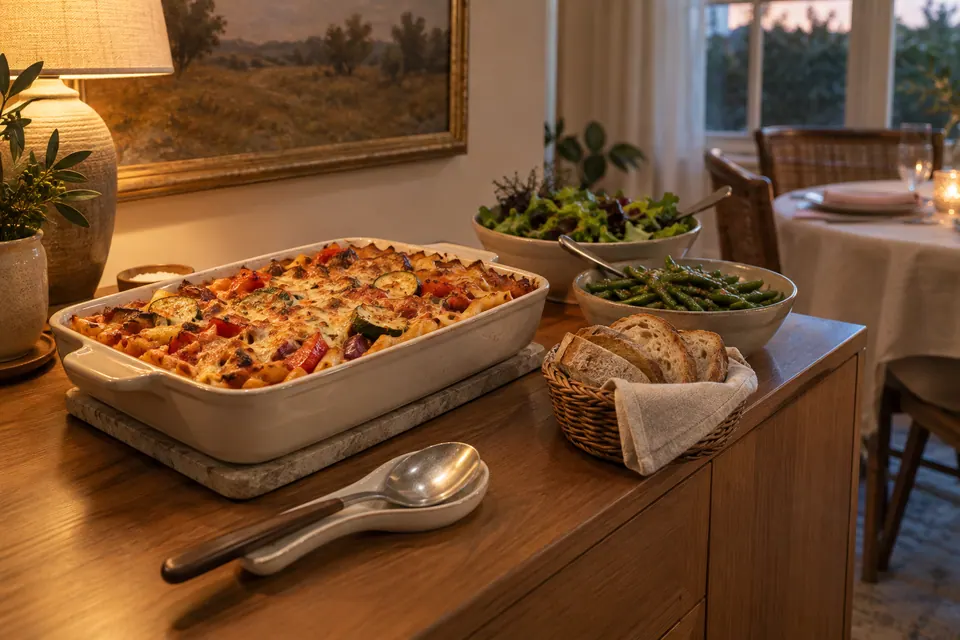
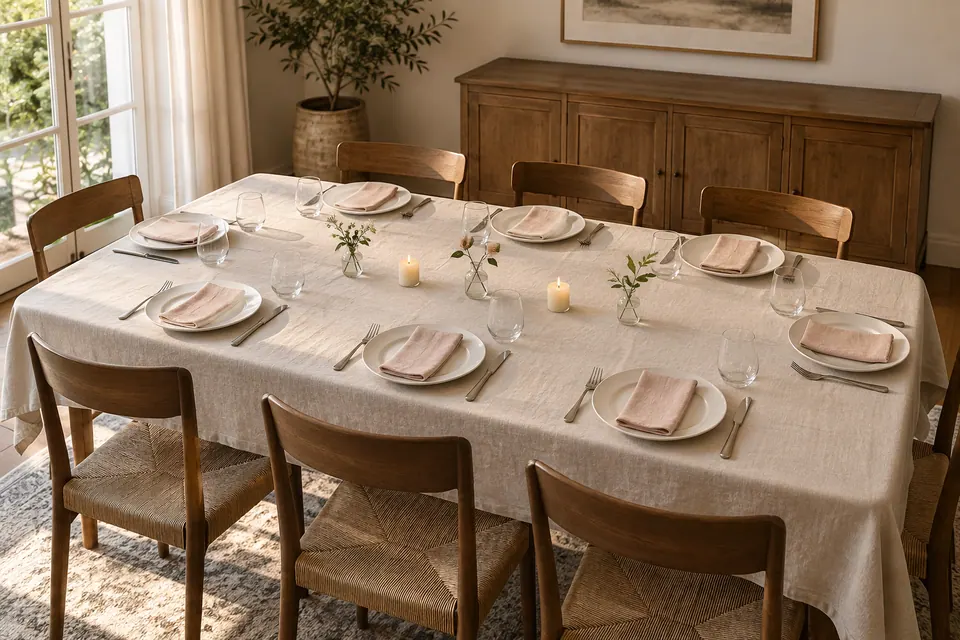
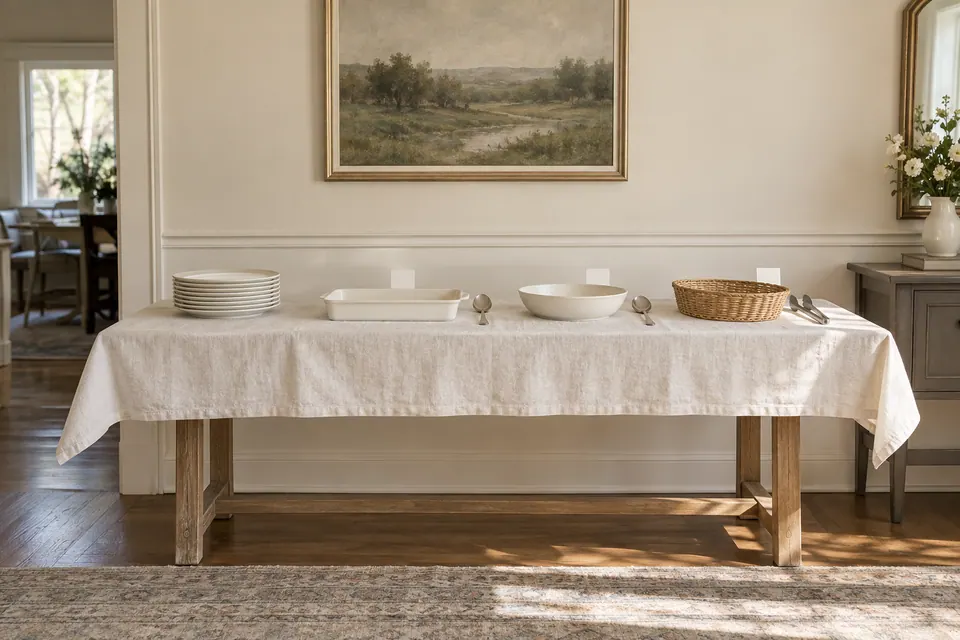
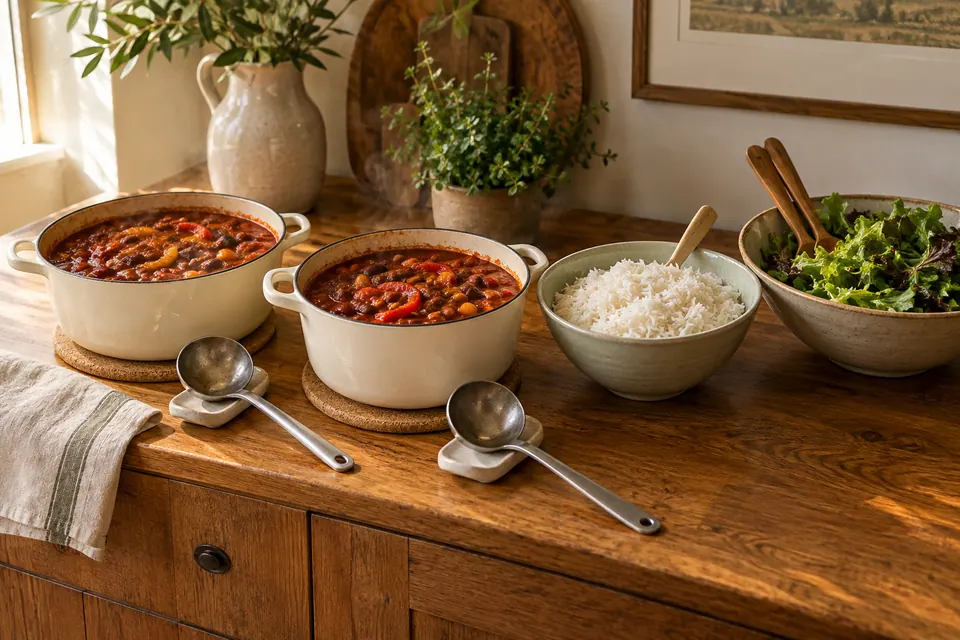
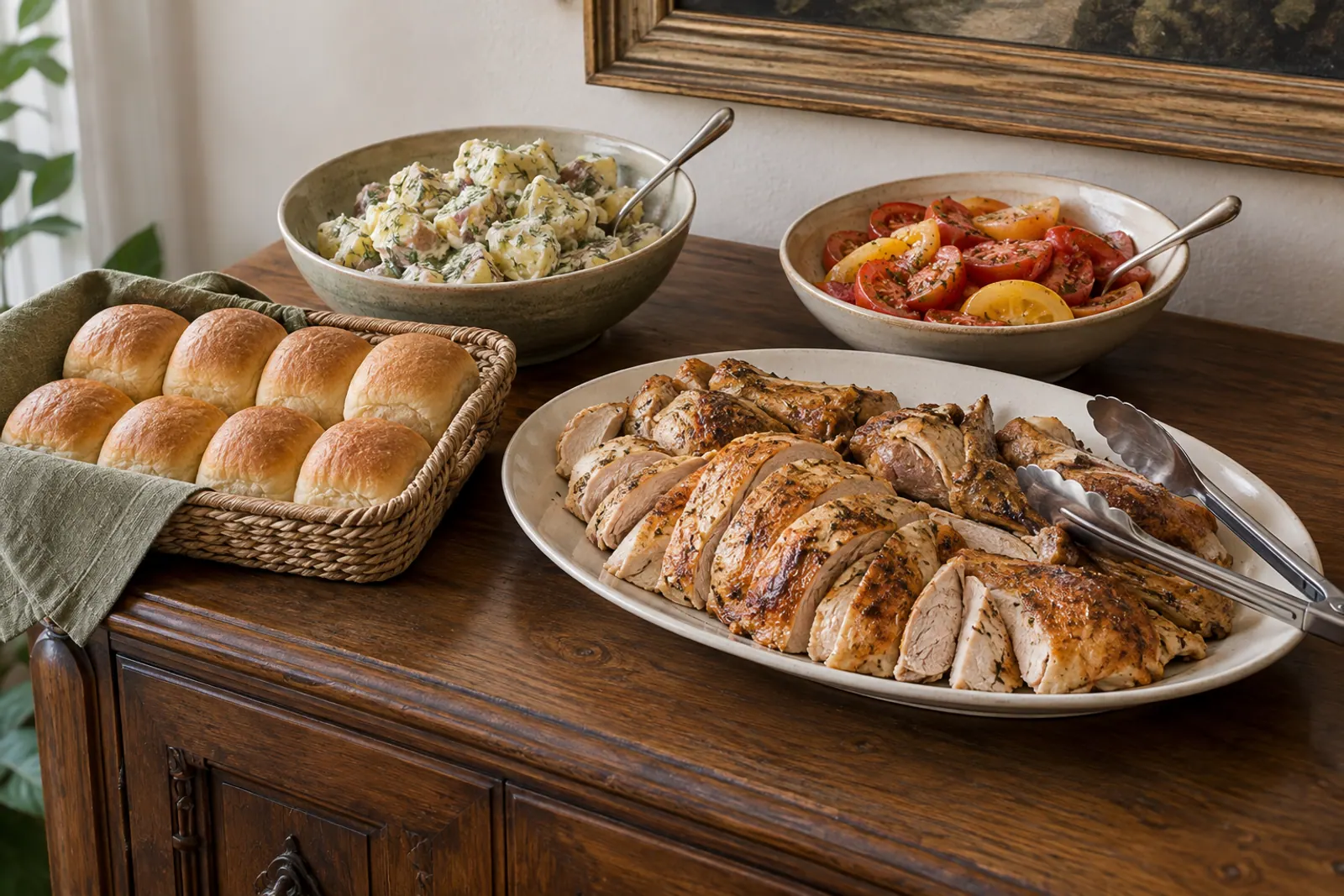
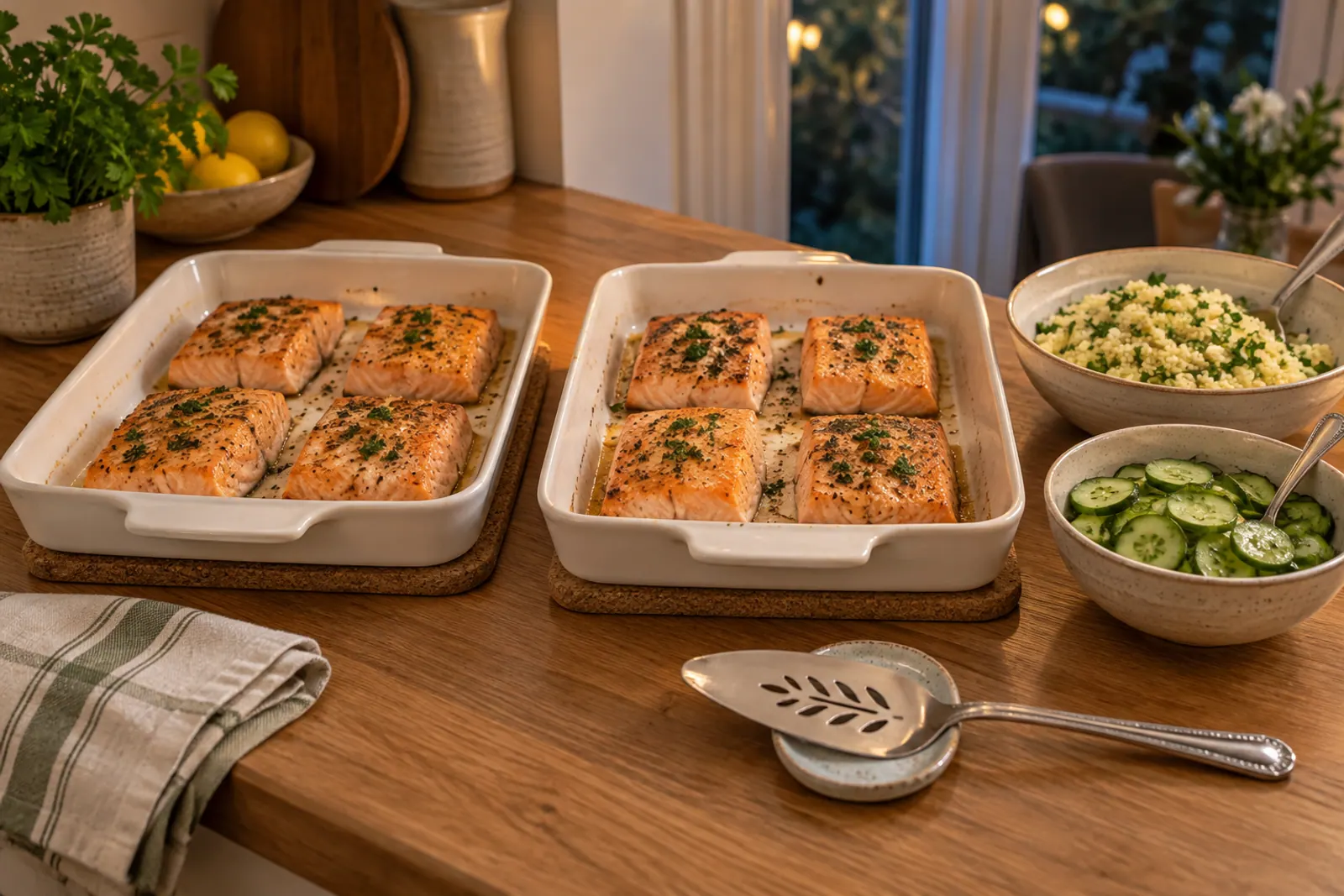
All three menus include the host and any cohost in the eight diners. They provide a main, sides, dessert and drinks, with one planned main portion per person. These are original hosting plans around attributed recipes or supplier-defined portions. We have checked the shopping arithmetic, not cooked or tested these complete menus. The photographs are AI-created styling concepts, not proof of serving yield or safe food temperature.
If you already want baked pasta, the elegant dinner party for eight remains the complete roasted-vegetable penne plan. The three choices here give the kitchen different jobs.
Choose the workload before choosing the dishes
| Menu | Main, sides and dessert | Kitchen requirement | Diet flexibility to check |
|---|---|---|---|
| A: bean-and-pepper chili | Chili, white rice, green salad and fruit sorbet | Two chili pans and one rice pan on three usable burners; freezer space for dessert | A plant-based starting point; check canned sauces, dressing and sorbet ingredients rather than assuming allergy suitability |
| B: cold roast chicken | Cooked chicken, dill potato salad, tomatoes, rolls and individual fruit tarts | Refrigerator space for the whole cold meal and dessert; no cooking appliance at service | The supplier must confirm main portions, ingredients and handling; potato salad, rolls and tarts may add egg, dairy or wheat |
| C: baked salmon | Salmon, cold herbed couscous, cucumber salad and individual lemon desserts | Two oven dishes with proper airflow; cold sides and dessert stored separately from raw fish | Fish and wheat are part of this base menu; check dressing and dessert before planning complete alternatives |
Choose A if the oven is unavailable and three pans fit the stove without handles crossing. Choose B if you want to spend the final half hour with guests and can store all the food cold. Choose C if someone can welcome guests while you attend to the oven. A name such as “easy dinner” does not remove these equipment requirements.
Add drinks and eight complete settings to any menu
The food tables below are alternatives. Pick one and add this shared list once. Pack sizes are shopping examples, not claims that every shop sells those sizes. Adjust the purchase column to the actual labels while keeping the planned use visible. For US shopping, 1 kg is about 2.2 lb, 600 g about 1⅓ lb, 400 g about 14 oz and 150 g about 5¼ oz. Use the gram amounts for the calculations.
| Buy or gather | Planned use | Reserve or check |
|---|---|---|
| Water | 4 liters initially | Keep refills available; this is an initial supply, not a consumption limit |
| Alcohol-free apple drink | 1 liter offered alongside water | Retain its label and check guest preferences; additional drinks are optional |
| Two jugs, ten water glasses and a spill cloth | One jug per drink and eight glasses in use | Two spare glasses; keep liquid beyond the jugs' usable fill in suitable containers |
| Tea or coffee for eight cups | Prepare after the main course for the people who want it | Count ten cups, ten teaspoons and the actual kettle or coffee equipment; add milk, an agreed alternative and sweetener as needed |
| Dinner plates or shallow bowls, forks, knives and napkins | Eight complete settings | Gather ten of each for two spares; Menu A also needs ten eating spoons |
| Dessert supplies | Eight dessert places | A: ten bowls and spoons; B: ten small plates and forks; C: eight purchased dessert cups plus ten spoons |
You do not need a starter for these menus. Offer drinks while guests settle, then serve the main. Use the dinner table for eight to check settings and walking space before adding decorations. Keep the drinks station away from hot pans.
Menu A: bean-and-pepper chili with rice and sorbet
Use the Good Food team’s Bean & pepper chilli, published as four servings. Make two separate four-serving batches, one per suitable pan, for eight planned main portions. Follow the publisher’s method for each batch; the combined shopping quantities are below. The rice, salad, dressing and dessert amounts are our menu additions.
This menu can start the day before: cook the two batches, divide them into shallow containers and refrigerate promptly. Keep each batch identified so it can return to its own pan for reheating. Cook the rice fresh on dinner day. The plan requires three usable burners during the final cooking period, even though the oven stays free.
| Buy or check | Use for dinner | Remaining amount or label check |
|---|---|---|
| Two onions | Both, divided between the chili batches | No planned edible remainder |
| Bell peppers | 700 g after removing seeds and stalks | Buy enough whole peppers to reach that prepared weight; trimming waste is separate |
| Olive oil | 2 tbsp, about 30 ml | Pantry check |
| Ground cumin and sweet smoked paprika | 2 tbsp of each | Pantry check; divide evenly between batches |
| Chili powder | 2 to 6 tsp total, following the recipe's heat choice | Agree the heat level with guests before measuring |
| Kidney beans in chili sauce | Two 400 g cans, all contents | 800 g including sauce; plain drained kidney beans are not the same ingredient |
| Mixed beans | Two 400 g cans, drained as directed | Use all drained beans; the can's 400 g is not its drained yield |
| Chopped tomatoes | Two 400 g cans, all contents | 800 g used; no unopened-can remainder |
| One 1 kg bag of dry white rice | 600 g dry, or 75 g per diner before cooking | 400 g remains dry; use the rice package's liquid and cooking instructions |
| Two 200 g packs of ready-to-use salad leaves | 400 g, or 50 g per diner | Use both packs; follow their handling instructions |
| One 250 ml bottle of suitable vinaigrette | 120 ml offered with the salad | 130 ml remains in the bottle; store as labeled |
| One 1-liter tub of fruit sorbet | Eight planned 125 ml portions | No planned reserve; check that the chosen product meets the guests' food needs |
Salt and black pepper are pantry checks for seasoning. These quantities provide eight recipe servings alongside rice and salad, not an extra full serving of chili for everyone. If seconds are important, add another complete recipe batch and reassess storage and burner space before shopping.
Gather two chili pans, two ladles, a rice pan with lid, a heat-safe rice serving bowl and spoon, a salad bowl and servers, two heatproof trivets for the chili pans, a food thermometer and shallow storage containers. Transfer the rice to its serving bowl so the third cooking pan stays in the kitchen. Keep sorbet frozen until its course; it has no oven or stove job.
If making the chili ahead, reheat each batch to 165°F / 74°C before serving. That is the federal guidance for reheating leftovers, checked with a thermometer. FoodSafety.gov’s temperature chart also gives the fish temperature used in Menu C.
Menu B: cold roast chicken with ready-made sides
Order eight fully cooked roast-chicken main portions, supplied chilled and suitable for cold service. Ask the supplier what one main portion includes, whether it is boneless or carved, and which ingredients and storage instructions apply. Eight thin carving slices do not automatically equal eight main portions. Whole-bird counts are deliberately not assumed here.
This plan pairs the chicken with purchased dill potato salad, sliced tomatoes and unwarmed rolls. Dessert is eight individual fruit tarts, stored as the supplier directs. Nothing is reheated at service. Buying hot chicken and cooling it at home is a different preparation job and is not part of this menu’s no-cook service plan.
| Buy or order | Use for dinner | Remaining amount or check |
|---|---|---|
| Eight confirmed cooked chicken main portions | One per diner | No main reserve; confirm the supplier's yield rather than inferring it from a photograph |
| Four 500 g containers of dill potato salad | 1.6 kg total, or 200 g per diner | 400 g remains unserved; keep that portion refrigerated and follow the product label |
| 1 kg tomatoes | 800 g usable tomatoes after trimming, sliced for service | Up to 200 g remains before allowing for trimming; do not count discarded stalks as food |
| One 250 ml bottle of suitable vinaigrette | 60 ml for the tomatoes | 190 ml remains in the bottle; store as labeled |
| Two six-roll packs | Eight rolls, one per diner | Four rolls remain; store or freeze according to the label |
| Eight individual fruit tarts | One supplier-defined dessert portion per diner | No planned reserve; confirm filling, ingredients and required refrigeration |
Set aside space for the actual chicken containers, all potato salad and the tarts before accepting the order. Drinks can move to another suitable cooler, but food cannot be squeezed into an already full refrigerator on the assumption that the door will stay shut.
Use one chicken platter with tongs, one potato-salad bowl with spoon, one tomato bowl with spoon and one bread basket. Keep a clean replacement platter and bowl available if you choose smaller serving batches. Serve the eight main allocations promptly; do not leave this cold dinner on display while guests finish a long activity.
Confirm collection and chilled transport before the day. If the supplier cannot provide the agreed chilled, ready-to-eat product, choose another menu or explicitly plan the necessary preparation and temperature control. Do not quietly add last-minute roasting or reheating to this option.
Menu C: baked salmon with cold couscous and cucumber
Use Lulu Grimes’s Baked salmon at Good Food, a four-serving recipe. Two batches give eight fillets, arranged without overlap in two suitable oven dishes. Our shopping assumption is roughly 150 g raw fish per fillet, about 1.2 kg total; the publisher specifies a fillet count rather than that weight.
The cold couscous and cucumber are separate menu additions. Prepare the couscous earlier, using its package’s cooking and liquid instructions, then divide it into shallow containers and refrigerate promptly. It must be cold before service. The fish is the only cooking job at the dinner finish.
| Buy or check | Use for dinner | Remaining amount or check |
|---|---|---|
| Eight skinless salmon fillets of similar thickness | One per diner; approximately 150 g raw each in this plan | About 1.2 kg total, no planned extra fillet; agree size with the fish supplier |
| Olive oil | 2 tbsp, about 30 ml, across the fish batches | Pantry check; no butter is included in this menu |
| One 1 kg pack of plain dry couscous | 600 g dry, or 75 g per diner before preparation | 400 g remains dry; the cooked yield depends on the product and its instructions |
| 1 kg cucumber | 800 g usable cucumber, sliced | Up to 200 g remains before trimming; peel only if wanted |
| One 250 ml bottle of suitable vinaigrette | 60 ml for couscous and 60 ml for cucumber | 120 ml used, 130 ml remaining; store as labeled |
| Parsley | 20 g prepared leaves: 10 g for fish and 10 g for couscous | Buy enough to allow for stalk removal; unused edible leaves are separate from trimming waste |
| Eight individual lemon dessert cups | One supplier-defined serving each | Choose a ready-to-eat product and follow its ingredient and storage information; no dessert baking is planned |
Use salt and black pepper as appropriate. Mix the allocated dressing and parsley into the cold couscous, keep it covered and chilled, and dress the cucumber close to service. These are proposed assembly quantities; taste a small portion before adding all the dressing.
The salmon recipe’s oven setting is 180°C conventional, about 355°F, or 160°C fan, 320°F convection. Use the oven’s corresponding setting and follow the linked method. A second dish can change heating, so the original single-batch timing is not a guarantee for two dishes. Check the thickest part of the fillets with a thermometer: the federal minimum for fish is 145°F / 63°C. The appearance in an AI photograph is not a doneness check.
Before choosing C, place both empty dishes in the cold oven and check the manufacturer’s airflow guidance, rack positions and handle clearance. Gather two trivets, a clean fish server, thermometer, two cold-side bowls and two serving spoons. If two dishes cannot cook together properly, choose another menu; sequential batches create a holding job this plan does not include.
If you decide to offer a small board before dinner, plan it separately from the complete meal. The party charcuterie board guide uses a stated appetizer offer, measured display space and a separate reserve; it does not replace the dinner menu quantities above.
Give the final hour a clear sequence
Let T0 mean the intended main-course serving time. For example, invite guests at 6:30 p.m. and plan dinner for 7 p.m. These are planning windows, not promises about cooking speed. The actual food and equipment determine readiness; move dinner later if needed.
| Stage | A: chili | B: cold chicken | C: salmon |
|---|---|---|---|
| Before dinner day | Read the recipe and check three pans on three burners. If cooking ahead, cool and refrigerate the two batches promptly. | Confirm eight chilled main portions, dessert storage and the collection plan. Reserve refrigerator space. | Read the recipe and try both empty dishes in the oven. Check room for raw fish, cold sides and dessert in the refrigerator. |
| Earlier on dinner day | Measure dry rice and prepare the salad bowl. Keep leaves chilled and sorbet frozen. | Collect and refrigerate the order as instructed. Keep ingredients and use-by information. | Prepare couscous, cool it promptly in shallow containers and refrigerate. Slice and chill cucumber. Keep raw fish separate. |
| Around T−60 | Start reheating both chili batches with enough time for the actual amount. Attend and stir as needed. | Set out empty serving pieces and count eight main allocations without leaving the food out. | Set the oven timer and work backward from the recipe plus your oven's preheat time. Keep fish refrigerated until preparation. |
| Before the rice's required start time | Check chili progress, then start rice using its full package cooking and resting time. A cohost welcomes guests. | No cooking job; the host can welcome guests while the meal stays chilled. | No rice job. A cohost welcomes guests so the cook can attend to the fish. |
| Final cooking window | Verify reheated chili reaches 165°F; if it finishes early, hold it at least 140°F. Finish rice for immediate service. | Slice tomatoes and arrange small cold batches close to serving time. Keep the tarts refrigerated. | Cook both fish dishes according to their progress. Check 145°F in the thickest parts before taking them out. |
| T0, when the main is ready | Dress salad and serve chili, rice and salad. Give each diner a main portion before seconds. | Bring out chicken, potato salad, tomatoes and eight rolls, then sit down to eat. | Bring out cold couscous and cucumber, then serve the fish immediately on protected surfaces. |
| After the main | Store eligible leftovers, then scoop sorbet and make requested hot drinks. | Store eligible leftovers, then bring out the individual tarts and hot drinks. | Store eligible leftovers, then serve the lemon dessert cups and hot drinks. |
For freshly cooked chili instead of reheating, allow the recipe’s complete preparation and cooking sequence for both batches before the rice finish. Do not treat the reheating row as a substitute for the original cooking method.
The main risk for A is three simultaneous stove jobs; do not leave boiling rice unattended to answer the door. For B it is lost chilled storage or a delayed collection. For C it is an oven that cannot finish both dishes together. Resolve the relevant issue before choosing the menu, not after the food is bought.
Replace complete meals when a guest needs an alternative
Ask what ingredients and handling arrangements will work before purchasing. A plant-based recipe is not automatically suitable for every allergy, and a familiar brand can have different ingredients in different products. Keep labels available and use separate utensils and storage where needed.
For a mixed Menu B with six chicken eaters and two guests choosing plant-based food, order six confirmed chicken mains and two supplier-defined complete plant-based mains that are suitable for cold service. Keep all eight allocations reserved. Choose potato salad, rolls and dressing that work for those guests, and replace two fruit tarts with two suitable complete desserts if necessary. Extra tomato slices do not replace the two main portions.
For Menu C, agree the alternative before using the oven schedule. A replacement that needs a different temperature or its own last-minute pan changes the plan. One practical choice is a supplier-prepared complete main designed for cold service, with compatible sides and dessert, so it has no competing oven job. Reduce the fish order to the actual fish-eater count and scale its recipe ingredients accordingly. Do not describe ordinary couscous as gluten-free; choose a suitable side with its own preparation instructions where required.
If several guests need the same substantial change, serving one compatible menu to everyone may be simpler. Our dinner party invitation wording gives food-reply lines that keep these arrangements private and specific.
Check temperatures, serving space and leftovers
Keep cold perishable food at 40°F / about 4°C or below and hot food at 140°F / 60°C or above when holding it. Without temperature control, discard perishables left out beyond two hours, or one hour when the surrounding air exceeds 90°F / about 32°C. Include preparation and transport time. Replace serving dishes with clean replenished ones rather than adding new food onto old portions. These checks follow FDA’s buffet guidance.
Divide eligible leftovers into shallow containers and refrigerate promptly, following any stricter supplier instructions. Do not leave a large pan on the counter waiting until it is completely cold. For cold menus, the amount that fits in the refrigerator matters just as much as the amount that fits on a platter.
Keep hot or heavy dishes on a protected service surface if they crowd the dining table. The buffet table layout guide helps separate food, drinks and returns. Choose the menu that your actual pans, storage and guests can support, and keep the final cooking period free of extra dishes.
With your menu chosen, use the party food calculator to turn your portions, recipe yields and usable stock into whole shopping packs. For an autumn gathering, try the free Thanksgiving name cards.
Choose chili when the stove can handle three pans, a cold roast-chicken dinner when refrigerator space is available, or salmon when the oven can finish two dishes together. Each menu includes sides, dessert and drinks for eight adults.
Checklist from this story
0 / 9 ready