An Elegant Dinner Party for Eight: Menu, Shopping List and One-Oven Plan
Plan dinner for eight with a complete pasta menu, a combined shopping list, US and metric quantities, and a practical serving schedule for one oven.
- The guest list
- 8 diners, including hosts
- A little preparation
- Set the room the day before; reserve about 2½ hours for dinner-day kitchen work
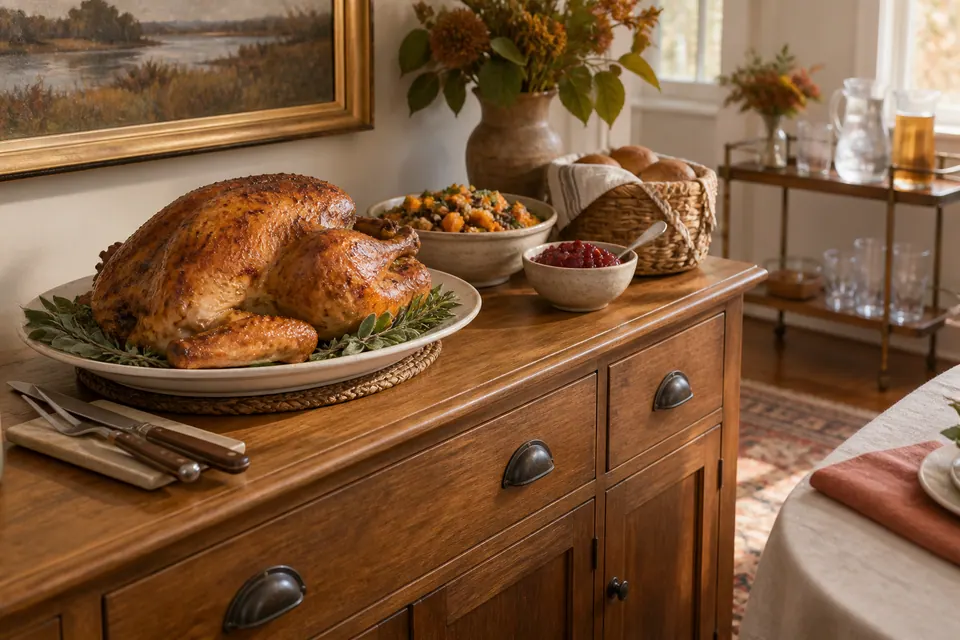
If guests are bringing the dishes, use the Friendsgiving potluck planner to assign portions, arrival times and equipment. Its shared-meal worksheet handles contributions from several kitchens.
The menu and its portion assumptions
Still choosing the main? Compare the three dinner party menus for eight to match a chili, cold chicken or salmon dinner to your stove, refrigerator or oven space.
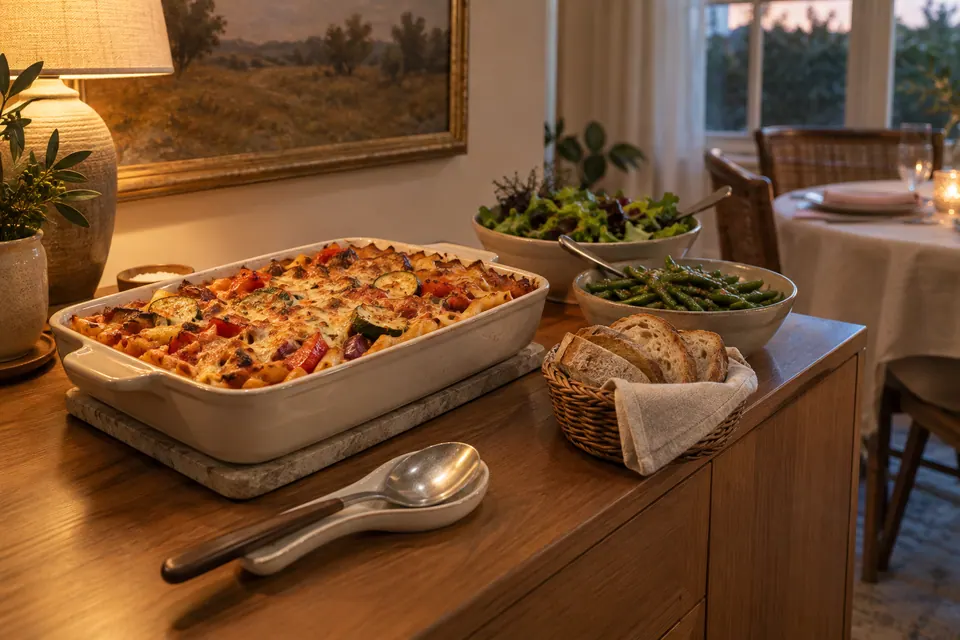
For eight people at home, a substantial baked pasta, two simple sides and a purchased dessert make a workable dinner menu. The oven roasts the vegetables first, then bakes the main. Green beans finish on the stove; bread and dessert need no oven space.
Before inviting guests, give the arrival and serving times separate lines. The dinner party invitation wording guide has complete messages for a host-provided meal and a coordinated potluck, plus follow-ups for contributions and changes.
This is a proposed hosting plan built around a linked eight-serving recipe. We have checked the shopping arithmetic and order of tasks, but have not cooked this complete menu. Use the recipe’s instructions and your equipment to judge cooking progress.
Count eight adult diners, including the host and any cohost. These amounts allow one serving of the main per person alongside the other dishes. They are planning portions, not a promise about appetite. For a group that will want seconds of the pasta, increase the recipe and check the larger batch’s pan and cooking requirements before using this schedule.
| Course | Amount for eight | Portion assumption |
|---|---|---|
| Welcome olives | 8 oz / 225 g drained, pitted olives | About 1 oz / 28 g each |
| Main | One eight-serving batch of roasted vegetable baked penne | One recipe serving each |
| Warm side | 1½ lb / 680 g trimmed green beans | About 3 oz / 85 g each before cooking |
| Salad | 12 oz / 340 g washed leaves | About 1½ oz / 43 g each |
| Bread | One 18 oz / 500 g loaf, cut into 16 slices | Two small slices each, served unwarmed |
| Dessert | One purchased lemon tart labeled for eight servings | One supplier-defined portion each |
| Drinks | 1 US gallon / 3.8 L water initially; tea or coffee for eight mugs | Keep water refills available |
Use Beth Moncel’s eight-serving baked penne recipe at Budget Bytes, with its jarred-sauce shortcut. One batch supplies this plan. Follow the linked preparation method; our additions and hosting timetable follow below.
The main contains wheat and dairy. Check every ingredient, including the cheese’s suitability for vegetarians, before describing the meal to guests. A guest who needs a different main needs a complete portion and an assigned place in the cooking schedule.
One shopping list for the whole dinner
Check your pantry first. The “use” column is the amount allocated to dinner; a pack may contain more. US and metric values are rounded shopping equivalents.
| Buy or check | Use for this menu | Where it goes |
|---|---|---|
| 1 lb / 454 g penne | The full pack | Main |
| 1 red onion, 1 zucchini, 1 yellow squash and 1 bell pepper | All four vegetables | Main |
| Two 24 oz / 680 g jars of pasta sauce | 36 oz / about 1.02 kg total | Main; refrigerate the remaining 12 oz / 340 g according to its label |
| 15 oz / 425 g ricotta | The full container | Main |
| Shredded Italian cheese blend | 2 US cups, about 475 mL by volume | Main; use the package’s cup-to-weight conversion when buying |
| 1½ lb / 680 g ready-trimmed green beans | The full amount | Warm side; buy extra if trimming unprepared beans |
| 12 oz / 340 g salad leaves | The full amount | Salad |
| 2 lemons | At least 2 tbsp / 30 mL juice | Half for the beans, half for dressing |
| Olive oil | 6 tbsp / 90 mL | 2 tbsp for the main, 1 for beans, 3 for dressing |
| Dijon mustard | 1 tsp / 5 mL | Dressing |
| Salt and black pepper | Recipe amounts for the main; season sides to taste | Pantry check |
| Pitted olives | 8 oz / 225 g drained | Welcome bowl; check drained weight on the jar |
| One bread loaf | About 18 oz / 500 g | Sixteen slices |
| Purchased lemon tart | Eight servings stated by the supplier | Dessert; check storage instructions when ordering |
| Water, tea or coffee, and optional milk | Water quantity above; eight mugs of the chosen hot drink | Drinks |
Use the cheese package’s stated yield instead of treating volume and weight as interchangeable. The shopping list excludes the optional garnish and replaces the homemade sauce ingredients with jars.
For our simple salad dressing, shake together the allocated 3 tablespoons / 45 mL oil, 1 tablespoon / 15 mL lemon juice and 1 teaspoon / 5 mL Dijon. Season to taste, cover and refrigerate. This is a proposed dressing ratio; taste it with a leaf before dressing the bowl.
Cook the green beans on the stove following their package guidance or your usual method. Drain well and toss with the remaining tablespoon / 15 mL each of oil and lemon juice. Their pan will be free while the pasta is in the oven.
Check the equipment before dinner day
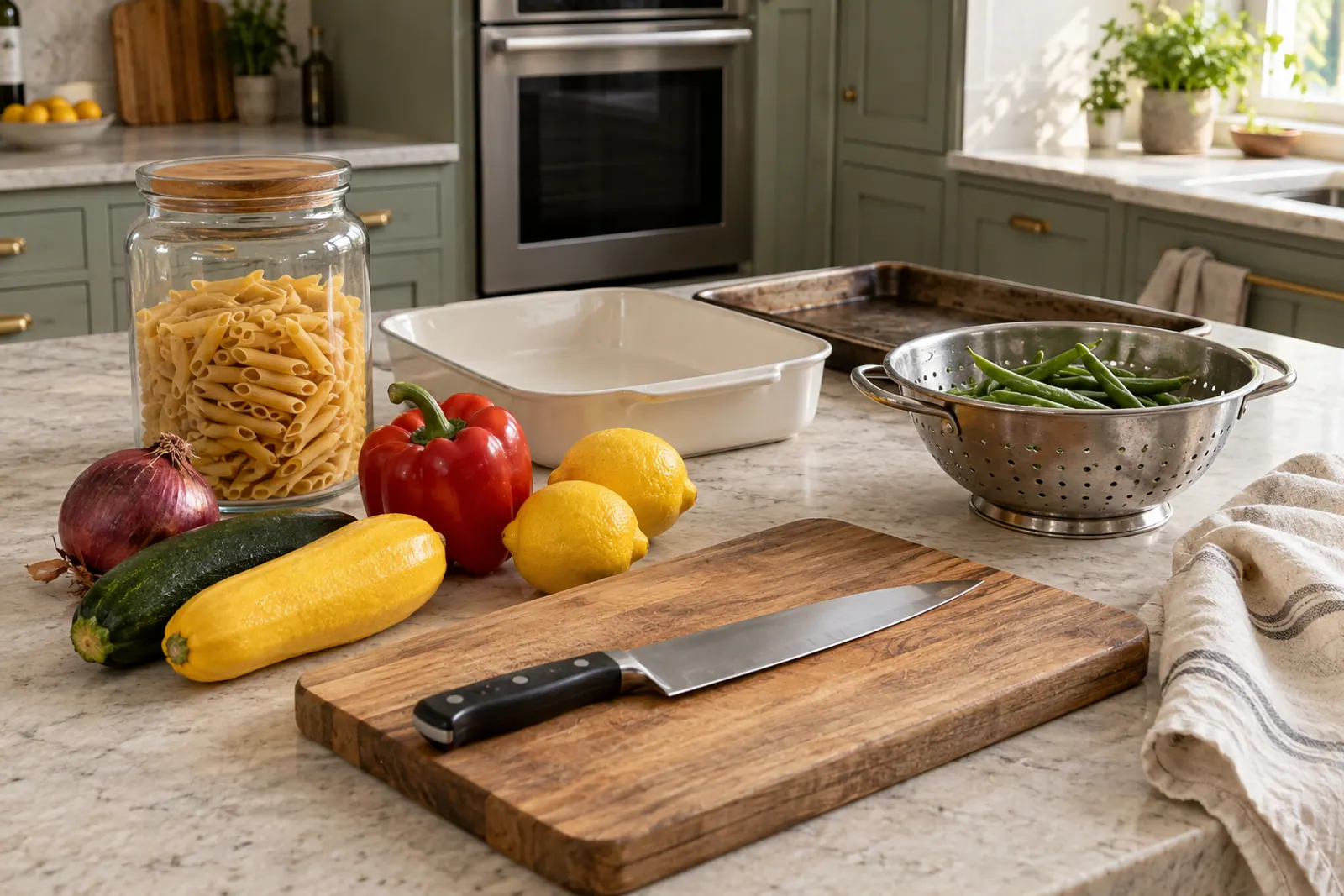
The linked main uses a 9 × 13 inch, approximately 23 × 33 cm, three-quart / 2.8 L casserole dish. Check its capacity, the space around its handles and whether it actually fits your oven. A smaller, deeper dish changes the cooking conditions.
Set out a roasting tray, pasta pot, colander, lidded pan for the beans and food thermometer. The recipe finishes under the broiler, which requires a specifically broiler-safe dish. If your dish is unsuitable, our suggested adaptation is to skip browning and finish baking until the main is ready.
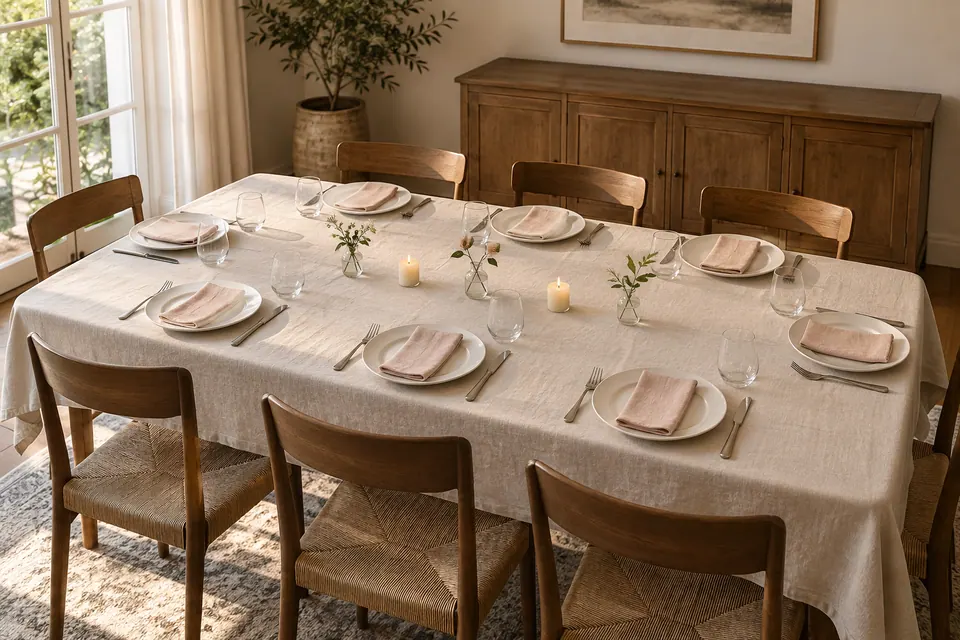
Put a serving spoon for the pasta, tongs for the beans, salad servers and a small spoon for the olives near their dishes. Add a bread knife, heatproof trivets, eight dinner plates and eight dessert plates. Use a sideboard if the dishes will crowd the dining table. Our dinner table for eight covers the place settings and space to leave for food.
What to do the day before
Set the table and place empty serving dishes where they will go. Keep the drinks station away from the stove so guests can refill a glass while you cook.
Wash and dry the produce, trim the beans, and refrigerate them in separate covered containers. Make and refrigerate the dressing. Keep cheeses refrigerated and reserve the storage space the tart’s supplier requires. Slice neither the bread nor the tart yet.
All vegetable roasting, pasta cooking and final assembly happen on dinner day in this plan. It does not assume an overnight assembled casserole will bake in the same time as the original recipe.
Write down the intended serving time as T0. For a 7 p.m. dinner, the schedule starts at 4:30 p.m.; invite guests for about 6:05 p.m., when the main should be baking. Tell them dinner is planned for 7.
A one-oven schedule for one cook
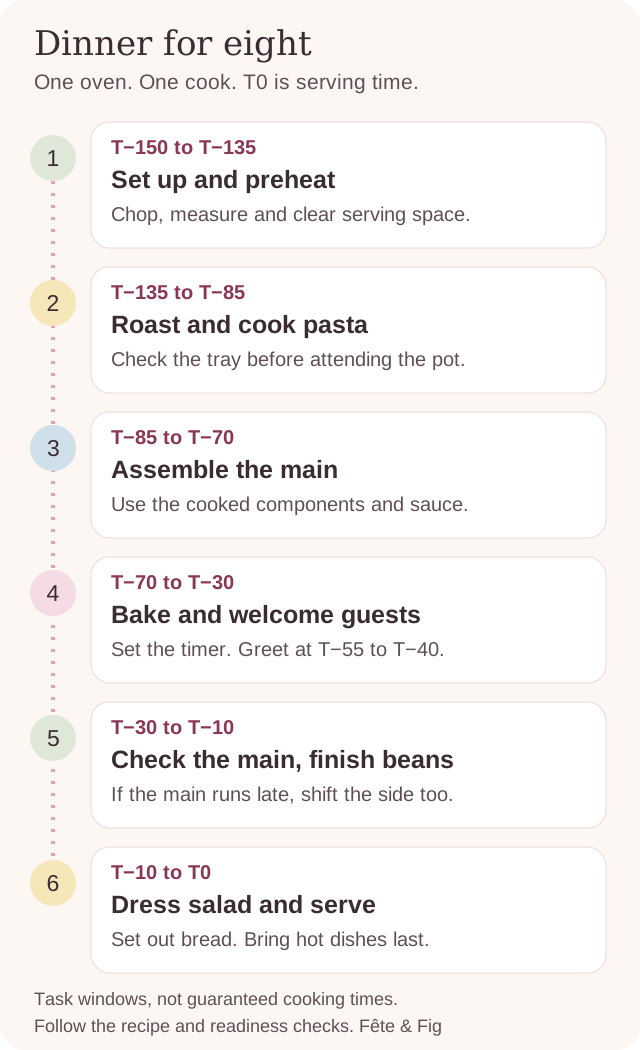
These are task windows, not guaranteed cooking times. Reserve roughly 2½ hours, read the recipe first, and use its instructions, the pasta package and your equipment to decide when to move on. Shift the following tasks if a stage takes longer.
| Time before serving | The cook’s job | Equipment and heat | Check before moving on |
|---|---|---|---|
| T−150 to T−135 | Finish chopping, measure ingredients and preheat. Return dairy to the refrigerator until assembly. | Counter, then oven | Read the complete recipe and clear a place for hot dishes. |
| T−135 to T−115 | Start roasting vegetables; measure the jarred sauce and fill the pasta pot. | Oven at the recipe’s 400°F / about 205°C; unheated pot | Set a reminder for the recipe’s halfway stir. |
| T−115 to T−110 | Attend to the roasting tray, then start heating the pasta water. | Oven first, then stove | Finish handling the hot tray before attending to the pot. |
| T−110 to T−90 | Cook and drain the pasta. | Stove and colander | Follow the package instructions; do not leave boiling water unattended to greet guests. |
| T−90 to T−85 | Check the roasted vegetables. | Oven | Continue roasting if they have not reached the recipe’s doneness. Shift the later windows. |
| T−85 to T−70 | Assemble the casserole using the cooked components. | Counter; oven available | Use the correct dish capacity and the linked method. |
| T−70 to T−55 | Put the main in the oven and set its timer. Arrange water and olives. | Oven, then drinks station | Follow the recipe’s bake instructions; make the timer audible from the gathering space. |
| T−55 to T−40 | Welcome guests while the main bakes. | Oven; no active stovetop job | Stay within hearing of the timer. |
| T−40 to T−30 | Give the oven your attention for the final checks and any optional browning. | Oven; broiler only with a suitable dish | Watch a broiler continuously. The dish’s progress determines when this stage ends. |
| T−30 to T−25 | Confirm the main is ready and arrange its short hot hold. | Oven or suitable holding equipment | Keep the food at least 140°F / 60°C, checked with a food thermometer. |
| T−25 to T−10 | Cook, drain and season the beans. Allow longer if their instructions require it. | Stove | Finish and switch off the burner before dressing the salad. |
| T−10 to T−5 | Dress the salad, slice bread and check water. | Counter | Keep salad refrigerated until this stage. |
| T−5 to T0 | Bring the hot dishes to the table and sit down. | Serving area | Use trivets and give each dish its own serving utensil. |
An oven’s “warm” setting does not itself prove the food is holding at the required temperature. Check the food. If the main is running late, keep the salad cold and delay starting the beans; move dinner back rather than letting the side sit while the main finishes. Guests already have water and olives.
The schedule has a deliberate handover from oven checks to the stovetop side. Do not begin a hands-on side while you need to watch the broiler. If your kitchen cannot support that short hot hold, omit the optional broiling stage and choose a side that needs less finishing time.
Serve dinner, then bring out dessert
Divide the main into eight portions before offering seconds. Put the beans and salad in bowls guests can pass comfortably. On a narrow table, serve the main from the sideboard and leave only the smaller dishes between place settings.
For guests serving themselves away from the dining table, the buffet layout guide compares a wall-side line with a two-sided island and keeps drinks, refills and used dishes out of the serving route.
Keep the tart stored as its supplier directs until dessert. Clear the main dishes before putting on the kettle or making coffee. A separate dessert course gives the table more room and avoids another kitchen job during dinner service.
A homemade dessert is a different plan: add its ingredients, storage and equipment needs before shopping. A dessert that must bake at serving time also changes the oven schedule.
For a daytime gathering with a different food format, see the Baby in Bloom brunch plan.
For an evening in which each course has a different host, use the progressive dinner itinerary. It assigns travel buffers, destination capacity and arrival handoffs; this guide remains a complete dinner prepared and served in one home.

Cool and store leftovers promptly
USDA guidance on leftovers says to keep cold food at 40°F / about 4°C or below and hot food at 140°F / 60°C or above. Refrigerate perishable leftovers within two hours, or one hour when the surrounding temperature exceeds 90°F / about 32°C.
Divide leftovers into shallow containers and refrigerate promptly; do not leave the whole casserole on the counter until it is fully cool. Use refrigerated leftovers within three to four days or freeze them, and reheat leftovers to 165°F / about 74°C. Follow any stricter package storage instructions.
After dinner, note how much food remained and which task needed more time. Those observations will make this proposed schedule more useful for your own oven and guests the next time.
For a different small-group meal, the two-soup bar plan separates chosen portions, measured ladle pours, first service and reserves. Confirm safe holding equipment before choosing that format.
Give the oven one job at a time, buy for eight diners including yourself, and finish the stovetop side only when the main is on track for serving.
Checklist from this story
0 / 9 ready