Progressive Dinner Party: Three-Home Itinerary and Host Workbook
Plan a progressive dinner party with a three-home itinerary, guest capacity checks, travel buffers, host handoffs and free blank and filled worksheets.
Get the progressive dinner workbook ↓- The guest list
- Worked example: 8 adults, including all hosts
- A little preparation
- Check the whole route and every home's capacity before sending the invitation
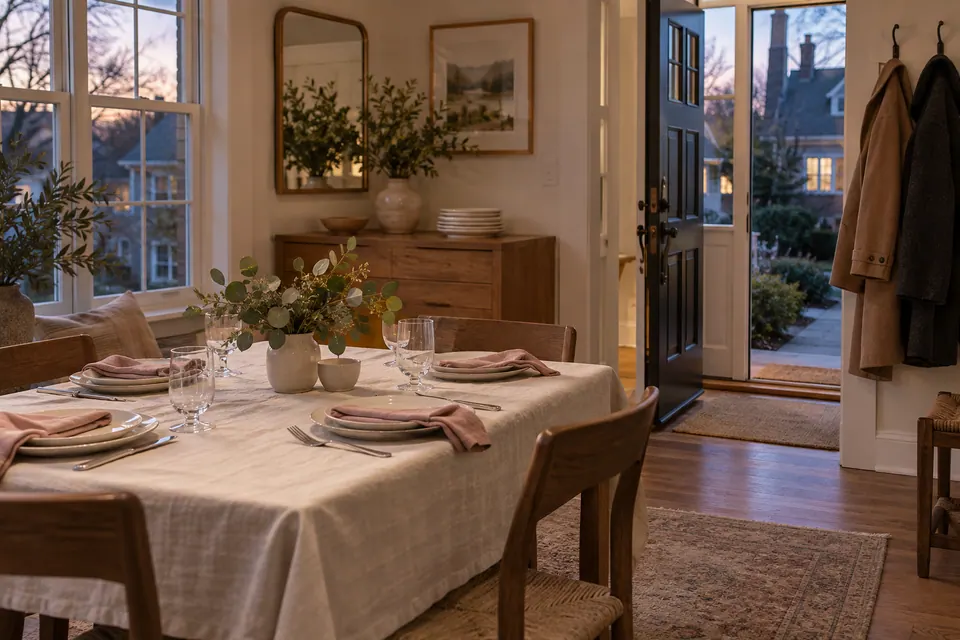
A progressive dinner party is an evening in which the same group eats successive courses at different homes. Its success depends on the movement between courses: every destination must fit the whole group, every host needs a preparation plan and everyone should know how to get home afterward.
Start with two or three nearby homes rather than adding a stop for every dish. The illustrative plan below takes eight adults, including all hosts, through three destinations with two ten-minute travel blocks. Those blocks assume a locally checked route with time to gather coats and settle in. They are not estimates for your neighborhood or a route we have walked.
The free progressive dinner workbook includes the filled example, a blank itinerary, capacity checks and a handoff sheet. Use the dinner menu guide to choose the food; this page handles the shared route and responsibilities.
Decide whether the group should move together
In a small progressive dinner, everyone can follow the same sequence: starter at one home, main course at the second and dessert at the third. One itinerary and one shared head count make that format manageable.
A larger neighborhood rotation, where separate groups visit different homes simultaneously, is a different planning job. It requires group assignments, capacity balancing and multiple parallel schedules. Do not apply an eight-person single-route itinerary to that event without redesigning the plan. Likewise, a potluck brings dishes to one destination; its transport and oven reservations belong in the Friendsgiving potluck planner.
Choose hosts who are comfortable with the proposed role. Nobody needs to offer a home simply because they have the largest table. A guest can help coordinate the route or handle a departure instead. Decide whether all hosts will enjoy every course or whether somebody will leave early to finish preparation, and make that decision explicit.
Check the smallest destination first
The group limit comes from the least accommodating stop, not the biggest dining room. Count everyone who will eat there, including its hosts. A home that can welcome eight people for a standing starter might not seat eight for a main course. Check the actual format, chairs, serving pieces and access route.
| Check | What the host confirms | What to change if it fails |
|---|---|---|
| Dining capacity | Places for the complete group in the intended seated or standing format | Reduce the group, change format by agreement or choose another destination |
| Access | Entrance, steps, doors and a suitable place for anyone needing a seat | Choose an accessible stop or a single-home route everyone can use |
| Facilities | Toilet access, coats, arrival space and lighting | Fix the practical issue before the invitation |
| Preparation | Food storage, equipment and a realistic finishing job | Choose a simpler course or a different host assignment |
| Travel | The actual route, surface, crossing and return arrangement | Change destinations or transport rather than borrowing time from dinner |
Ask about access and food arrangements privately. The shared itinerary needs agreed actions, such as “use the side entrance,” rather than personal medical details. If one guest cannot use the route, redesign it before inviting the rest of the group. A fallback is useful only if the affected person can use it too.
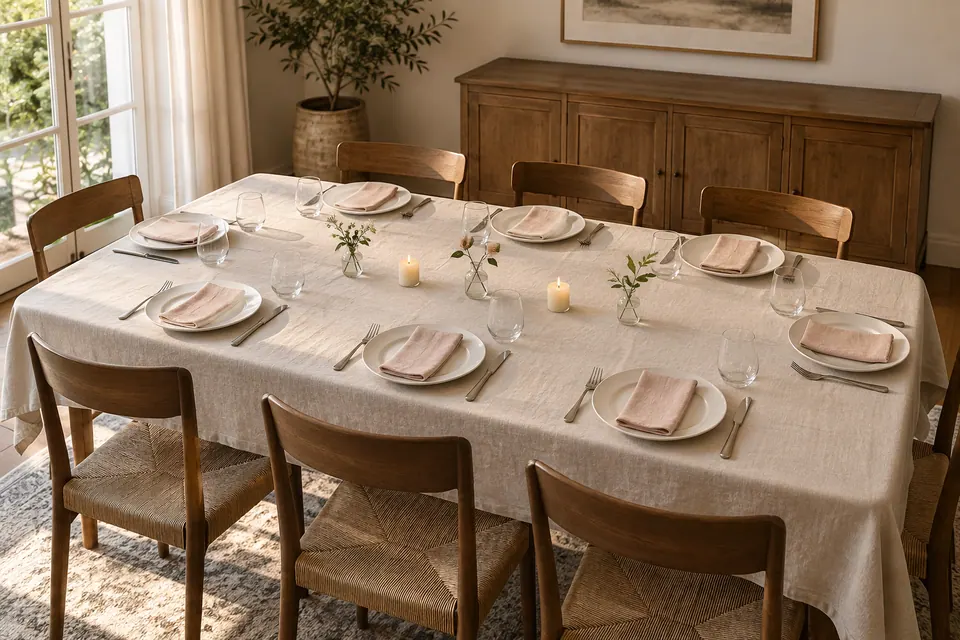
For the main-course home, the table plan for eight helps check the actual seating and serving space. A photograph of eight place settings is not proof that a particular room or route fits eight guests.
Agree on one itinerary before assigning courses
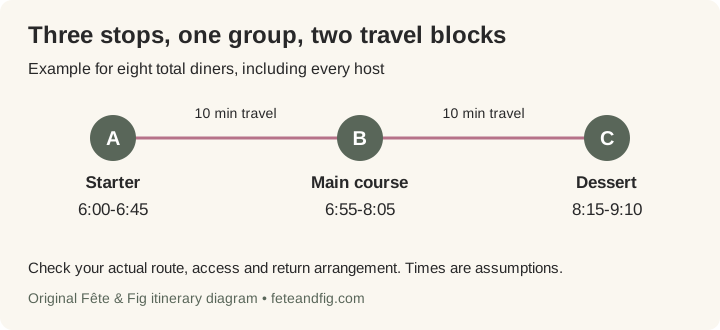
List arrival, course, departure, travel and settling time as separate blocks. Travel time is more than the minutes between two front doors. It includes collecting coats, leaving together, waiting where needed and reaching the next serving space.
Have a host check the actual route at the relevant time of day. Review weather, lighting and any crossings. If vehicles are needed, agree who drives, passenger capacity, parking and the return arrangement. Choose drivers who will not drink alcohol; do not leave that choice until departure. A walking route also needs a workable way home from the final stop.
The example allows 45 minutes at the starter home, 70 minutes for the main course and 55 minutes for dessert, plus two travel blocks. These are selected planning blocks, not etiquette rules. Choose different times for your recipes, guests and journey.
| Time | Place and owner | Plan | Departure or handoff |
|---|---|---|---|
| 6:00-6:45 p.m. | Home A; Morgan and Casey | Welcome and starter; eight places in the agreed format | Casey gathers the group; Morgan secures the home and joins |
| 6:45-6:55 p.m. | Route A to B; Riley coordinates | Locally checked travel and arrival block | Riley confirms the group is together before proceeding |
| 6:55-8:05 p.m. | Home B; Sam and Jamie | Main course; eight actual seats and a manageable finishing plan | Jamie confirms next arrival with Avery; Sam handles the departure check |
| 8:05-8:15 p.m. | Route B to C; Riley coordinates | Second checked travel and arrival block | Riley communicates a delay rather than rushing the group |
| 8:15-9:10 p.m. | Home C; Avery and Taylor | Dessert and conversation; eight places available | Taylor confirms each guest's agreed return arrangement |
The eighth diner, Jordan, has no home-host assignment. That is intentional: hosting is a contribution, not a requirement to attend. Everyone, including Riley and Jordan, is included in each course’s eight-diner count.

Give each stop a handoff and a departure job
A host should not have to welcome arrivals, finish food, find missing bowls and monitor a message thread at the same moment. Assign the finishing task separately from the arrival task where possible. Confirm serving dishes, utensils and clearing space before leaving for the first stop.
The example assumes each host can prepare their course in advance as permitted by the actual recipe and handling directions, then finish it in a manageable way after arriving. If a course requires somebody at home during the preceding stop, write down who will miss that course and how their meal is handled. Do not pretend everyone can be in two homes at once.
The FDA’s buffet guidance calls for appropriate hot and cold controls and prompt handling of perishable leftovers. Assign those responsibilities before leaving a home. A scheduled departure is not permission to leave food uncontrolled while the group travels.
| Job | Named person's action | Handoff information |
|---|---|---|
| Arrival | Welcome the full group and show the agreed entrance, coats and facilities | Anyone arriving separately or needing a confirmed adjustment |
| Course | Finish and serve the agreed food using the actual recipe and handling plan | Prepared yield, storage and any reserved portions |
| Next stop | Tell the next host when departure is actually beginning | Expected arrival, head count and any change |
| Departure | Handle food, appliances and securing the home before joining the move | Which jobs are complete and who is still finishing |
Do not send the coordinator away while a host is still locking the door unless that separation is agreed. The group can pause while necessary work is completed. Small buffers make that easier; optimistic schedules make the last person feel obliged to hurry.
Send guests one version of the plan
The coordinator sends the addresses, timing, agreed entrances, transport details, contact route and return arrangement in one message or shared file. Each host confirms that version. Keep private phone numbers and home addresses in the guest copy rather than posting them publicly.
Invitation wording can be simple:
We are planning a progressive dinner for eight on [date]. We will begin at [Home A] at [time], move together to [Home B] for the main course and finish at [Home C] for dessert. The agreed travel plan is [details], with [return arrangement]. Please confirm by [date] and tell [coordinator] privately about any access or food arrangements we need to resolve before finalizing the route.
Use the dinner invitation wording guide for response deadlines and tone. This itinerary supplies the additional information created by changing destinations.
Give any revised plan a clear date or version and send it to everyone. A change discussed only with one host is not a change the rest of the group can follow. A downloaded CSV is useful for editing, but it does not automatically synchronize across guests’ devices.
Plan for weather, delays and a missing home
Choose a fallback that has enough real capacity before you rely on it. Moving all three courses to Home B works only if Home B agrees, fits the whole group and can accommodate the changed preparation and service. Otherwise reduce the number of courses or postpone. Naming a fallback does not create kitchen space.
For a delay, have the coordinator communicate an updated arrival to the next host. Let that host decide what their food and equipment plan permits. Shorten an optional conversation block by agreement rather than compressing the travel block or ignoring food handling. Guests should not hurry across a route to rescue an optimistic schedule.
If a host becomes unavailable, freeze the old itinerary and issue one revised version. Recheck capacity, courses, equipment, travel and return arrangements. If someone leaves early, tell every later host the new serving count and confirm whether an already prepared portion has a suitable use. The plan is a coordination aid, not a fixed promise that the evening can absorb any change.
Download the progressive dinner workbook
The free three-page workbook contains the filled example, a blank itinerary with travel blocks and a capacity and handoff checklist. Print on the matching paper at actual size. The CSV is blank so you can enter private addresses in your own copy.
- Progressive dinner workbook, US Letter PDF
- Progressive dinner workbook, A4 PDF
- Blank progressive dinner itinerary, CSV
The eight-person example is a planning model. It does not certify access, predict journey time or establish cooking and holding instructions. For coordinated menu and paper details at each home, the elegant dinner guide and dinner menu options provide the next decisions.
Progressive dinner questions
How many homes do we need?
Two or three nearby homes are a manageable starting choice for a small group following one route. Choose destinations by capacity, access and workable preparation rather than assigning a house to every dish.
Should each host count themselves in the food portions?
Yes. Count everyone eating at that stop, including all participating hosts. Eight guests plus additional hosts is a different head count from the eight total diners used here.
How much time should we allow between homes?
Check the actual route and include gathering, travel and arrival. The two ten-minute blocks in the example are assumptions for a particular proposed nearby route, not recommended times for an unmeasured journey.
Can every host attend every course?
Only if the preparation plan allows it. Choose dishes and permitted preparation steps that make participation workable, or agree explicitly that a host leaves early. A course that needs continuous finishing cannot be assigned to someone who is still at the previous stop.
Build a progressive dinner around a route every guest can use and a head count every destination can serve. Give each course a host, each move a realistic buffer and the whole evening one coordinator who can communicate changes.
Checklist from this story
0 / 8 ready