Tablecloth Size Guide: Measure the Drop and Calculate Your Fit
Calculate round and rectangular tablecloth sizes in inches or centimeters. Compare cloths you own, check unequal drops and plan floor-length fabric.
Calculate your tablecloth size ↓- A little preparation
- About 10 minutes with a measuring tape
Tablecloth size calculator
Find a finished cloth size, or check how far a cloth you already own will hang. Use a rectangular cloth on a rectangular table, or a round cloth on a round table.
These are finished fabric measurements, with the cloth centered. Rectangular corners can hang lower than the straight edges. Hemming, fabric shrinkage and fit around chairs are separate checks.
To find your tablecloth size, add twice the drop you want to the tabletop’s length and width. For a round table, add twice the drop to its diameter. A 72 × 36-inch table with a 10-inch drop needs a finished 92 × 56-inch rectangular cloth. In metric measurements, a 200 × 100 cm table with a 30 cm drop needs a 260 × 160 cm cloth.
The drop is the amount of fabric hanging below the tabletop edge. Choose that measurement before comparing sizes in a shop. A label such as “seats six” does not tell you the cloth’s actual length or width, and six-seat tables do not all have the same dimensions.
Use the tablecloth calculator to find a size or check a cloth you already own. The formulas and worked examples below also work with a measuring tape and pencil.
Measure the table you will actually use
Open the extension leaves before measuring. For a rectangle, record the full tabletop length and width, edge to edge. For a square, those two dimensions are equal. For a round table, measure straight across the center to find the diameter. Do not measure around its curved edge.
Keep your measurements in one unit throughout each calculation. One inch is exactly 2.54 cm; the calculator converts entered values when you change units. Rounding your measurements to a whole centimeter too early can slightly change the result, so retain the precision your measuring tape allows.
Next, pull up a chair. Hold the tape vertically down from the tabletop to the point where you want the cloth’s straight edge to finish. Sit down and move the chair to check the proposed position. This is more useful than choosing a length from an event label alone.
Retailers offer their own style suggestions. For example, Crate & Barrel’s measuring guide distinguishes shorter casual drops from longer formal ones and uses the same add-twice-the-drop method. Treat those styling suggestions as options. Your table height, chair arms and guests’ access needs determine whether the finished arrangement works.
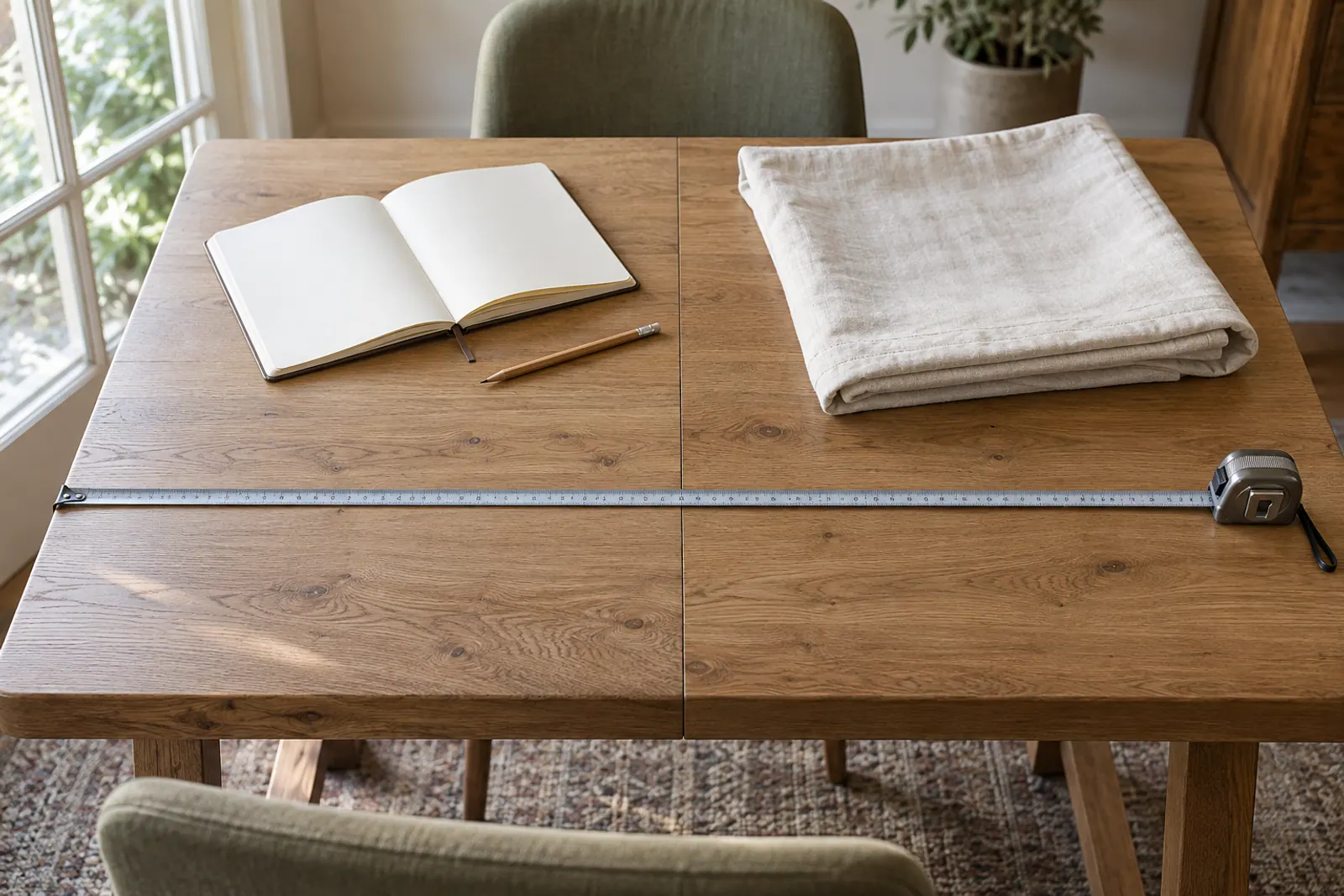
The two sizing formulas
| Table shape | Finished cloth measurement | What to measure |
|---|---|---|
| Rectangle | Length = table length + 2 × drop; width = table width + 2 × drop | Full length and width of the tabletop |
| Square | Each cloth side = table side + 2 × drop | One side, after checking the table is square |
| Round | Cloth diameter = table diameter + 2 × drop | A straight line across the center |
These formulas give the finished, usable cloth size. If you are sewing, add the seam or hem allowance required by your chosen finish separately. If you are buying fabric or a ready-made cloth, check its care instructions and any stated shrinkage or size tolerance before deciding what to order.
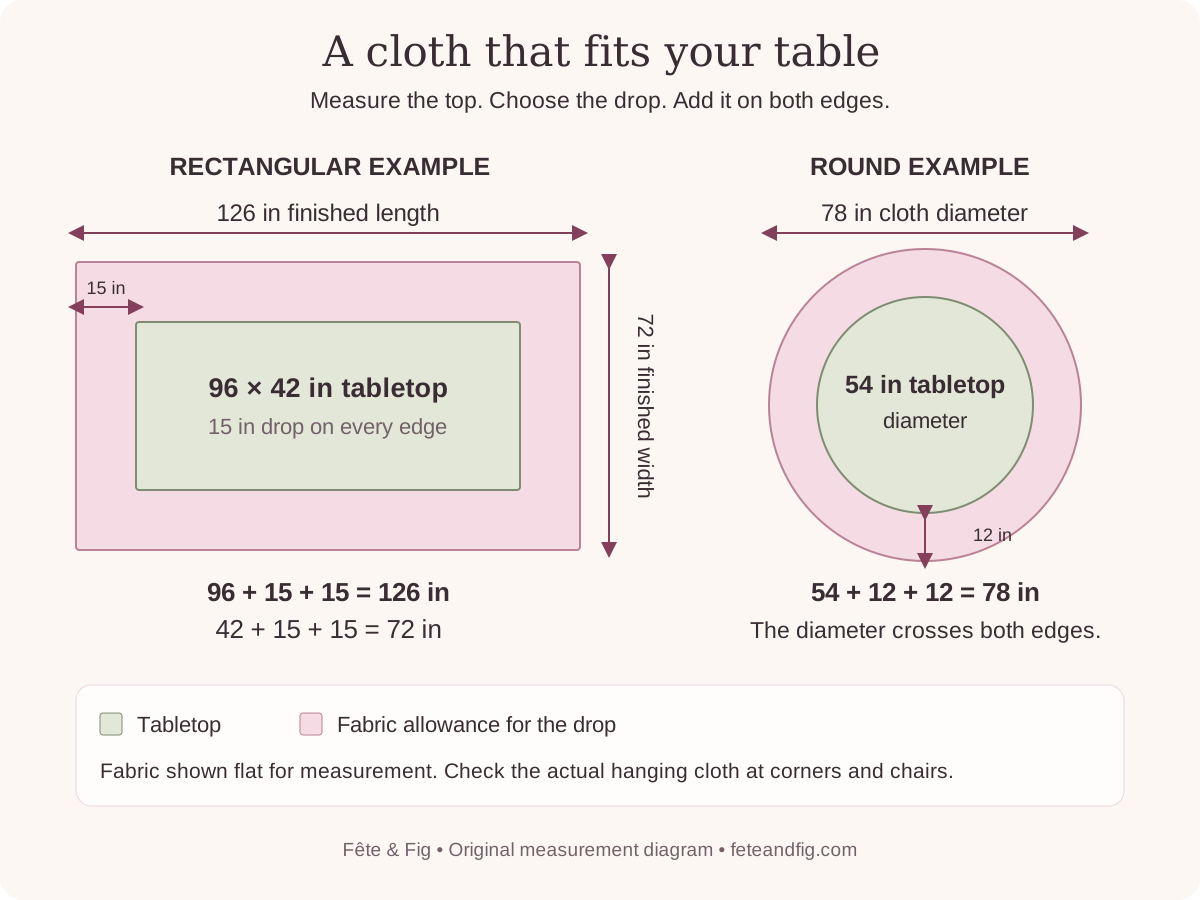
Worked sizes in inches and centimeters
The rows below are calculations for the stated measurements, not a list of sizes every retailer stocks. Each example uses an even drop on opposing edges. If you choose another drop, recalculate both dimensions.
| Tabletop | Chosen drop | Calculation | Finished cloth |
|---|---|---|---|
| 72 × 36 in rectangle | 10 in | 72 + 20; 36 + 20 | 92 × 56 in |
| 96 × 42 in rectangle | 15 in | 96 + 30; 42 + 30 | 126 × 72 in |
| 36 × 36 in square | 8 in | 36 + 16 on each side | 52 × 52 in |
| 54 in round | 12 in | 54 + 24 | 78 in round |
| 200 × 100 cm rectangle | 30 cm | 200 + 60; 100 + 60 | 260 × 160 cm |
| 120 cm round | 25 cm | 120 + 50 | 170 cm round |
For a 6-foot folding table, measure the width too. If the actual top is 72 × 30 inches, a 10-inch drop needs a 92 × 50-inch cloth. An 8-foot table measuring 96 × 30 inches needs 116 × 50 inches for that same drop. “Six foot” and “eight foot” describe length; they do not complete the calculation.
The 96 × 42-inch example also appears in our dinner table layout for eight. The cloth size belongs to that measured tabletop. It is not a rule that every eight-person table needs the same cloth.
Check a cloth you already have
Center the cloth and work backward:
Drop at each end = (cloth length − table length) ÷ 2.
Drop along each side = (cloth width − table width) ÷ 2.
For matching round shapes, use (cloth diameter − table diameter) ÷ 2. A result of zero means the fabric ends at the tabletop edge. A negative result means it does not reach that edge, so it is a shortfall, not a hanging drop.
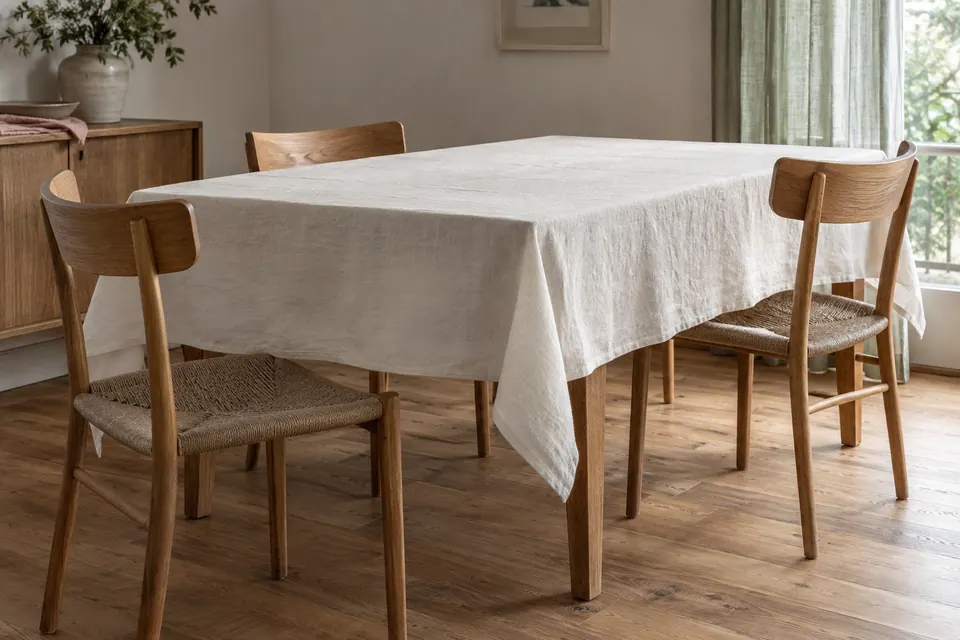
Here are three possible fits for a 72 × 36-inch table. Each cloth is centered with its longer dimension along the table length.
| Finished cloth | Drop at each end | Drop along each long side | What the result tells you |
|---|---|---|---|
| 90 × 60 in | 9 in | 12 in | The sides hang 3 in lower than the ends. |
| 108 × 60 in | 18 in | 12 in | The ends hang 6 in lower than the sides. |
| 70 × 50 in | 1 in short at each end | 7 in | The cloth does not cover the full table length. |
An unequal drop does not automatically make a cloth unusable. Put it on the table and decide whether both lengths suit the arrangement. If you rotate a rectangular cloth, swap its length and width in the calculation. A cloth that worked in one orientation may leave exposed tabletop in the other.
When shopping, compare several actual product measurements this way. Buying the next larger size without checking both directions can create a much longer end drop than you intended.
For floor length, measure the height
A floor-length calculation uses the distance from the top of the tabletop to the floor, not the distance from underneath the tabletop. Measure at the place where the table will stand, especially if the floor is uneven.
For a 60-inch round table that is 30 inches high, the theoretical floor-reaching cloth diameter is 60 + 2 × 30 = 120 inches. If you choose to leave a 2-inch gap above the floor, the desired drop becomes 28 inches and the calculated diameter is 116 inches. That gap is an example choice, not a universal clearance requirement.
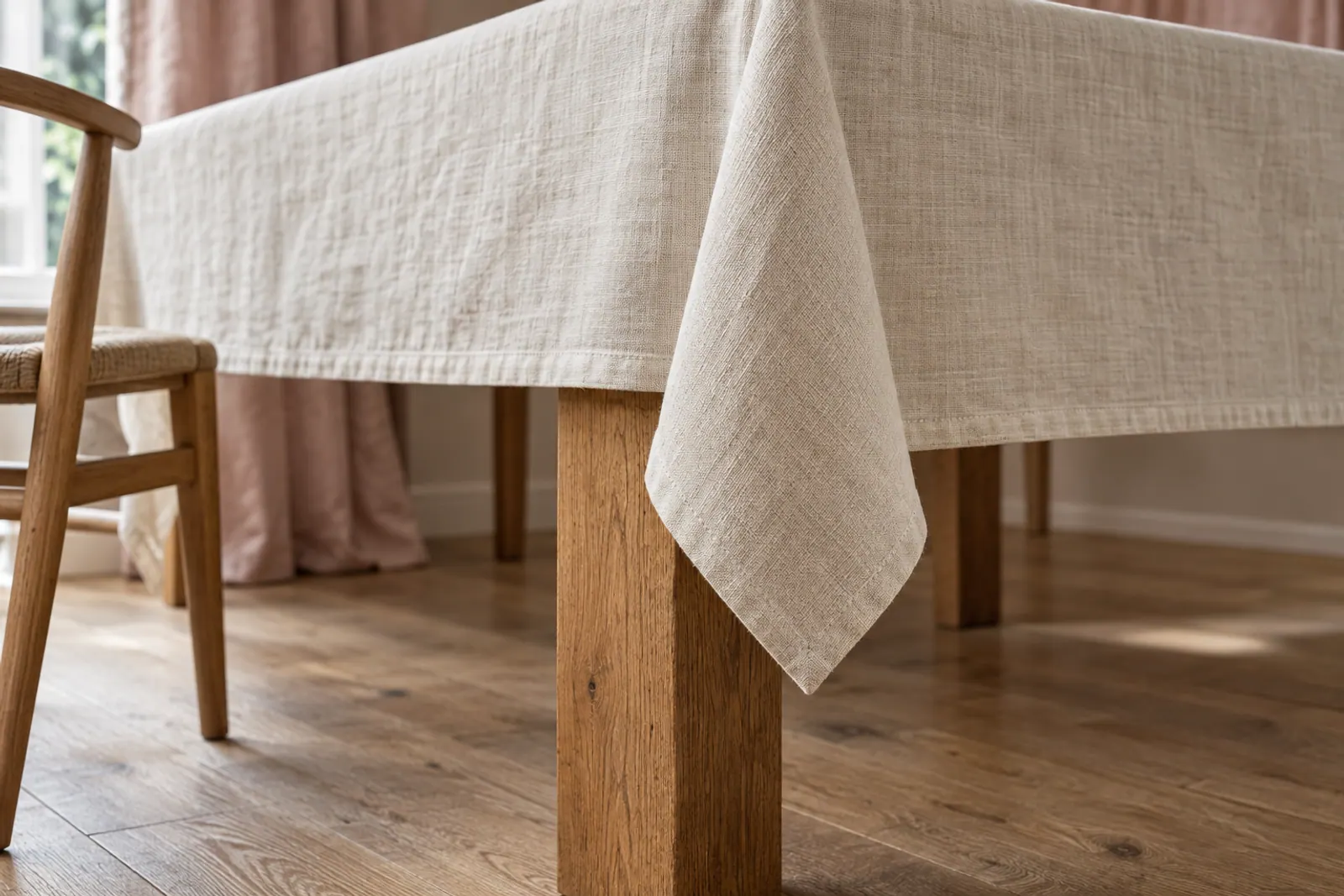
Rectangular corners need a separate check. The length and width formulas calculate the allowance at the straight edges. Corners contain extra fabric and can hang lower, so matching the straight-edge drop to the table height does not guarantee that every part clears the floor. Try the actual cloth, including its corners, before placing chairs or routing guests around it.
For a buffet against a wall, you may want different front and back drops. The equal-drop calculator does not model that arrangement. Calculate each dimension as table dimension + allowance on one edge + allowance on the opposite edge, then check the cloth’s position physically. For example, an 80 cm-deep buffet with a 60 cm front drop and a 10 cm back drop needs 150 cm of fabric across that direction.
Oval tables and mixed shapes need a fit check
The calculator is for a rectangle on a rectangle, a square on a square, or a round cloth on a round table. It does not predict the drape of a square cloth on a round table or a rectangular cloth on an oval top.
For an oval table, the longest and widest measurements are a useful starting point, but the curves determine how the fabric hangs between them. Ask for the cloth’s actual shape and dimensions, or try an existing cloth before ordering. A rectangular cloth can cover an oval table while leaving longer sections of fabric at the corners. Do not describe that as an even drop all around.
Keep a short measurement note
Record these five details before borrowing, renting or buying a cloth:
- The table’s shape and actual length, width or diameter, with leaves fitted.
- Its height, if you are considering a long drop.
- The preferred straight-edge drop and the resulting finished cloth dimensions.
- The available cloth’s measurements and its calculated drop in each direction.
- The result of checking corners, feet, chair movement and the route around the table.
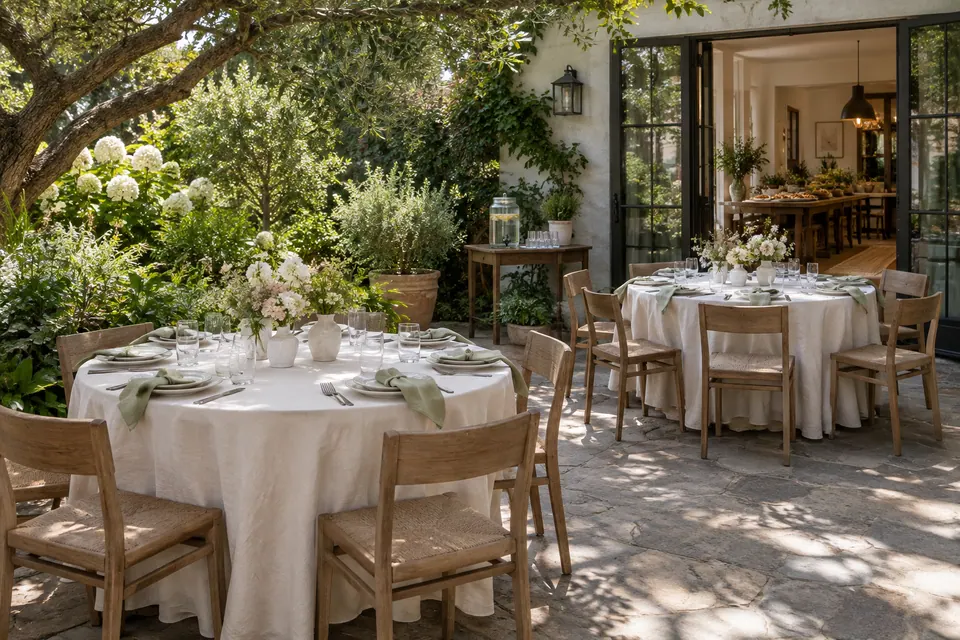
Once the cloth fits, use the measured table setup guide to place plates, glasses and serving pieces. For an outdoor celebration, the garden bridal shower layout helps you check how the dressed table sits within the wider gathering.
Add twice the desired drop to each table dimension. For a cloth you already own, subtract the table dimension from the matching cloth dimension and divide by two. Check length and width separately.
Checklist from this story
0 / 5 ready