Cocktail Party Food Ideas: A Standing Menu with Two Refills
Plan one-handed cocktail bites with a counted menu, opening display and two refill waves, a separate reserve, shopping quantities and a free planner.
Count the bites and refill waves ↓- The guest list
- 12 adults; a 90-minute before-dinner gathering
- A little preparation
- Confirm the real menu and yields, then prepare opening, refill and reserve containers separately
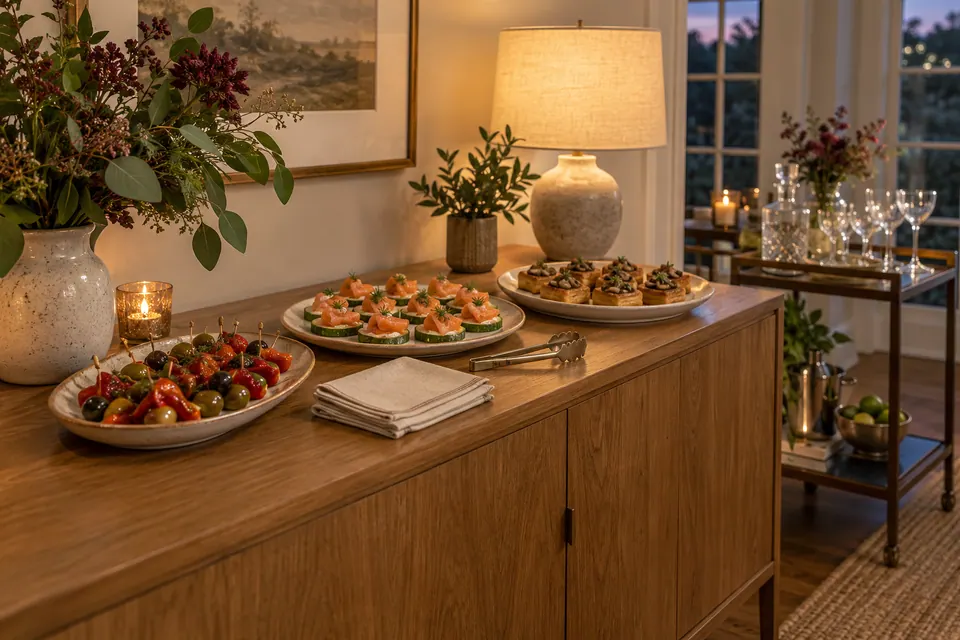
Good cocktail party food ideas let someone take a small bite without finding a chair, cutting through a large sandwich or balancing a bowl of sauce. Choose a short menu with different textures, provide small plates for anyone who wants one and bring fresh food in planned waves.
This original plan is for twelve adults during a ninety-minute before-dinner gathering. The host chooses six displayed bites per adult, not because six is a universal appetite rule, but to make a specific modest offer before another meal. If this is dinner, guests have different needs or the service is longer, change the offer and menu before shopping. The planner records duration without pretending that time alone determines appetite.
Choose bites that work in one hand
Use one picked vegetable bite, one cool cucumber bite and one small warm pastry. These are menu formats to make with a recipe or supplier instructions you already trust, rather than new tested recipes.
| Food | One defined bite | Check on the real sample |
|---|---|---|
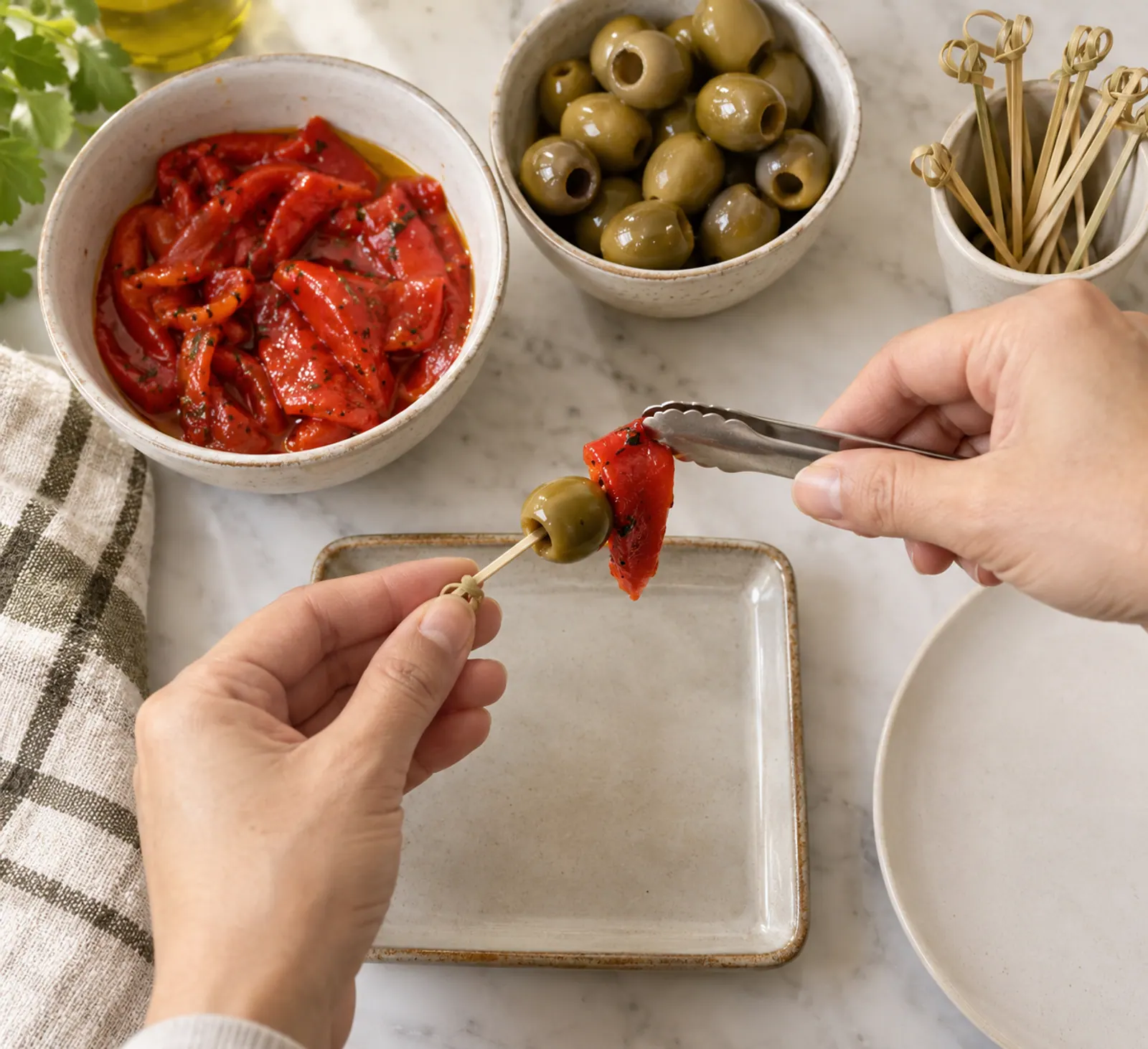
| Roasted pepper and olive pick | One usable roasted pepper strip and one pitted olive on a short pick | Drain as appropriate for the product; the strip stays on the pick and does not trail onto a sleeve |
| Smoked salmon cucumber bite | One firm cucumber base carrying one chosen small salmon fold | The actual base supports its topping when lifted; serve a small plate rather than promising every guest will eat it in one bite |
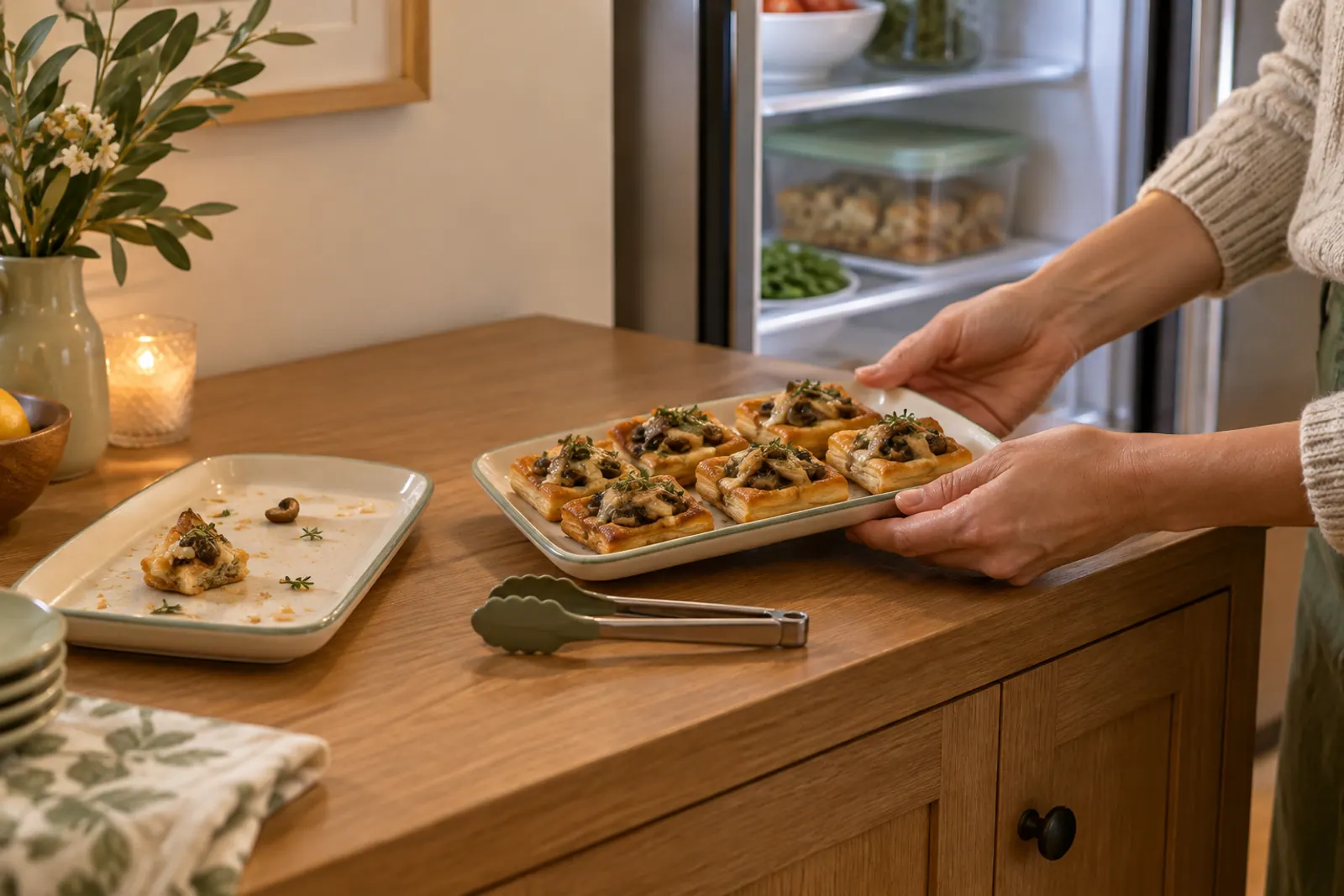
| Mushroom pastry square | One small cooked square from the chosen product or established recipe | It lifts without collapsing, is manageable while standing and needs no cutting at the food station |
Make one real example of each before committing to the full count. A photograph does not show whether a cucumber base bends or a pastry crumbles. Choose smaller pieces or a different food when the actual sample is awkward; do not shrink the portions automatically in the calculator and assume the food changed with them.
Ask about dietary needs directly. The three-row mix does not assign suitable meals to particular guests, and a decorative label does not establish ingredient suitability. Where a guest needs a different offer, agree and count that food separately. Keep the drinks and cup return in the drink station plan, so the menu remains about standing food rather than another counter-layout guide.
Count the opening and two refill waves
The example chooses 12 × 6 = 72 displayed bites and a separate 12-bite reserve, for 84 intended bites. Equal menu weights allocate twenty-four displayed bites and four reserve bites to each food. Opening receives 50% of each food’s display count, the first refill 25% and the second refill the remaining 25%.
| Food | Opening, minute 0 | First refill, minute 30 | Second refill, minute 60 | Held reserve | Total target |
|---|---|---|---|---|---|
| Pepper and olive picks | 12 | 6 | 6 | 4 | 28 |
| Salmon cucumber bites | 12 | 6 | 6 | 4 | 28 |
| Mushroom pastry squares | 12 | 6 | 6 | 4 | 28 |
| All three foods | 36 | 18 | 18 | 12 | 84 |
The reserve is not on the opening platter and is not automatically a third refill. It remains available for a chosen contingency, under the food’s required storage conditions. Setting reserve to zero removes it cleanly. Whole-pack surplus is a different quantity and should not quietly become another reserve.
Use the service planner to change the guests, chosen bites, mix and timing. It rounds whole bites by largest remainders, with menu order resolving equal remainders. Every food’s opening plus two refills equals its displayed count; all displayed counts add back to the chosen guest total. Percentages therefore describe intended proportions, while the actual integer totals tell you what to put on each platter.
Shop for the missing bites, not the whole stock twice
The example starts with no usable complete bites. Its pepper picks and cucumber bites use one-piece assembly units, so each needs twenty-eight finished pieces. The pastry example uses an illustrative twelve-count pack. Confirm your actual product count; the planner does not infer it from packaging size.
| Food | Target / usable owned | Entered pack or batch yield | Obtain or assemble | Surplus outside the plan |
|---|---|---|---|---|
| Pepper and olive picks | 28 / 0 | 1 completed pick | 28 picks: 28 usable pepper strips, 28 pitted olives and 28 picks | 0 completed picks |
| Salmon cucumber bites | 28 / 0 | 1 completed bite | 28 tested cucumber bases and 28 of your chosen salmon folds | 0 completed bites |
| Mushroom pastry squares | 28 / 0 | 12 squares per stated pack | 3 packs, supplying 36 squares | 8 squares, kept separately under product instructions |
The complete supplied count is 92, comprising the 84-bite menu target and eight unused pastry squares. That does not change the displayed total to ninety-two. Cook or prepare only what your product and service plan require, and handle unused stock according to its instructions.
For ingredients, check real yields before buying. A jar is not a known number of usable pepper strips, and a cucumber is not automatically a known number of firm bases. Cut the sample size you intend to use, measure the usable yield and round your shopping units. We do not assign an invented salmon weight or claim that a particular jar or vegetable will make twenty-eight portions. The party food calculator handles further ingredient or package rounding from your chosen yields.
If four suitable complete pastry bites are already available, enter four as owned stock. The remaining twenty-four bites require two twelve-count packs; owned plus new then equals twenty-eight with no surplus. Usable stock is subtracted once, and the reserve is already inside the target.
Set aside the equipment before preparing food
For the stated three-wave menu, prepare nine small platters, three for each display. Borrow enough pieces or plan a real washing and drying handoff before reusing them. Keep reserve in three separate suitable covered containers, one for each food; the unused pastry stock needs its own storage location.
| Gather | Chosen count | Check |
|---|---|---|
| Small food platters | 9 | 3 opening platters plus 3 for each refill; fit the real twelve- and six-bite displays |
| Clean serving utensils | 9 available across the service | One per food per wave, or a verified clean-and-dry replacement plan |
| Reserve containers | 3 | Each holds its food's four reserve bites under the required holding conditions |
| Small plates | 24 as a chosen offer | One per guest plus twelve spare; adjust for reusable plates and your washing plan |
| Napkins | 36 as a chosen offer | Three per adult across the evening, rather than a claimed universal need |
| Time and temperature checks | One service record and suitable food/appliance thermometers | Check actual storage and food, not a photograph or a warmer's appearance |
Three actual 30 × 20 cm platters can occupy a 120 × 45 cm counter in one row with their left edges at 5, 45 and 85 cm. This leaves ten centimeters between platter footprints and five at either end. It is a footprint example, not proof of hand clearance: check utensils, labels, the front approach and the refill person’s actual route with your real pieces. Keep drink glasses and used picks away from food preparation and clean serving utensils.
Replace the platter at each refill
Give one helper the cold-food trays and another the pastry tray and used-plate return when help is available. Label each held container by food and wave, not only by a decorative color. At minute thirty and minute sixty, bring the planned fresh trays and take used trays back separately. Reduce or delay the offer if the real preparation or holding arrangement is not ready.
The FDA’s safe buffet guidance supports using small fresh platters and replacing the used dish rather than topping it up. Keep cold food at 40°F / about 4.4°C or below and hot food at 140°F / 60°C or above, checking with appropriate thermometers. Follow the actual recipe or supplier’s cooking and storage instructions.
Discard perishables left at room temperature beyond two hours, or one hour when the air is above 90°F / about 32.2°C. Record when each tray goes out and follow the food’s handling requirements during preparation too. A ninety-minute event is not, by itself, proof of safe food handling; this planner does not monitor time or temperature. Keep the cold backup refrigerated until needed and do not put new food onto the old platter.
| When | Food offer | Owner's check |
|---|---|---|
| Before opening | Confirm the actual samples, assemble and label the three displays | Storage and cooking instructions followed; reserve and eight unused pastry squares are separate |
| Minute 0 | 12 of each food, 36 displayed bites | Record tray times; utensils and the guest approach are ready |
| Minute 30 | First fresh refill: 6 of each, 18 bites | Bring new platters; return used dishes separately and check holding |
| Minute 60 | Second fresh refill: 6 of each, 18 bites | Check the actual food before offering it; reserve remains a separate choice |
| Minute 90 | End this planned food offer | Handle remaining food under its instructions and recorded time/temperature conditions |
Keep a current plan beside the preparation area
The planner on this page exports a current CSV and a one-page A4 or Letter service sheet. You can also open the free offline cocktail-bites planner or download its self-contained HTML file. Editing uses no remote font, library, account, automatic save or analytics collector.
Calculate the current inputs, then save a project JSON before closing. A project restores the menu, counts, timing and paper choice; it is not shared editing or synchronization. Invalid imports leave current inputs untouched, and a valid import asks before replacing them. Any edit invalidates exports until you calculate again. The print control checks readable one-page fit and requests the browser dialog; it cannot confirm a completed PDF or physical print.
Print with matching paper, portrait, 100% scale, no margins and browser headers and footers off. When long menu labels make one page unreadable, shorten the labels or use the CSV instead. Keep downloaded projects private if you choose to put personal information into a food label. The intended result is a usable handoff record for this standing menu, not a promise that every guest will eat the same food or amount.
Choose bites that can be managed while standing, decide the total offer for this gathering and divide each food into an opening display and two fresh refills. Keep the chosen reserve and any whole-pack surplus separate.
Checklist from this story
0 / 11 ready
Your standing-bites service plan
Choose bites per adult for your actual gathering. Duration is recorded but does not automatically multiply food. Menu weights describe your chosen mix; integer portions round across rows with totals preserved.
The worked example is ready to calculate. Replace its inputs with your own plan.
Replace the current measurements and menu with this saved project? Save the current plan first if you need both.
Entries stay in this tab. No automatic save, shared editing or synchronization is used. Save projects locally and keep them private. Clearing or closing the tab does not delete downloaded files. Print at matching paper, portrait, 100%, no margins and no browser headers or footers; the tool checks one-page fit before requesting print.
Worked example without JavaScript
12 adults × a chosen 6 bites = 72 displayed bites. Three equally weighted foods receive 24 each: 12 at opening, 6 at minute 30 and 6 at minute 60. A separate 12-bite reserve adds 4 per food, making 84 intended bites. One-bite assembly units require 28 pepper picks and 28 cucumber bites. Three 12-count pastry packs supply 36 squares for a 28-square target, leaving 8 outside the plan. This is arithmetic, not evidence of appetite or a tested recipe.
Sources and file checks
The menu counts are original editorial assumptions for a before-dinner gathering, not measured appetite, nutrition advice or tested recipes. Integer allocation, exact reserve, stock subtraction, pack rounding, CSV and project validation checks passed. Three photographic styling scenes were AI-created. No physical food preparation, standing-bite, holding-equipment or printer trial is claimed.
- FDA: Serving Up Safe BuffetsSmall fresh platters, hot and cold holding temperatures, and the two-hour rule with the shorter limit above 90 degrees Fahrenheit.
- MDN: Window print()The planner requests a browser print dialog; it cannot establish that a PDF was saved or paper was printed.
- MDN: Blob text()The offline planner reads a selected local project as text before validating its structure and calculations.