Coffee Bar Ideas for a Party: Measured Pours and a Brew Plan
Plan a party coffee bar from actual mug pours, measured batch yield, brew cycles and flask capacity, with a free service planner and a worked example.
Paid links: we may earn a commission. As an Amazon Associate I earn from qualifying purchases.
Open the coffee service planner ↓- The guest list
- A worked example for 16 adults, with 12 expected coffee drinkers including the hosts
- A little preparation
- Measure one actual brew and usable holding vessels before choosing the service timetable
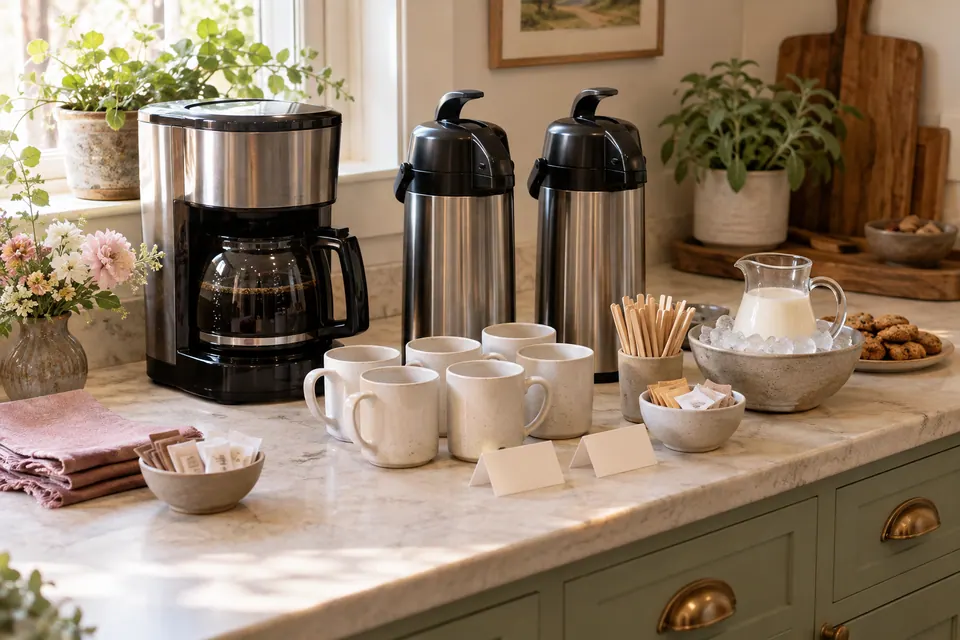
The most useful coffee bar ideas for a party solve three jobs: give guests a comfortable pour, have enough finished coffee ready when they want it, and leave the host time to enjoy the gathering. A line of mugs and attractive jars will not tell you whether one machine can brew the next round quickly enough.
Start with the people who actually want coffee. Then measure the coffee volume in one pour, the finished yield of your machine’s full batch, its complete brew-and-reset cycle, and the usable capacity of your holding vessels. The free coffee service planner turns those measurements into an arrival allocation and one refill wave, including any shortfall that needs a different plan.
Choose the coffee drinkers and service style
For a small gathering of 16 adults, you might expect 12 coffee drinkers, including the hosts, while the remaining guests choose water or an agreed alternative. This is an illustrative count, not a rule that three quarters of every guest list drinks coffee. Ask about preferences when collecting replies and adjust for the actual group.
Choose a service window before estimating refills. Coffee offered with dessert after dinner has a different job from a coffee counter open through a long morning gathering. The planner uses one initial pour per coffee drinker and an adjustable number of refills per drinker. An assumption of 0.5 means one refill for half of the group, rounded up to a whole pour. It does not mean every person receives half a mug.
Three practical ways to arrange a coffee bar:
| Gathering | Coffee arrangement | Host job |
|---|---|---|
| After-dinner dessert | Mugs and the first coffee allocation on a side counter; dessert plates served separately. | Offer coffee when dessert starts, then ask who wants a refill before making another batch. |
| Morning catch-up | A measured first batch ready at arrival, with one planned refill point and water available throughout. | Recheck actual demand before the later brew; guests reuse their mugs where practical. |
| Small shower or celebration | A clearly labeled regular-coffee offer, with the agreed alternative handled as its own service job. | Assign one person to coffee so another can greet guests or run the activity. |
If coffee accompanies a dessert table, choose the food separately using the dessert table guide. For the placement of water, glasses and a general drinks queue, use the drink station guide. This coffee plan focuses on brewing and capacity rather than repeating that room layout.
Measure the pour, finished yield and complete cycle
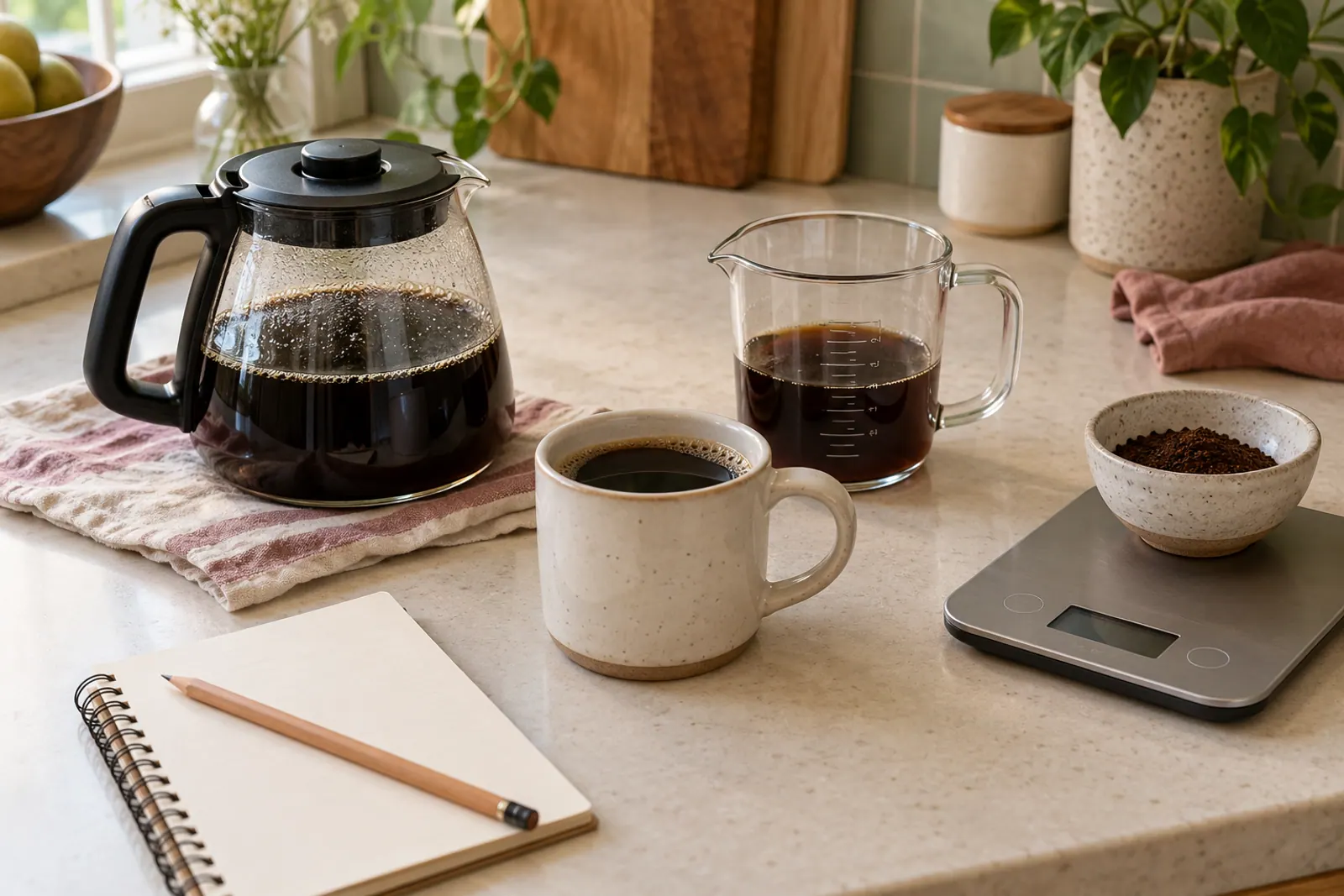
Fill one actual mug to the coffee level you want to serve, leaving room for milk if offered, and measure that liquid using a suitable measuring vessel. A mug’s brim capacity is not the same as a comfortable coffee pour. In the example below the coffee pour is 180 mL; change it for your own mugs and service.
Run your own batch with the machine’s instructions and the recipe you intend to use. Measure the finished usable coffee, rather than reading the reservoir’s water level or treating a machine’s “12 cups” as twelve guest mugs. Water put in and coffee available to pour are separate measurements. The article and AI-created images do not document a physical brew trial.
Time the complete cycle: fill, brew, transfer to the chosen holding vessel, then complete any reset required before the next batch. Enter that full cycle in the planner. A brewing-only time can leave the proposed refill schedule short of the transfer and reset minutes it actually needs.
Measure the usable capacity of each vessel according to its instructions and intended fill level. Add only vessels that can hold this coffee at the same time. If the machine’s carafe must be empty for the next brew, do not also count it as storage for earlier coffee. Two vessels with a usable 1,500 mL each provide 3,000 mL of holding space; their printed nominal capacities may differ.
The alternate planner unit is US fluid ounces, approximately 29.57 mL each, distinct from Imperial fluid ounces. It is not a manufacturer-defined coffee cup. NIST’s conversion table identifies these units separately. Choose the unit before entering the three liquid measurements; the tool will not silently reinterpret existing numbers when you switch it.
Build two service waves with one machine
Use an initial wave at arrival and one stated refill minute. This deliberately simple model assumes all initial pours are served at minute 0, then all expected refills are available at the chosen refill point. It is a conservative staging plan for those two moments, rather than a prediction of individual arrivals or a continuous guest queue.
Round expected refills up to a whole pour. Choose a separate reserve percentage of the initial and refill pours, then round that reserve up too. The reserve is extra coffee available if needed, not expected consumption. When there are refills, the planner has the reserve ready at the refill wave. Without refills, it has that reserve ready at arrival.
Brew enough whole batches for the initial target. After the first pours, carry any finished coffee still in the holding vessels forward. Subtract that carry from the later target before deciding how many more batches to brew. This prevents the same leftover coffee from being counted twice or an unnecessary later batch from being added.
Check the holding space against full batch output, not just the planned drinking volume. The model does not silently spill or discard the last part of a batch to make a small flask look sufficient. It also checks the first brewing window against the minutes available before arrival, and later brewing against the refill deadline. A failed check produces a shortfall and no feasible brew timetable.
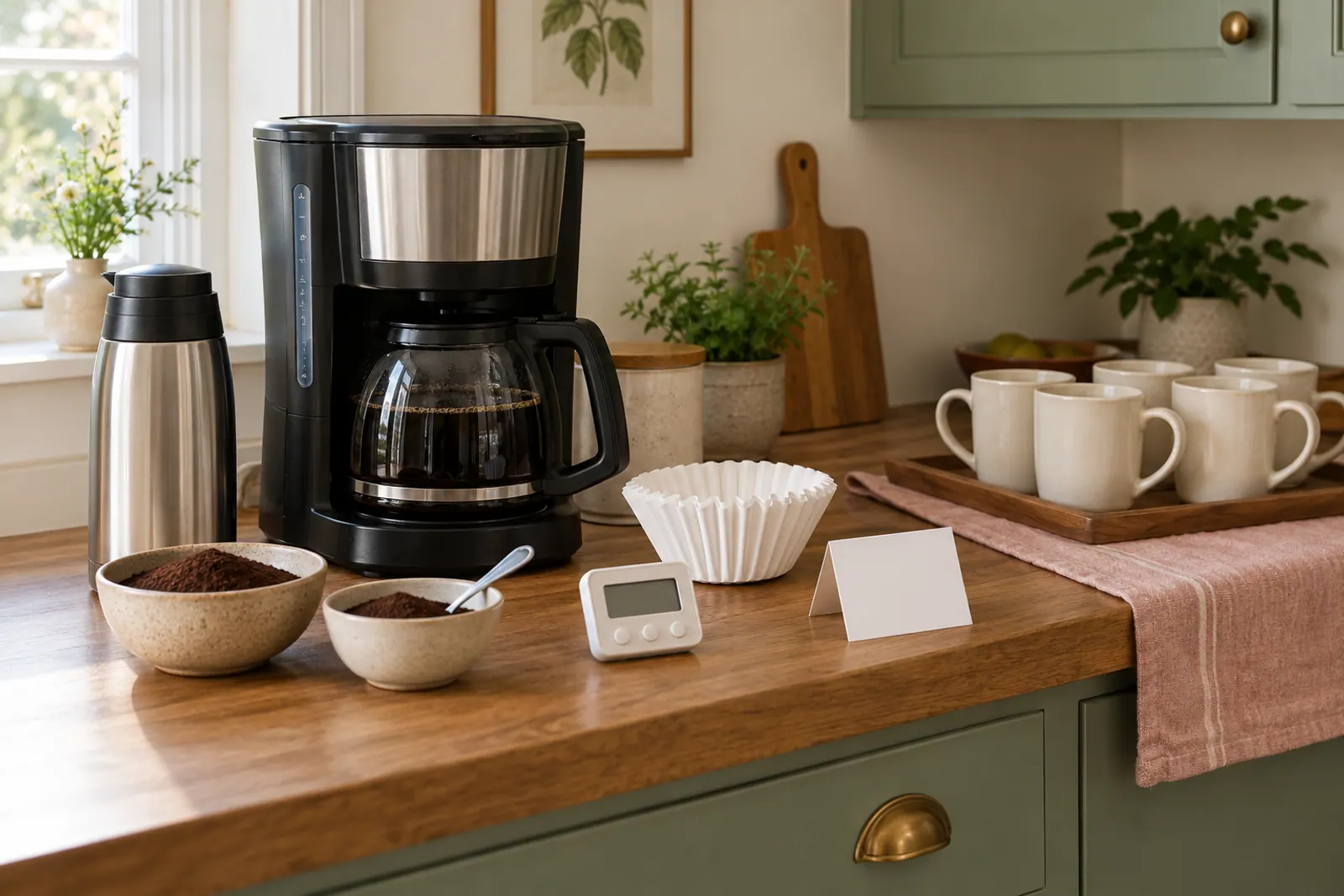
Read the worked coffee example
Suppose the gathering has 12 expected coffee drinkers, a 180 mL coffee pour, 0.5 refills per drinker, and a chosen 10% reserve. The illustrative equipment produces 1,000 mL of finished coffee per batch, takes 10 minutes for a complete cycle, and has 3,000 mL of usable holding space. The host allows 35 minutes before arrival, chooses a refill at minute 40, and plans a 90-minute coffee service.
| Step | Calculation | Result |
|---|---|---|
| Initial coffee | 12 × 180 mL | 2,160 mL for 12 initial pours |
| Expected refills | 12 × 0.5 = 6 pours; 6 × 180 mL | 1,080 mL for six refills |
| Chosen reserve | 10% × 18 pours = 1.8, rounded up to two pours | 360 mL extra, ready at the refill wave |
| Initial batches | 2,160 ÷ 1,000, rounded up to three | 3,000 mL brewed; 30 minutes needed |
| Carry after initial pours | 3,000 − 2,160 | 840 mL remains in the holding vessels |
| Later batch | 1,080 + 360 − 840 = 600 mL additional target | One whole 1,000 mL batch; 10 minutes needed |
| Coffee held at refill time | 840 + 1,000 | 1,840 mL before the six refill pours |
| Total and remaining coffee | Four batches = 4,000 mL; expected drinking = 3,240 mL | 760 mL remains: 360 mL reserve and 400 mL from batch rounding |
The initial three cycles can run from 30 minutes before arrival to arrival, within the 35-minute preparation window. The later full cycle can run from minute 30 to minute 40 after arrival. Both stages fit the stated 3,000 mL holding capacity. That is an arithmetic check of this example, not a guarantee of beverage quality or a test of any particular appliance.
For a hand calculation, use the same sequence: round the initial batch count up, deduct the initial pours to find the carry, then round up only the additional later volume after subtracting that carry. Multiply each stage’s batch count by the complete cycle time. Compare its full held volume with the actual usable vessels before assigning a brewing job.
For a purchasing illustration, entering 70 g of ground coffee per batch gives 280 g for four batches. That 70 g is an example input, not our recommended recipe or a claim that it produces the example yield. Use your machine instructions and preferred recipe, and measure the yield they actually produce. Buy or measure reservoir water separately; 4,000 mL of finished coffee does not establish how much water to put into a reservoir.
Plan your coffee service
Open the free coffee service planner, or download the self-contained HTML tool for offline use. It requires no account and has no automatic saved copy.
- Choose mL or US fl oz. Enter coffee drinkers, your refill assumption and the reserve you want.
- Enter your actual coffee pour, finished batch yield, combined usable holding capacity and complete cycle time.
- Set the preparation minutes, refill minute and service duration. Enter your own grams of grounds per batch, or 0 to omit that purchasing estimate.
- Select Calculate service plan. Read the allocation, carry-forward coffee and every time or holding shortfall. The refill minute must fall within the service duration.
- Save a private project JSON to resume later, download the current CSV, or print the current review sheet. Importing into populated entries asks before replacement.
The supported range is 0–500 coffee drinkers and 0–5 assumed refills per drinker. The pour is 1–1,000 mL, batch yield 1–100,000 mL and usable holding space 0–1,000,000 mL, with equivalent limits for US fl oz. Complete cycles are 0.1–120 minutes, and timing windows are 0–1,440 minutes. These bounds keep the tool usable; they do not endorse serving at those extremes.
Changing any input makes the old result stale. Calculate again before CSV export or printing. Changing the liquid unit asks before clearing those three measurements while preserving counts, percentages, minutes and grams. Save the project before closing the tab; clearing entries does not delete files already downloaded.
For a printout, choose matching A4 or US Letter, portrait orientation and 100% scale, with no margins or browser headers and footers. Check the preview. A failed allocation can still be printed as a review sheet with its shortfalls clearly shown, but it has no brew timetable to follow. The tool cannot confirm that a file finished downloading or a physical sheet was printed.
Give coffee, milk and mugs distinct places
Keep brewing supplies and hot transfer work on the host’s side of the counter. Put the guest mugs where a person can take one without reaching over the machine or moving a hot flask. Follow the appliance and vessel instructions for clearance, cords, lids and operation; the planner does not inspect the physical setup.
Count mugs by the coffee drinkers plus the spares you choose. Twelve people receiving six refills do not automatically require eighteen reusable mugs. Give guests a way to identify their own mug, or have a clear used-mug place if you prefer to collect and wash them. Choose dishwasher space and the washing plan around the actual gathering.
Keep refrigerated milk cold: the FDA buffet guidance specifies 40°F or colder, about 4°C. Put out a small amount in a suitable chilled setup and keep backups in the refrigerator. Discard unchilled perishables after two hours, or one hour when the surrounding temperature exceeds 90°F. Track that time separately from the coffee timetable; the calculator is not a food-temperature monitor.
Label the drinks actually offered. Regular coffee, decaf and a milk alternative need their own clear identification, supplies and utensil decisions. A decaf batch is a separate brewing job. Two independently calculated plans using the same machine do not prove their combined timetable fits; assign those cycles separately or change the equipment arrangement.
Change the plan when a capacity check fails
Not enough time before arrival: allow a longer preparation window, reduce the initial coffee offer by agreement, or choose another actual service arrangement. Rehearse the complete cycle again if your current time excluded transfer or reset. Do not squeeze two sequential batches into one batch’s time on paper.
Not enough time for the refill wave: move the agreed refill point later within service, revise the expected demand, or arrange suitable additional brewing capacity outside this one-machine tool. A later refill point is not a recommendation to hold milk unchilled for longer or to ignore the equipment’s holding instructions.
Not enough holding space: find suitable vessels with enough measured usable capacity, or change the batch and service plan. The model requires the full finished batch to fit; it will not call 3,000 mL adequate just because the guests are expected to drink only 2,160 mL. Partial brews need their own measured yield and cycle rather than an assumption that every measurement scales proportionally.
Party coffee bar questions
How much coffee do I need for 20 guests? First count which of the twenty want coffee and choose a pour, refill assumption and reserve. Guest count alone does not determine the liquid amount. Use the resulting demand with your measured whole-batch yield and service timings.
Does a 12-cup coffee maker serve 12 people? Its cup label is not a count of your actual mugs. Measure the usable finished output of the batch you intend to brew, then divide by your measured coffee pour. The planner uses those liquid measurements directly.
Can I use the tool for continuous arrivals or multiple machines? It models one sequential machine and two service waves. Continuous arrivals, several machines and shared regular/decaf brewing need a separate operational timetable. Do not read this two-wave result as proof of those different arrangements.
Should all the reserve be brewed before guests arrive? In this model reserve is ready with refills when a refill wave exists, and at arrival when there are no refills. Choose another service arrangement if you need reserve earlier. Whole initial batches may already leave extra coffee, which the tool carries forward.
Can the planner tell whether coffee will stay hot or taste good? No. Its minutes and capacity are arithmetic checks. Follow the vessel and machine instructions, rehearse with your own equipment, and check the actual service conditions. The photographs are AI-created preparation concepts, not evidence of a brew or holding test.
A useful party coffee bar starts with coffee drinkers and measured pours, rather than a machine's cup count. Check the finished yield, full brew-and-reset time and usable holding vessels. The free planner allocates whole batches across arrival and one refill wave, carries excess coffee forward and shows any time or holding shortfall.
Checklist from this story
0 / 10 ready
Sources and file checks
The two-wave coffee allocation and worked quantities are original editorial examples, not a hosted event or brew-strength recommendation. Software checks cover rounded servings and full batches, carry-forward conservation, volume units, time and holding shortfalls, projects, CSV and stale-output printing. The tool does not verify a machine, holding temperature, taste or physical printing. AI-created photographs illustrate preparation concepts; readers must measure their own equipment.
- NIST Guide to the SI: Conversion factors, Appendix B.8Distinguishing US fluid ounces from Imperial fluid ounces and expressing the planner's alternate volume unit.
- FDA: Serving Up Safe BuffetsKeeping refrigerated milk cold during service, the two-hour rule for unchilled perishables and its shorter limit in very hot conditions.