Cake Serving Chart: Clear Slice Sizes and Original Cutting Diagrams
Plan cake portions with an original serving chart, equal-wedge and grid cutting diagrams, explicit slice dimensions and free printable cutting cards.
Get the cake cutting cards ↓- A little preparation
- Measure the finished cake and choose the cutting pattern before serving
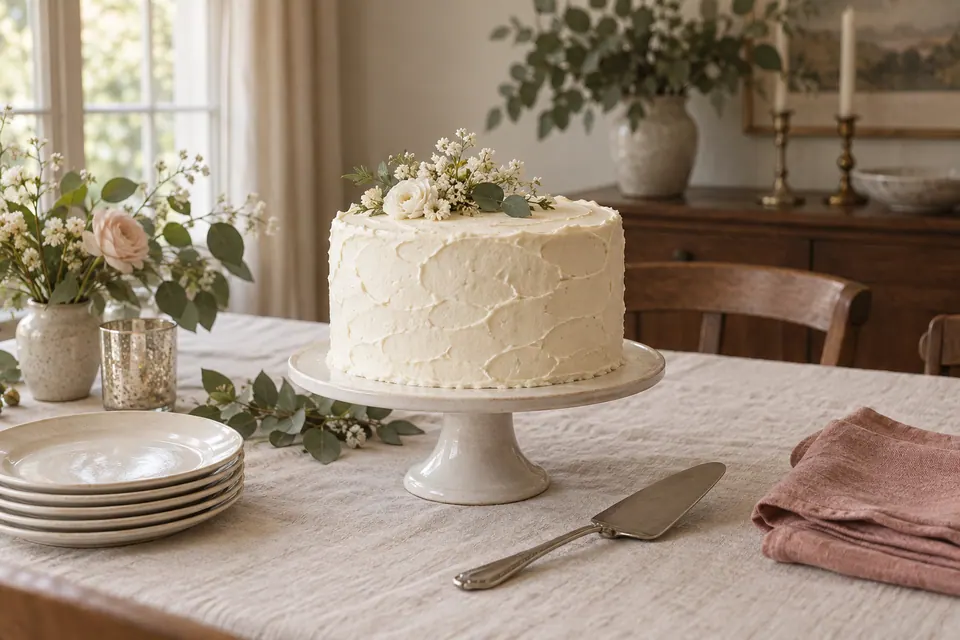
A cake serving chart is useful only if it tells you what a serving looks like. An eight-inch cake can be cut into twelve wedges, sixteen thin wedges or several rows of smaller pieces. Those are different portions. The diameter alone does not settle how much cake each guest will get.
Our chart ties every count to an original, drawn cutting pattern. The rectangular examples use a grid. The round examples use equal-angle wedges, deliberately keeping the curved edge instead of calling it a rectangular slice. These are calculated pieces, not physically tested bakery yields. Frosting, uneven edges, cake height and the person cutting can change the result. For a purchased cake, ask the baker to describe their intended portion and cutting method.
Choose the portion before choosing the cake
First decide what the cake is doing in the meal. A modest piece after dinner and a generous slice at a birthday tea are not interchangeable. If you want smaller pieces because there are other desserts, tell the cutter that in advance. Do not discover halfway through serving that the first eight guests received twice the planned amount.
Wilton’s serving guide distinguishes approximately 1½ × 2-inch party pieces from 1 × 2-inch wedding pieces and describes its counts as guidance. Our table below uses its own larger grid portions and explicit wedge patterns; it does not reproduce Wilton’s yield table.
All dimensions below describe the top of the piece. Each cut goes through the cake’s edible height. A two-inch-high square and a tall layered square with the same footprint contain different amounts of cake. We do not multiply servings merely because a cake is taller. Ask the baker whether a very tall cake should be separated into supported tiers or shorter sections before cutting.
Read the cake serving chart with its cutting pattern
| Finished cake | Cutting plan | Pieces | Top dimensions of a piece |
|---|---|---|---|
| 6-in round | 8 equal wedges | 8 | 45° wedge; 3-in radial depth; outer arc about 2.36 in |
| 8-in round | 12 equal wedges | 12 | 30° wedge; 4-in radial depth; outer arc about 2.09 in |
| 10-in round | 16 equal wedges | 16 | 22.5° wedge; 5-in radial depth; outer arc about 1.96 in |
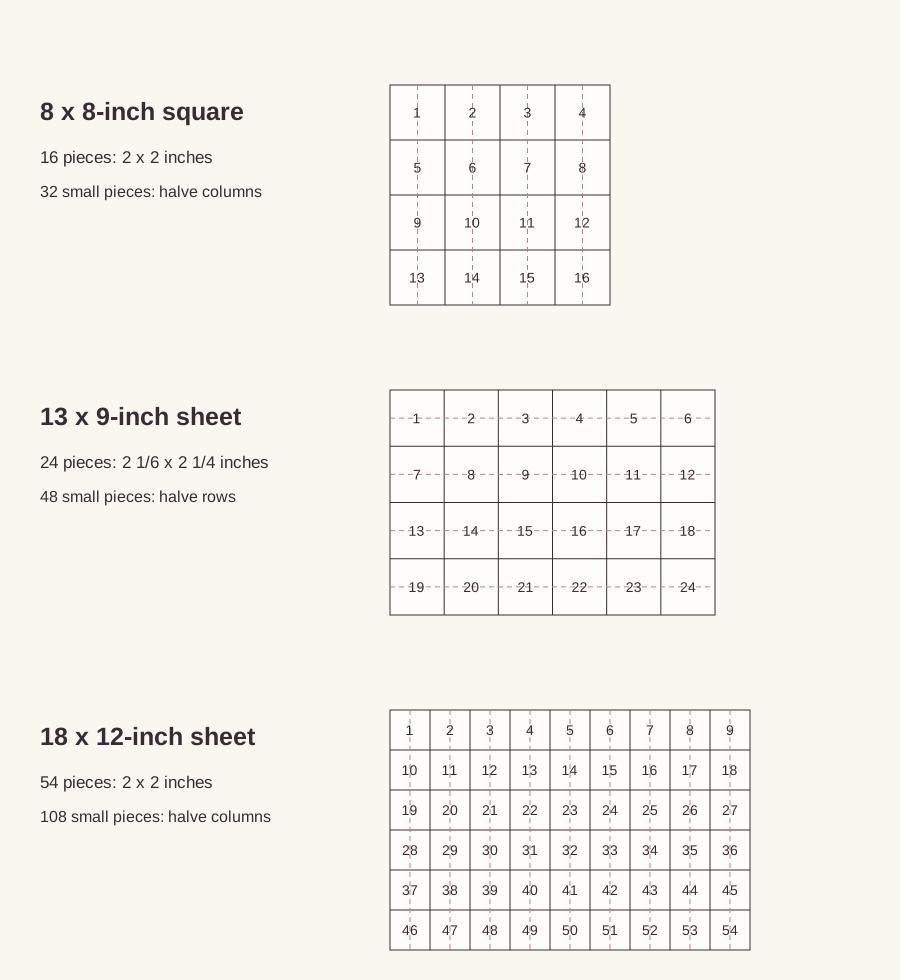
| 8 × 8-in square | 4 columns × 4 rows | 16 | 2 × 2 in, about 5.1 × 5.1 cm |
| 8 × 8-in square, smaller pieces | 8 columns × 4 rows | 32 | 1 × 2 in, about 2.5 × 5.1 cm |
| 13 × 9-in sheet | 6 columns × 4 rows | 24 | 2⅙ × 2¼ in, about 5.5 × 5.7 cm |
| 13 × 9-in sheet, smaller pieces | 6 columns × 8 rows | 48 | 2⅙ × 1⅛ in, about 5.5 × 2.9 cm |
| 18 × 12-in sheet | 9 columns × 6 rows | 54 | 2 × 2 in, about 5.1 × 5.1 cm |
| 18 × 12-in sheet, smaller pieces | 18 columns × 6 rows | 108 | 1 × 2 in, about 2.5 × 5.1 cm |
For the 13 × 9-inch example, six columns require five interior cuts and four rows require three. There are 24 pieces because the drawing has 6 × 4 cells. Dividing a round cake’s area by a nominal rectangle would not tell you how to cut its curved outer edge, so we have not used that shortcut.
Measure after any edge trimming. A cake that finishes 12 × 8 inches cannot use the 13 × 9-inch dimensions unchanged. Divide its actual width by your chosen column count and its length by your chosen row count. This gives the planned rectangle, provided the cake is actually rectangular. Rounded corners and domed edges need a practical adjustment.
Cut a sheet cake into equal rows
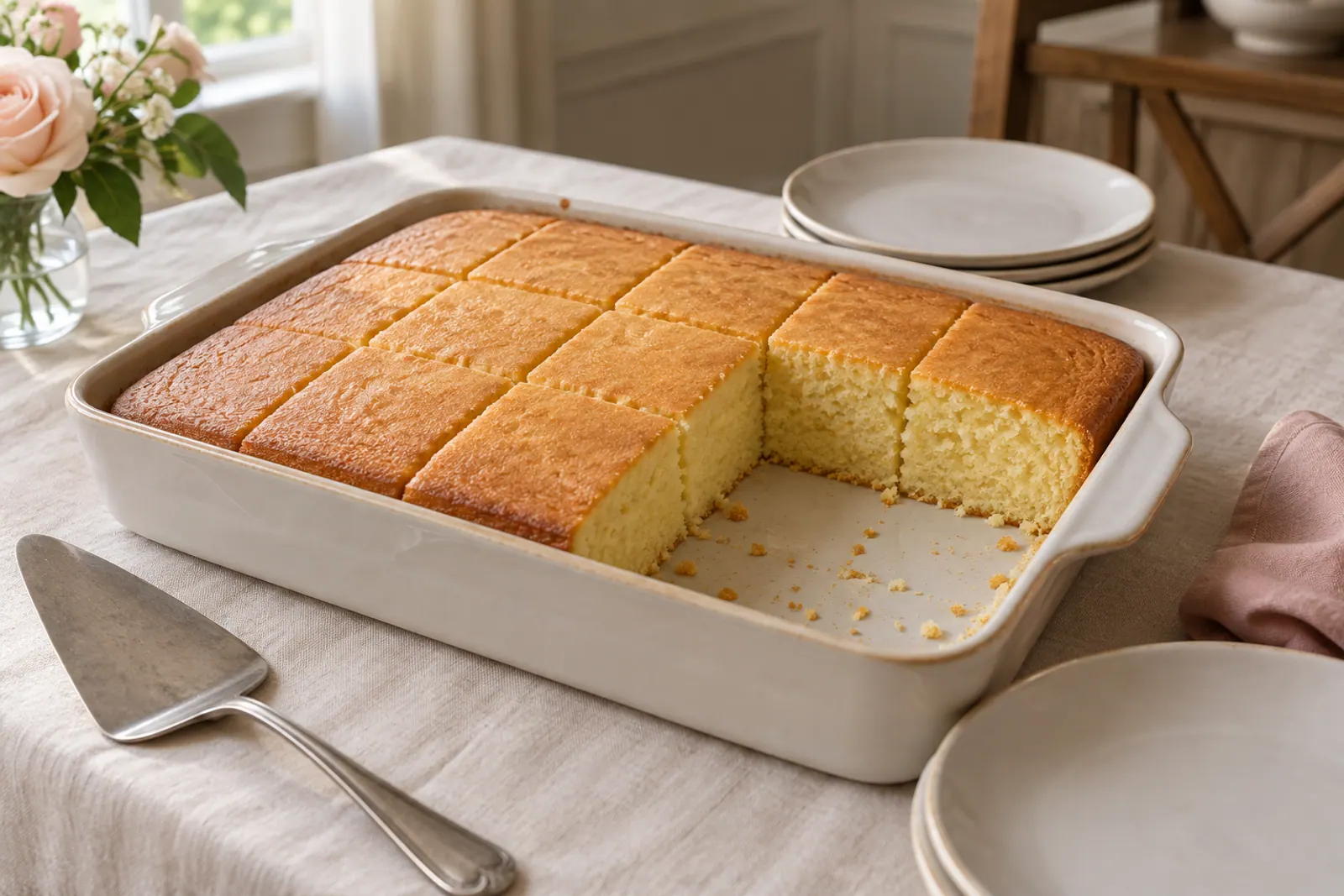
- Place the cake securely. Use its board or a stable serving surface that suits the cake. Check how the baker wants a filled or decorated cake handled.
- Find the two edible dimensions. Do not include the tray rim, board or overhanging decoration. Decide which direction will be columns.
- Mark the row ends lightly. For the 13 × 9-inch example, divide the nine-inch edge into four 2¼-inch rows. Mark both opposing edges so the cuts stay parallel.
- Cut the rows, then the columns. Along the thirteen-inch edge, mark six equal lengths of 2⅙ inches. Make the five interior column cuts. Keep the blade vertical; a slant changes the bottom of the piece.
- Lift one piece and look at it. Confirm it suits the plates and the intended serving. Follow the same marks for the rest, rather than changing the size as the tray empties.
If you need 48 smaller pieces from that same sheet, halve each of the four row bands to make eight rows. The six columns stay in place. In the eight-inch square, halve each two-inch column to turn sixteen 2 × 2-inch pieces into thirty-two 1 × 2-inch pieces.
Our dessert table guide covers where to put the cake and other sweets. The chart here covers the cake cuts, so you can hand one clear instruction to the person serving.
Cut a round cake into marked wedges
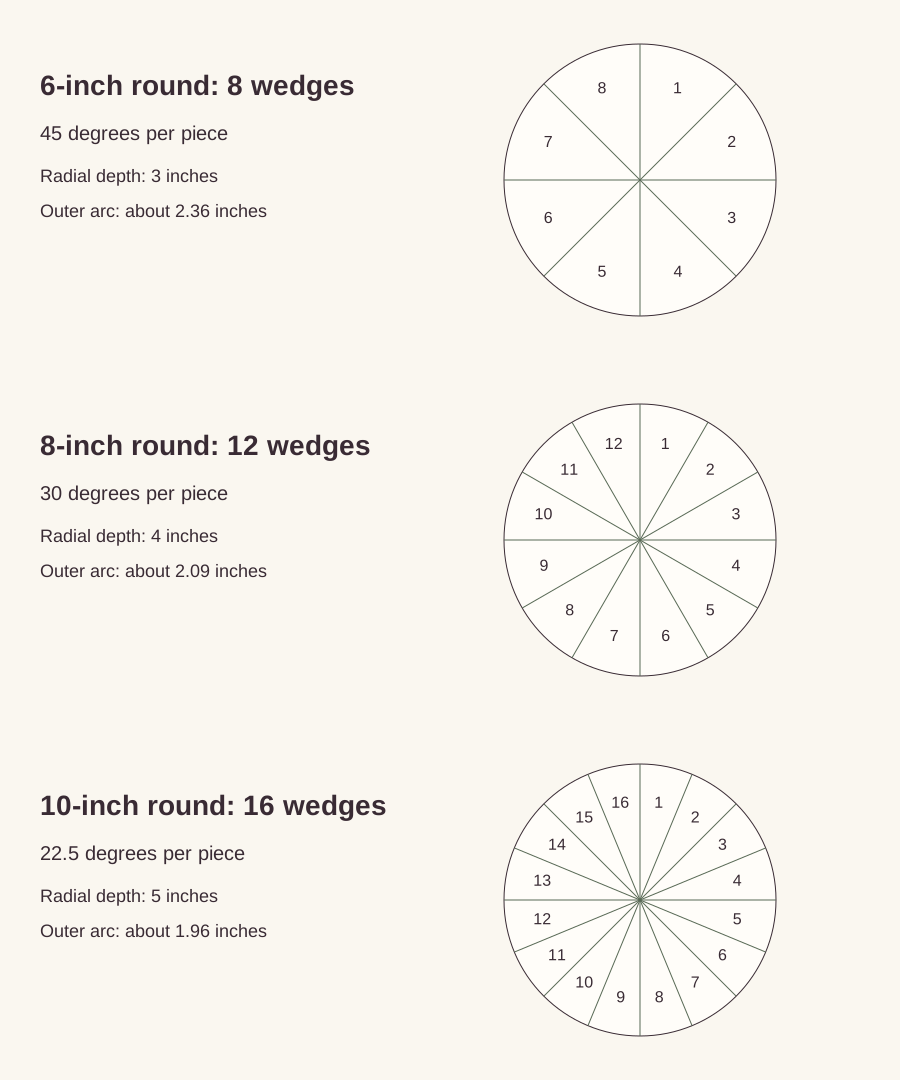
For eight pieces, mark quarters first and halve each quarter. For twelve, mark quarters and split each quarter into three equal angles. For sixteen, mark quarters, halve them into eighths, then halve each eighth. Check the marks around the rim before making full-depth cuts through the center.
The outer arc formula is π × diameter ÷ wedge count. For the eight-inch, twelve-wedge example, it is π × 8 ÷ 12, about 2.09 inches. That is the length along the curved outside edge. The point narrows to zero at the center, and the piece extends four inches radially. It is not a 2.09 × 4-inch rectangle.
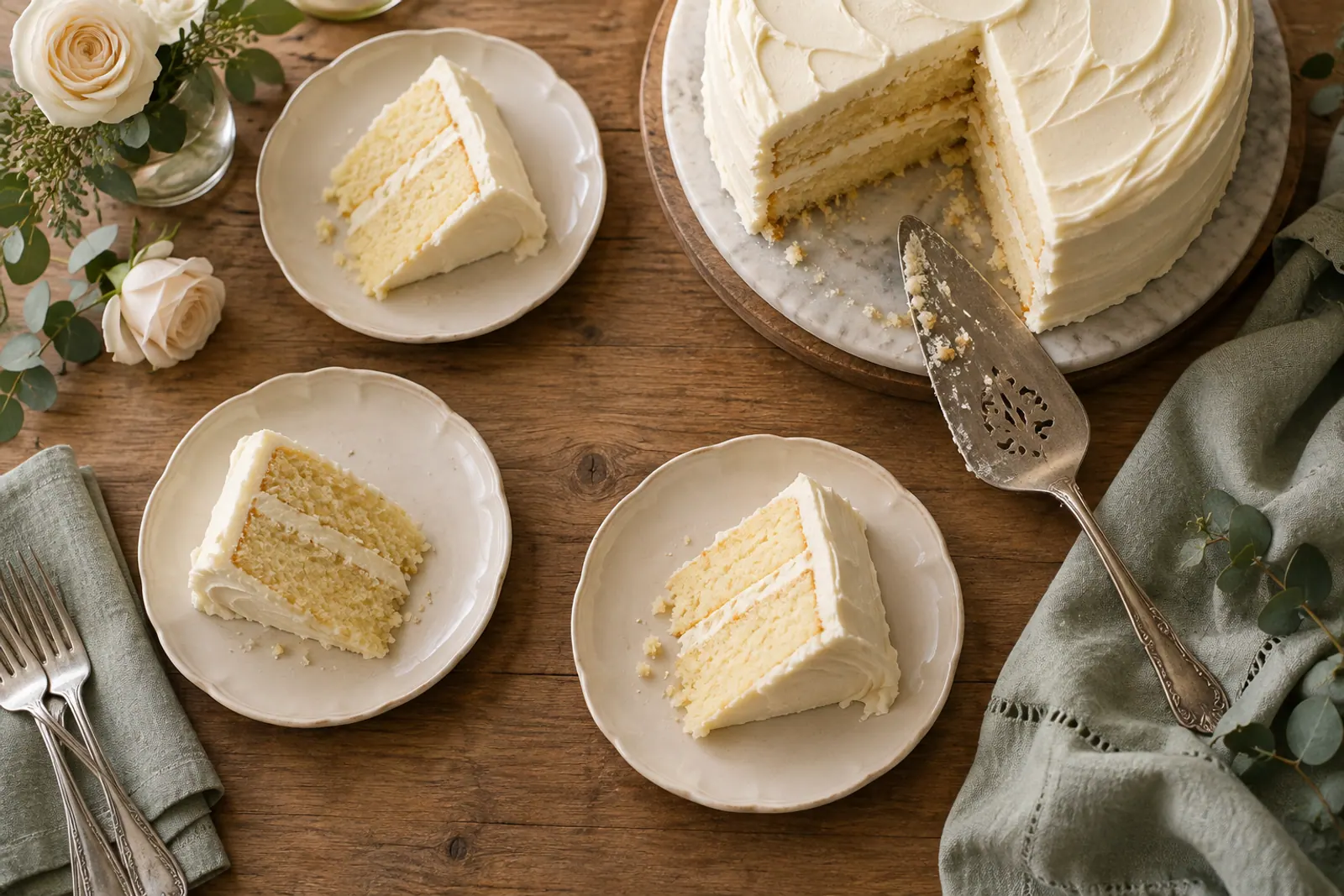
Large wedges can be awkward on small plates, particularly on a tall cake. Choose plates and a server that support the slice. A baker may recommend a ring or strip pattern instead. Wilton’s round-cake instructions illustrate a ring method for larger cakes; those counts belong to that method, not to our wedge drawings. Do not combine one chart’s number with another chart’s cuts.
Match the count to the actual guest list
Write down cake eaters, not simply chairs. If twenty guests are attending and four have said they will skip cake, sixteen planned pieces cover one piece for each of the sixteen cake eaters. Any allowance for seconds, damage or a late guest is your separate choice. Record it as extra pieces rather than quietly reducing everyone’s portion.
For a worked example, suppose you need 22 pieces of roughly the larger sheet-cake size. The drawn 13 × 9-inch grid has 24 cells, leaving two above that requirement. This is a comparison of planned cuts, not proof that every real cake will yield 24 intact pieces. If the baker’s actual edible dimensions, filling or preferred slice size differ, confirm a different order.
Do not count supporting boards, pillars or an inedible display tier as cake. Ask the bakery which tiers are edible and how to remove supports. Keep storage and serving instructions with the cake, especially when the filling needs particular handling. For a seated dessert, the formal table-setting guide helps decide which plates and utensils to bring out.
Download the cake cutting cards
The free two-page packet contains the chart, the grid and wedge diagrams, and a small order-and-serving record. Choose US Letter or A4. The diagrams are reference drawings, not full-size cake stencils. Print portrait at actual size; write the cake’s actual measurements and the agreed cuts on the card.
Cake serving questions
How many people does an eight-inch cake serve? In our eight-inch round example, twelve equal 30° wedges make twelve pieces. An eight-inch square cut into a four-by-four grid makes sixteen 2 × 2-inch pieces. Shape, height and the portion you intend to serve matter, so ask for the cutting plan with any quoted count.
How many pieces come from a 9 × 13-inch cake? Our larger plan has six columns and four rows, making 24 pieces with a 2⅙ × 2¼-inch top. Halving those rows gives 48 smaller pieces with a 2⅙ × 1⅛-inch top. These are planned geometric cuts through the edible height.
Can I use the cake pan size? Use it for an early estimate, then measure the finished edible cake. Trimming, rounded corners and the cake’s shape may change the usable dimensions.
Does a taller cake serve twice as many? Not automatically. The same top-view pattern still has the same number of cuts, with taller pieces. Follow the baker’s instructions if supported layers need to be separated.
A cake's serving count belongs to a specific cutting pattern. Use equal rectangular grids for square and sheet cakes, or an explicitly numbered wedge pattern for a round cake, then check the resulting piece against your guests and the actual cake height.
Checklist from this story
0 / 7 ready