# Winter and Christmas Table Setting for Six: A Clear Serving Plan

Set a winter or Christmas dinner table for six with small decorations, three shared bowls, a measured layout and a course-by-course service plan.

Canonical: https://feteandfig.com/stories/winter-dinner-table
Author: Fête & Fig Editorial (https://feteandfig.com/about)
Published: 2026-09-11T00:47:28.000Z
Updated: 2026-10-12T09:00:00.000Z

For a winter table setting that leaves room for dinner, put one small seasonal decoration beside each place and keep the center for **three bowls that guests can pass**. Repeat a cream, slate-blue and natural-wood palette across six settings. The winter detail stays near the plates instead of becoming a centerpiece everyone must reach around.

This proposed plan uses a **60-inch round table for six**, about 152 cm across. It is a different service arrangement from our [fall table with removable decor trays](/stories/fall-table-setting): the winter ornaments can stay in place while three lightweight side dishes circulate. Hot or heavy main dishes are served from a separate surface.

## Put the winter detail at each place

Use six small freestanding wooden stars or other flat-based winter ornaments from your existing decorations. For this drawing, each fits inside a 2-inch-wide footprint and is no more than 2 inches high, about 5 cm in either direction. Use one repeated shape if you have it, or repeat two shapes in alternating places. There are no loose ornaments scattered between the serving bowls.

Pair plain plates with slate-blue napkins and the natural tabletop, or use a cream cloth you already own. A finished 90-inch round cloth gives this particular table a 15-inch drop. Check a different cloth with the [tablecloth calculator](/stories/tablecloth-size-guide); bare wood is a complete option too.

The winter character comes from the small repeated shapes, cool textile color and familiar pieces. A vase, garland, candle cluster or extra layer of plates would change the space available, so none is part of this counted plan. Use existing room lighting to make faces and food easy to see.

## Gather six settings and three shared bowls

The inventory assumes one main plate and a dessert eaten with a fork. Change the utensils if your menu includes soup or another course, then repeat the fit check. The two spare settings remain off the table.

<table>
<caption>Winter table inventory for six diners</caption>
<thead><tr><th scope="col">Piece</th><th scope="col">Gather</th><th scope="col">At the table initially</th></tr></thead>
<tbody>
<tr><th scope="row">Chairs</th><td>6</td><td>6 evenly spaced positions; check legs, arms and movement</td></tr>
<tr><th scope="row">Dinner plates, forks and knives</th><td>8 of each</td><td>6 of each; the drawing uses 10-in plates</td></tr>
<tr><th scope="row">Napkins and water glasses</th><td>8 of each</td><td>6 of each; the illustrated glasses have 2½-in bases</td></tr>
<tr><th scope="row">Dessert plates and dessert forks</th><td>8 of each</td><td>None; bring 6 of each with dessert</td></tr>
<tr><th scope="row">Small reusable winter ornaments</th><td>6</td><td>1 beside each setting, within a 2-in-wide footprint</td></tr>
<tr><th scope="row">Lightweight sharing bowls</th><td>3</td><td>3 with 8-in outside diameters, including any handles</td></tr>
<tr><th scope="row">Clean replacement bowls</th><td>3</td><td>None; keep 3 matching-footprint bowls ready for refills off the table</td></tr>
<tr><th scope="row">Serving utensils</th><td>6</td><td>3 in use, 1 suited to each bowl; 3 clean replacements nearby</td></tr>
<tr><th scope="row">Existing cloth</th><td>1, or none</td><td>Optional; the example 90-in round cloth gives a 15-in drop</td></tr>
</tbody>
</table>

The three bowls are for modest first servings of bread and two cold sides, chosen to suit your meal. A bowl's diameter does not tell you how many portions it holds. Use your recipe or supplier's serving amount, check the actual bowl capacity, and keep refill portions appropriately stored. This is a table plan rather than a menu or food-quantity calculator.

Put water jugs, the main's serving dishes and dessert pieces on a separate surface. The central circle is easier to use when it does not also carry a large jug or a heavy casserole.

## Reserve a thirty-inch serving circle

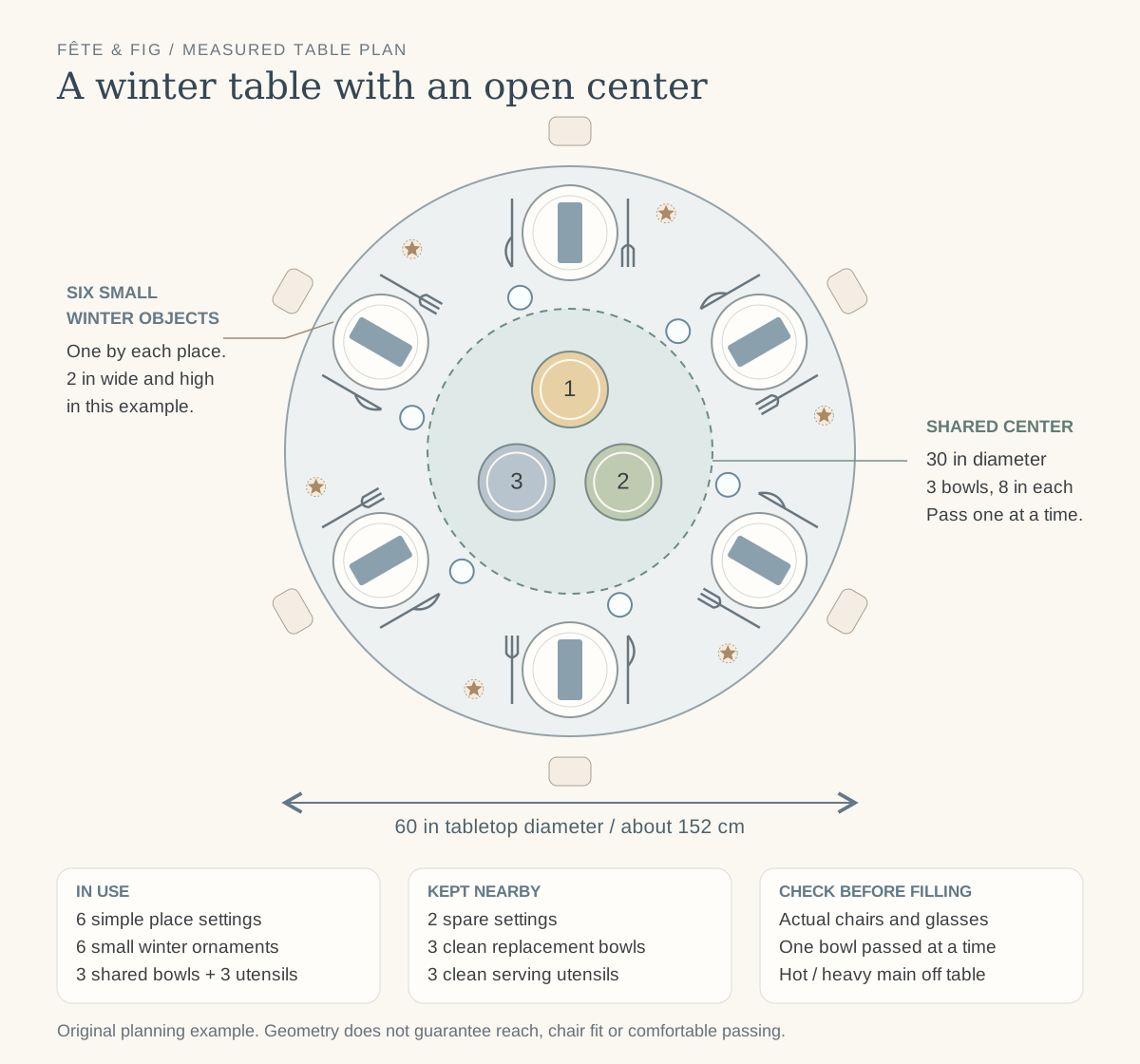
A 15-inch illustrative place-setting allowance around the edge of the 60-inch tabletop leaves a **30-inch-diameter center**, about 76 cm. It is a planning division, not a guaranteed reach zone. Six equal positions are 60 degrees apart; their table-edge arcs are about 31.4 inches, or 80 cm. An arc length is not elbow room or a chair-width standard.

For the drawing, the table center is the origin. The top seat is the first position; the other five follow at 60-degree intervals. Measurements below locate the example pieces consistently without requiring you to copy every position with a ruler.

<figure class="content-diagram" id="winter-table-layout">
  <img src="/images/diagrams/winter-round-table-layout.svg" width="1200" height="1120" loading="lazy" decoding="async" alt="Six settings surround a sixty-inch round tabletop. A thirty-inch central planning circle contains three eight-inch bowls, while one small winter ornament sits near the outer edge beside each place." />
  <figcaption>Original measured example. Bowls and objects are drawn by footprint; chair symbols mark positions rather than required chair sizes. <a href="/images/diagrams/winter-round-table-layout.svg">Open the full-size winter table plan</a>.</figcaption>
</figure>

<table>
<caption>Measurements in the round winter table diagram</caption>
<thead><tr><th scope="col">Element</th><th scope="col">Example geometry</th><th scope="col">Practical check</th></tr></thead>
<tbody>
<tr><th scope="row">Table and serving circle</th><td>60-in tabletop; 30-in central circle after the 15-in edge allowance</td><td>About 152, 76 and 38 cm respectively; actual settings may need more space</td></tr>
<tr><th scope="row">Six dinner plates</th><td>10-in diameters; centers 23 in from the table center, 60° apart</td><td>About 25 cm across and 58 cm from center; use the actual plates</td></tr>
<tr><th scope="row">Six small ornaments</th><td>2-in-wide footprints; centers 27 in from center, 22° clockwise from each plate's radial line</td><td>About 5 cm wide; their outside edges remain 2 in inside the tabletop edge in this drawing</td></tr>
<tr><th scope="row">Three sharing bowls</th><td>8-in diameters; centers 6½ in from center, 120° apart</td><td>About 20 cm across; about 16.5 cm from center. Top bowl first, then lower right and lower left</td></tr>
<tr><th scope="row">Space between bowls</th><td>About 11.3 in between centers, leaving about 3.3 in between 8-in rims</td><td>About 29 and 8 cm respectively; these gaps are calculations, not hand-clearance promises</td></tr>
<tr><th scope="row">Outer reach of the bowl group</th><td>10½ in from center, leaving 4½ in inside the serving-circle boundary</td><td>About 27 and 11 cm; utensils and hands still need a real passing test</td></tr>
</tbody>
</table>

The illustrated plate centers leave space between the central circle and the plates. Put the glasses and cutlery where each diner can actually use them, outside the circle. The drawing shows glasses with 2½-inch bases centered 17 inches from the table center, 18 degrees counterclockwise from the plate line, above the diner's knife. Larger glassware needs another check.

The tiny ornament belongs near the outer edge beside the setting. If a guest's arm, glass or chair movement meets it, move it to the sideboard. Its decorative role does not justify an awkward place setting.

## Test the passing movement with empty bowls

Place the three empty bowls in the center before filling them. Sit at all six places and try passing one bowl to a neighbor. Keep a steady hold until the other person has it. The person nearest a bowl can start it around; nobody needs to stretch across the center to claim the farthest dish.

Do not place all three bowls in motion at once. Keep a vacant landing area within the central circle while a bowl is being passed, and return it before starting another. If a filled bowl would be too heavy or awkward, use a smaller serving portion or have the host bring that side to each person. A larger table would not automatically solve the handling problem.

<table>
<caption>A simple service sequence for the round table</caption>
<thead><tr><th scope="col">Stage</th><th scope="col">Dining table</th><th scope="col">Host's task</th></tr></thead>
<tbody>
<tr><th scope="row">Before the meal</th><td>6 settings, 6 small ornaments and the empty bowl positions</td><td>Test every seat and passing movement; keep food stored until service</td></tr>
<tr><th scope="row">Main course</th><td>3 small shared bowls; pass 1 at a time</td><td>Serve the main from the sideboard and help with any awkward bowl</td></tr>
<tr><th scope="row">Refills</th><td>Remove the used serving bowl before replacing it</td><td>Bring a clean, freshly filled bowl; do not top up food already in the used dish</td></tr>
<tr><th scope="row">Dessert</th><td>Clear dinner dishes and all 3 sharing bowls; bring 6 dessert settings</td><td>Store suitable leftovers promptly and keep the remaining pieces off the table</td></tr>
</tbody>
</table>

The fresh-dish refill method follows [FDA's home-buffet guidance](https://www.fda.gov/food/buy-store-serve-safe-food/serving-safe-buffets). Keep cold refills refrigerated and use the food's actual storage instructions. If the meal needs several large serving pieces or frequent replenishment, use the [wall-side or island buffet plans](/stories/buffet-table-layout) instead of filling this circle beyond its purpose.

For a hot drink after dinner, move service away from the shared bowls. The [hot chocolate bar guide](/stories/hot-chocolate-bar-ideas) counts complete cup pours from actual batch capacity and gives the host a refill log. Its hot-service plan is separate from this seated table arrangement.

## Adapt this layout for Christmas dinner

A **Christmas table setting** can use the same six places and small reusable stars. Change the menu and service order deliberately before adding festive pieces: a starter, hot main and dessert need a different clearing sequence from one main plate and a fork dessert.

The example below adds **eight starter plates and eight starter forks** to the existing inventory: six are used and two remain as spares. It uses one additional main serving dish with a suitable utensil on the sideboard. These are proposed equipment counts; check your actual menu, dish weight and surface protection rather than treating them as a complete Christmas menu.

<table>
<caption>A Christmas course sequence using the same six-seat layout</caption>
<thead><tr><th scope="col">Stage</th><th scope="col">Dining table</th><th scope="col">Off-table task</th></tr></thead>
<tbody>
<tr><th scope="row">Arrival</th><td>6 water glasses, napkins and small stars; no food display</td><td>Have the starter pieces, main plates and clean replacement bowls ready.</td></tr>
<tr><th scope="row">Starter</th><td>6 starter plates and starter forks; leave the bowl circle clear</td><td>Keep 2 spares of each starter piece nearby.</td></tr>
<tr><th scope="row">Main</th><td>Clear all starter pieces; bring 6 dinner plates, forks and knives, then the 3 small sharing bowls</td><td>Serve the main from the sideboard; use clean bowls for refills.</td></tr>
<tr><th scope="row">Dessert</th><td>Clear dinner pieces and all 3 bowls; bring 6 dessert plates and forks</td><td>Store suitable leftovers and keep 2 spare dessert settings off-table.</td></tr>
<tr><th scope="row">Coffee afterward</th><td>Clear used dessert pieces before placing any cups</td><td>Run the <a href="/stories/coffee-bar-ideas-for-party">coffee service plan</a> at a separate station; carry cups only when the route is clear.</td></tr>
</tbody>
</table>

Do not stack the starter and dinner plates just to make the arrival table look fuller. Extra glasses, crackers or gift parcels need a new footprint check. Keep a cracker or small gift at a separate arrival place and bring it over at the agreed moment if it crowds the water glass or passing route. Leave garlands and candle groups off this counted layout rather than assuming they fit inside the food circle.

Tell guests whether they are invited for the whole meal or coffee afterward using the [holiday dinner invitation adaptations](/stories/dinner-party-invitation-wording#adapt-the-opening-for-a-holiday-dinner). For a standing Christmas gathering, use the [cocktail food and refill plan](/stories/cocktail-party-food-ideas) instead of stretching this seated arrangement into a buffet.

## Return the pieces to everyday use

The winter objects can return to a shelf after the meal. Wash and store the three bowls as ordinary serving pieces, and use the plain napkins without the ornaments for another dinner. There is no centerpiece assembly to pack away intact.

For a different guest count or table shape, begin with your furniture and [the general seating checks](/stories/dinner-table-for-eight). Do not squeeze another setting into this six-person drawing or multiply its dimensions by a guest-count ratio. The useful part to reuse is the decision: small personal decoration outside a clearly reserved serving area.

## Images from this guide

![Six ivory plates and slate-blue napkins around an oak table, with six small wooden stars and three central serving bowls.](https://feteandfig.com/images/winter-dinner-table-round-table-for-six-1600.webp)

Keep the winter details at each place and reserve the center for small shared dishes. AI-created styling concept.

![A small wooden star beside an ivory plate, slate-blue linen napkin, fork, knife and water glass on an oak table.](https://feteandfig.com/images/winter-dinner-table-wooden-star-setting-1600.webp)

One small reusable ornament adds winter detail without filling the center. AI-created styling concept.

![Three empty ivory serving bowls with clean serving utensils and folded slate-blue napkins on an oak console.](https://feteandfig.com/images/winter-dinner-table-clean-serving-bowls-1600.webp)

Choose the actual bowls and utensils before testing how they pass between seats. AI-created styling concept.
