# Soup Bar Ideas: Two Offers, Measured Bowls and a Hot-Service Plan
Plan a two-soup bar for twelve from guest choices, measured ladle portions and real pack yields, with hot-holding jobs, printable host sheets and a shopping CSV.
Canonical: https://feteandfig.com/stories/soup-bar-ideas
Author: Fête & Fig Editorial (https://feteandfig.com/about)
Published: 2026-10-08T21:30:00.000Z
Updated: 2026-10-08T21:30:00.000Z
Practical **soup bar ideas** need a plan for the second bowl as well as the first. Choose two offers, ask about first choices and use the actual ladle, bowl and pack yields to count what will be prepared. A sideboard full of attractive pots does not tell you their usable capacity or whether the soup stays hot.
This is a worked **seated indoor lunch for twelve**, with bread and a suitable simple side. It uses host-chosen quantities rather than a universal appetite rule. The soup can come from a recipe you use successfully or a prepared product with known directions; this guide does not supply or claim to have tested soup recipes.
## Give each offer a clear job
Choose two genuinely different offers that you can prepare and hold with the equipment available. A tomato-based vegetable soup and a lentil-based soup are possible menu descriptions, but their actual ingredients and suitability depend on the recipe or product. Keep complete information available and agree on suitable meals directly with guests who need them.
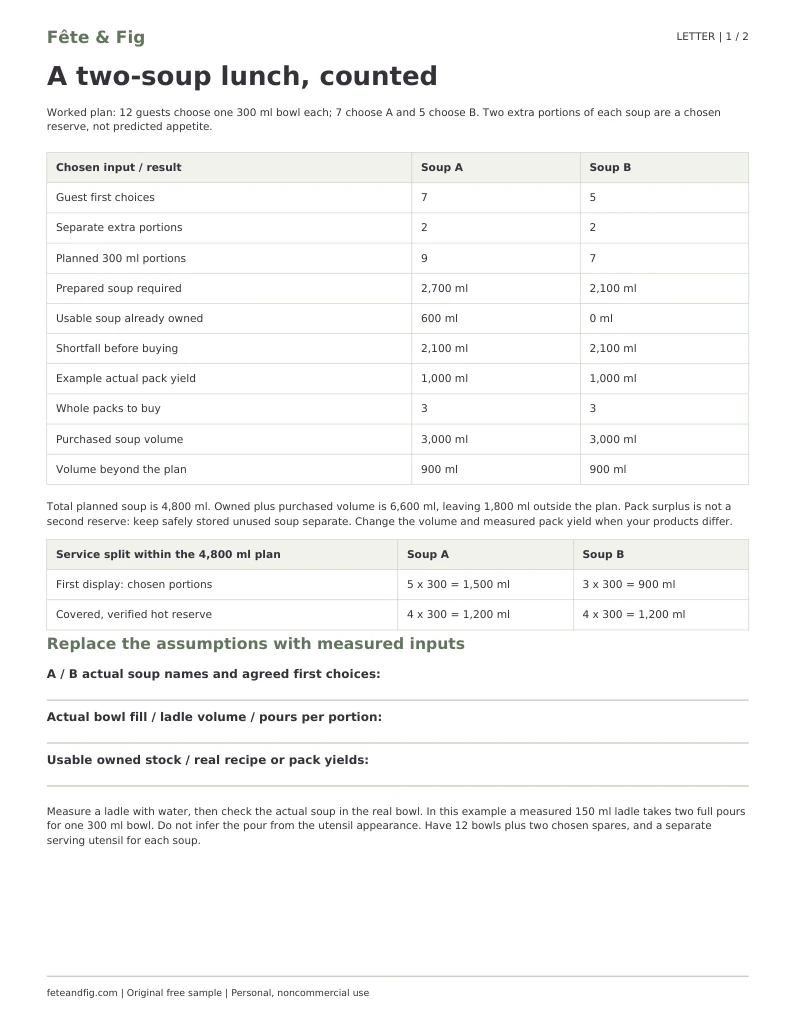
Ask which soup each person expects to choose first. Here, **seven choose Soup A and five choose Soup B**. The host chooses **two additional 300 ml portions of each** for second helpings or a preference change. Those four spare portions are a stated allowance; they do not guarantee that every possible change will be covered.
If the event is a tasting, choose a smaller actual serving and count the number of tastes instead. If it is a main meal, check the complete meal rather than treating a small soup sample and a bread roll as a replacement dinner. For other seated meals, the [dinner menu comparison](/stories/dinner-party-menu-ideas) retains its separate menus and kitchen checks.
## Measure the ladle and bowl
Use water to measure several full pours from the real ladle. Repeat the motion you will use in service, then check the actual soup because solids, thick texture and ladle fill can change the portion. Do not infer milliliters from a photograph or a nominal utensil description.
The worked example uses a **measured 150 ml ladle**, two full pours per bowl and a **chosen 300 ml portion**. Pour that amount into the actual bowl, leaving comfortable carrying space below its rim. Choose another bowl or portion if the fit is poor. A full-to-the-brim capacity is not the same as a working serving.
For twelve guests, this example keeps **fourteen bowls and fourteen spoons** available: twelve places and two chosen replacements. If second helpings require a clean bowl each time, count those separately. Give each soup its own clean serving ladle and resting dish; guest spoons do not go into the shared pots.
## Count the reserve once
Worked 300 ml portion plan for twelve guests
Input or result
Soup A
Soup B
Guest first choices
7
5
Chosen additional portions
2
2
Planned complete portions
9
7
Prepared volume needed
2,700 ml
2,100 ml
Usable prepared stock already owned
600 ml
0 ml
Volume still needed
2,100 ml
2,100 ml
The combined planned volume is **4.8 L**, including the four spare portions. Count owned soup only when you know it is usable and has been stored and handled appropriately. Do not subtract an uncertain leftover simply because there is a container in the refrigerator.
For the shopping example, each actual pack supplies **1,000 ml of ready-to-serve soup**. Each 2,100 ml shortfall needs three whole packs. Soup A then has 600 ml owned plus 3,000 ml bought; Soup B has 3,000 ml bought. Each has **900 ml beyond the plan**, for **1.8 L of total package surplus**. This surplus is separate from the spare portions already counted; leave safely stored unused product out of the prepared service.
If a pack is concentrated, use the ready-to-serve yield after following its directions. If making soup, use the recipe's verified finished yield and round up to whole batches. Use the [party food calculator](/stories/party-food-calculator) for bread or other counted side supplies; the soup worksheet keeps liquid volumes in milliliters.
## Match the first display to the working vessels
The example begins with **1.5 L of A and 0.9 L of B**, or five and three chosen portions. The remaining planned soup is **1.2 L of each**. First display plus reserve still equals 2.7 L of A and 2.1 L of B; nothing is added a second time.
Check the actual appliance or serving vessel's instructions and working fill before accepting those quantities. A pot's maximum brim volume says little about a safe ladle motion, a fitted lid or the warmer's minimum fill. Reduce the display batch or choose another arrangement if the real equipment cannot support it.
Keep bowls, soup choices and bread in a simple serving order, with seating ready for the hot bowls. Keep drinks and used-bowl returns apart from the pouring point. The [buffet table layout guide](/stories/buffet-table-layout) handles measured wall and island routes; apply its space checks to the actual vessels here.
## Assign the heat and refill jobs
Name one soup host to handle the hot pots, ladles and thermometer, with an agreed refill owner. Record the actual batch, check time, temperature and action. A warm-looking pot, steam or a decorative vessel does not confirm safe holding.
[FDA buffet guidance](https://www.fda.gov/food/buy-store-serve-safe-food/serving-safe-buffets) calls for hot food at **140 F / 60 C or above** and cold food at **40 F / about 4 C or below**. Verify with a food thermometer and replace nearly empty containers with fresh ones instead of topping up old soup. Follow the appliance's instructions for its permitted contents and supervision.
For cooled cooked soup, use an agreed reheating route before it enters hot service. [USDA FSIS reheating guidance](https://ask.fsis.usda.gov/article/What-methods-of-reheating-food-are-safe) specifies **165 F / about 74 C** for leftovers and bringing soups to a boil. A slow cooker, chafing dish or steam table used only to hold food is not a shortcut for reheating cooled leftovers.
If all reserve soup is being held hot, confirm that the reserve equipment also maintains the required temperature. If reserve is refrigerated, its reheating job needs time, space and a named owner; it is not immediately ready to pour because the display pot has run low.
## End service with a clear cooling plan
Discard perishables outside safe hot or cold holding for more than **two hours**, or **one hour when the air is above 90 F / about 32 C**. Count preparation and transport as part of the elapsed time; refrigerating again does not reset it. [FDA time guidance](https://www.fda.gov/food/buy-store-serve-safe-food/serving-safe-buffets).
For soup that remains usable, divide it into shallow containers and refrigerate promptly, following the product or recipe's relevant instructions. [USDA leftover guidance](https://ask.fsis.usda.gov/article/How-do-I-handle-leftovers-safely). Record what was actually served and left, so the next gathering can use observed results instead of treating this example as a prediction.
## Download the two-soup host plan
Choose the free **[A4 host plan](/downloads/soup-bar-host-plan-a4.pdf)** or **[US Letter host plan](/downloads/soup-bar-host-plan-letter.pdf)**. Each two-page PDF has the worked quantities and blank measured-input fields, then the heating/holding handoff and eight-row temperature/action log. Print single-sided at 100% or Actual size.
The **[shopping CSV](/downloads/soup-bar-shopping.csv)** contains both offers' guest choices, portions, stock, shortfall, pack rounding, first display and reserve volumes. It is a fixed worked example, with no spreadsheet formulas or automatically saved guest data. Replace its assumptions before shopping for another gathering.
A direct render of the actual Letter host sheet. Its quantities are the worked assumptions explained in this guide.
## Images from this guide

Choose a manageable soup service with a dedicated utensil for each offer. AI-created styling concept; these vessels do not demonstrate safe holding or measured capacity.
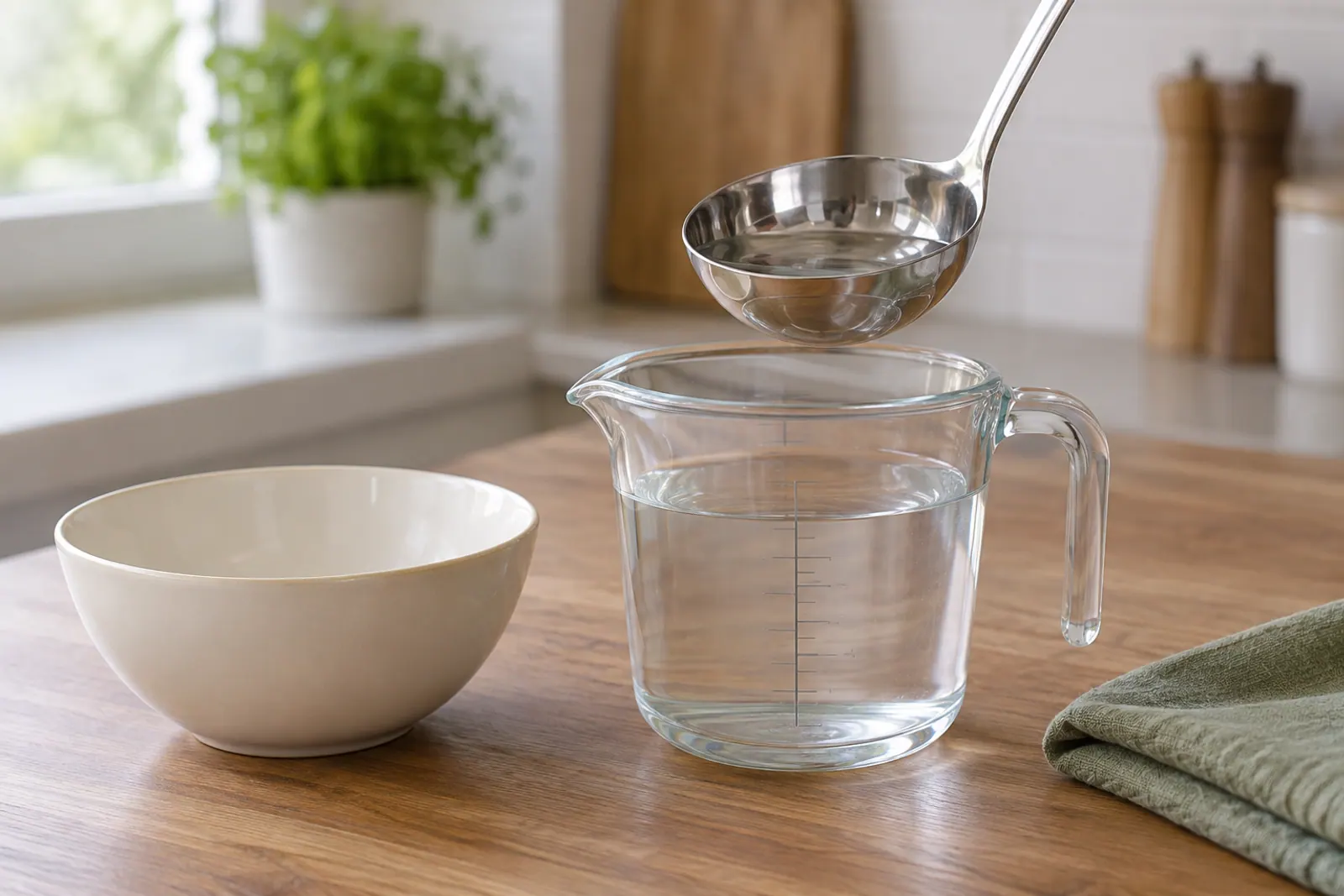
Check the real ladle and bowl before setting the portion. AI-created measuring illustration; the pictured tools do not establish a specific volume.
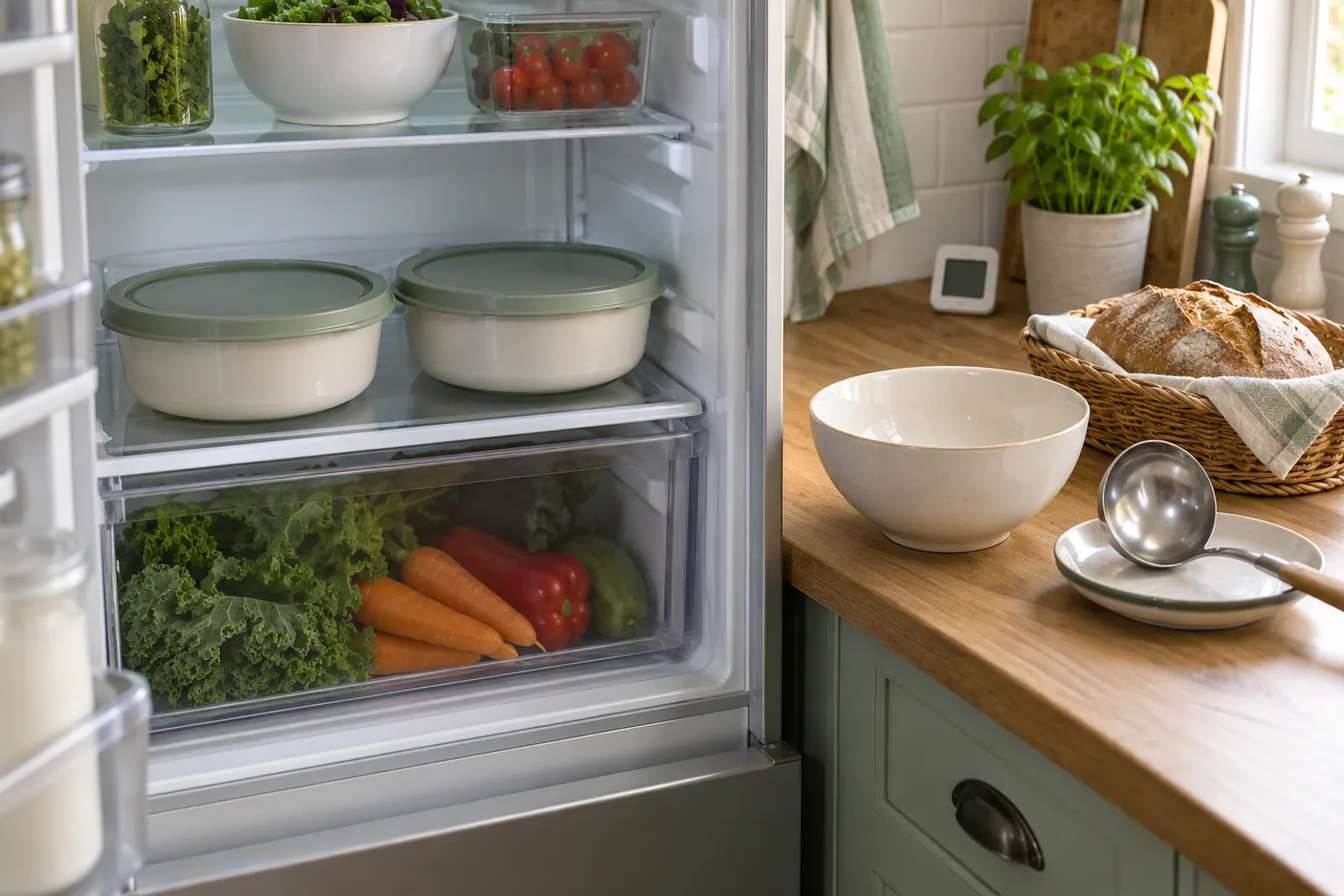
Covered cold reserves need an agreed reheating route before they return to service. AI-created planning illustration, not evidence of the refrigerator temperature.
## Sources and file checks
This is an original worked service plan, not a tested recipe or universal portion rule. The guest split, 300 ml bowls, chosen spare portions and 1 L packs are explicit assumptions. The CSV arithmetic and all four A4/Letter PDF pages were checked and visually inspected; no soup, appliance, event or physical printer trial has been conducted.
- [FDA: Serving Up Safe Buffets](https://www.fda.gov/food/buy-store-serve-safe-food/serving-safe-buffets): Hot and cold holding temperatures, fresh-container refills and the two-hour or one-hour time limits.
- [USDA FSIS: What methods of reheating food are safe?](https://ask.fsis.usda.gov/article/What-methods-of-reheating-food-are-safe): Reheat cooled leftovers to 165 F, bring soups to a boil and use a heating method rather than relying on a holding warmer.
- [USDA FSIS: How do I handle leftovers safely?](https://ask.fsis.usda.gov/article/How-do-I-handle-leftovers-safely): Prompt refrigeration in shallow containers and limiting time outside safe holding.
[How we prepare and check our guides](https://feteandfig.com/editorial-policy)