# Friendsgiving Potluck Planner for 12: Dishes, Owners and One Oven

Plan a Friendsgiving potluck for twelve with a dish sign-up example, portion assumptions, transport checks, one-oven coordination and a printable worksheet.

Canonical: https://feteandfig.com/stories/friendsgiving-potluck-planner
Author: Fête & Fig Editorial (https://feteandfig.com/about)
Published: 2026-09-10T23:33:33.000Z
Updated: 2026-10-08T00:00:00.000Z

A Friendsgiving potluck needs one agreed dish list, one person collecting changes and a kitchen plan that every contributor knows. Assign portions as well as dishes, ask how each contribution will travel, and confirm oven space before anyone promises a casserole.

Use the [potluck worksheet](#potluck-planner) to record ten contributions and five oven reservations. The example below serves **twelve adults, including the hosts**. It is a proposed coordination plan with fictional names and planning portions, not a meal we have cooked or an event we have hosted.

## Set the guest count before assigning food

This example assumes ten people eating turkey and two having a vegetarian main. That is a sample guest list, not an expected split for every gathering. The two vegetarian portions are complete main meals reserved for those guests. Shared sides do not replace them.

Ask contributors to name a dish they can reliably prepare or buy. A household can bring one contribution together, and someone can help with setup instead of food. The table is a way to cover dinner, not a requirement that every person buy the same amount or spend the same sum.

Before accepting a dish, confirm its ingredients and preparation arrangements with anyone who needs an alternative. “Vegetarian” does not resolve every dietary need. Keep that conversation with the relevant people; the shared dish list needs accurate food information, not guests' private details.

## A complete contribution list for twelve

The weights below mean prepared food available to serve. They are shopping and serving assumptions for a meal with several dishes. Contributors should use their chosen recipe or supplier's yield to produce that amount. US weights are rounded equivalents.

<table>
<caption>Illustrative Friendsgiving contribution plan: ten rows, twelve diners</caption>
<thead><tr><th scope="col">Contribution</th><th scope="col">Owner</th><th scope="col">Amount and purpose</th><th scope="col">Arrival or storage plan</th><th scope="col">Bring or reserve</th></tr></thead>
<tbody>
<tr><th scope="row">Turkey</th><td>Morgan, host</td><td>10 main servings, defined by the chosen recipe or supplier</td><td>Prepared at the host's home; the only oven dish</td><td>Suitable roasting and serving pan, carving tools, tongs and food thermometer</td></tr>
<tr><th scope="row">Lentil-and-mushroom stew</th><td>Jamie</td><td>2 full recipe-defined main servings, reserved</td><td>Arrive chilled by T−90; reheat on the stove, then keep hot for service</td><td>Lidded saucepan, ladle and agreed hot-holding equipment</td></tr>
<tr><th scope="row">Mashed potatoes</th><td>Taylor</td><td>1.8 kg / about 4 lb; twelve 150 g side portions</td><td>Arrive hot at T−30 only with confirmed hot transport and holding</td><td>Suitable insulated carrier, preheated warmer and serving spoon</td></tr>
<tr><th scope="row">Roasted squash and grain salad</th><td>Avery</td><td>1.2 kg / about 2⅔ lb; twelve 100 g side portions</td><td>Transport chilled; refrigerate on arrival</td><td>Covered bowl and serving spoon</td></tr>
<tr><th scope="row">Green bean salad</th><td>Sam</td><td>900 g / about 2 lb; twelve 75 g side portions</td><td>Transport chilled; refrigerate on arrival</td><td>Covered bowl and tongs</td></tr>
<tr><th scope="row">Cranberry sauce</th><td>Riley</td><td>360 g / about 13 oz; twelve 30 g condiment portions</td><td>Transport chilled; refrigerate on arrival</td><td>Covered jar or bowl and small spoon</td></tr>
<tr><th scope="row">Plain dinner rolls</th><td>Drew</td><td>18 rolls; one each plus six for seconds</td><td>Bring covered; serve unwarmed</td><td>Bread basket and tongs</td></tr>
<tr><th scope="row">Purchased pies</th><td>Robin</td><td>2 pies labeled for 6 servings each; 12 dessert portions</td><td>Choose pies with clear cold-storage instructions; keep chilled until dessert</td><td>Pie plates, knife and server</td></tr>
<tr><th scope="row">Welcome crackers and olives</th><td>Casey, cohost</td><td>180 g / about 6 oz crackers and 225 g / 8 oz drained olives; light nibbles for twelve</td><td>Set out a small welcome amount; follow package storage instructions</td><td>Ingredient labels, small dishes and an olive spoon</td></tr>
<tr><th scope="row">Water and an alcohol-free drink</th><td>Morgan, host</td><td>6 L water and 2 L sparkling apple drink initially, with refills available</td><td>Prepare a station away from the cooking area</td><td>Jugs, glasses and refill supplies</td></tr>
</tbody>
</table>

The sides provide different amounts on purpose: potatoes are the larger starch portion, the two salads are accompaniments, and cranberry sauce is a condiment. Do not add those serving counts together and call the result extra main meals. If more than two people want the stew, increase its complete portions before shopping.

Choose suitable ingredients for the shared sides, including stock and dressings. Reserve the two stew portions before opening the rest of the buffet. If everyone wants to taste it, plan an additional batch rather than taking food from those two meals.

The pie count relies on a supplier's six-serving yield. If your chosen pies have another size, recalculate the number needed. The drink amounts are a starting station supply, not a limit on what guests may drink.

## Confirm the dish, not just its name

A useful reply includes the **dish, owner, serving count, arrival time, transport method, final kitchen job and serving equipment**. “I'll bring potatoes” leaves most of the work undecided.

Ask for the dimensions of any pan that needs fridge, stove or oven space. Test the actual empty containers where possible, allowing for handles, lids and other food. An oven reservation does not reserve a burner or refrigerator shelf.

For Taylor's potatoes, agree on hot transport and a suitable warmer before accepting that plan. If those are unavailable, arrange a chilled potato salad using the same prepared-weight allowance and confirm fridge space. Make that change before the day; the oven does not become available because a dish arrives needing heat.

For a contributor who cannot cook, suggest the agreed rolls, labeled bakery dessert, drinks or borrowing serving pieces. A specific useful contribution is easier to coordinate than an open request for “anything.”

One host should collect changes and confirm the final list. A short message can do the job:

<blockquote>
<p>Please send me your dish name, serving count, expected arrival time, and any fridge, stove or oven space it needs. Bring its serving utensil and ingredient information. I will confirm the kitchen plan before the menu is final.</p>
</blockquote>

## Reserve one oven without promising cooking times

For the example, **T0 is dinner at 5 p.m.** Most guests arrive from 4:15 p.m. Jamie arrives with the chilled stew by 3:30 p.m. to handle its separate stovetop job. Taylor brings the hot potatoes at 4:30 p.m., under the agreed transport plan. Casey welcomes guests while Morgan attends to the main.

The oven belongs to the turkey throughout preparation and any needed hot holding. Rolls and pies do not get a warming slot. The five rows below describe that reservation and its checks; they are not five different dishes to squeeze into the oven.

<table>
<caption>One-oven coordination example, with T0 at 5 p.m.</caption>
<thead><tr><th scope="col">Reservation</th><th scope="col">Window</th><th scope="col">Oven use</th><th scope="col">Owner and decision</th></tr></thead>
<tbody>
<tr><th scope="row">Setup</th><td>Before the recipe's required start</td><td>Preheat and arrange racks as the chosen instructions require</td><td>Morgan checks the pan, thermometer and instructions before cooking begins</td></tr>
<tr><th scope="row">Turkey only</th><td>Recipe-calculated start to a T−45 target</td><td>Follow the selected recipe or supplier's method and setting</td><td>Morgan calculates the actual start; 4:15 p.m. is an intended finish, not a doneness guarantee</td></tr>
<tr><th scope="row">Readiness and contingency</th><td>T−45 to T−30 target window</td><td>Continue cooking if needed; no guest dish is accepted</td><td>Morgan checks readiness and the recipe's resting or carving sequence; later stages move if needed</td></tr>
<tr><th scope="row">Main hot hold, if needed</th><td>T−30 to T0</td><td>Use suitable holding conditions that keep the food at least 140°F / 60°C</td><td>Morgan checks the food temperature; the oven display alone is not a food reading</td></tr>
<tr><th scope="row">No further reservation</th><td>T0 onward, after main service</td><td>Turn the oven off when it is no longer needed</td><td>Rolls and dessert require no oven finishing</td></tr>
</tbody>
</table>

Choose the turkey recipe or product before filling in the cooking start. Include its preparation, preheating and any required resting sequence. If the instructions do not fit the target, change the start or serving time. Do not shorten the method to satisfy the worksheet.

USDA advises cooking poultry to **165°F / about 74°C**, measured with a food thermometer. Previously cooked leftovers also need to reach that temperature when reheated. Follow the applicable recipe or product instructions alongside the [USDA cooking and reheating guidance](https://www.fsis.usda.gov/food-safety/safe-food-handling-and-preparation/food-safety-basics/leftovers-and-food-safety).

If the main runs late, tell the other food owners before they begin their final service tasks. Keep cold dishes refrigerated and hot dishes under verified temperature control. A planned 5 p.m. dinner is a coordination target, not a reason to serve unfinished food.

Our [dinner menu and one-oven service plan](/stories/elegant-dinner-party-at-home) covers a different situation: one cook preparing a complete pasta dinner. This potluck gives separate contributors defined jobs instead.

## Give every contribution an arrival route

USDA's [food preparation and transport guidance](https://www.fsis.usda.gov/news-events/news-press-releases/food-safety-tips-catered-and-diy-wedding-food) says to keep cold food at **40°F / about 4°C or below**, and hot food at **140°F / 60°C or above** during transport. Pack appropriate cold sources or insulation, and check the food rather than assuming a bag will maintain its temperature.

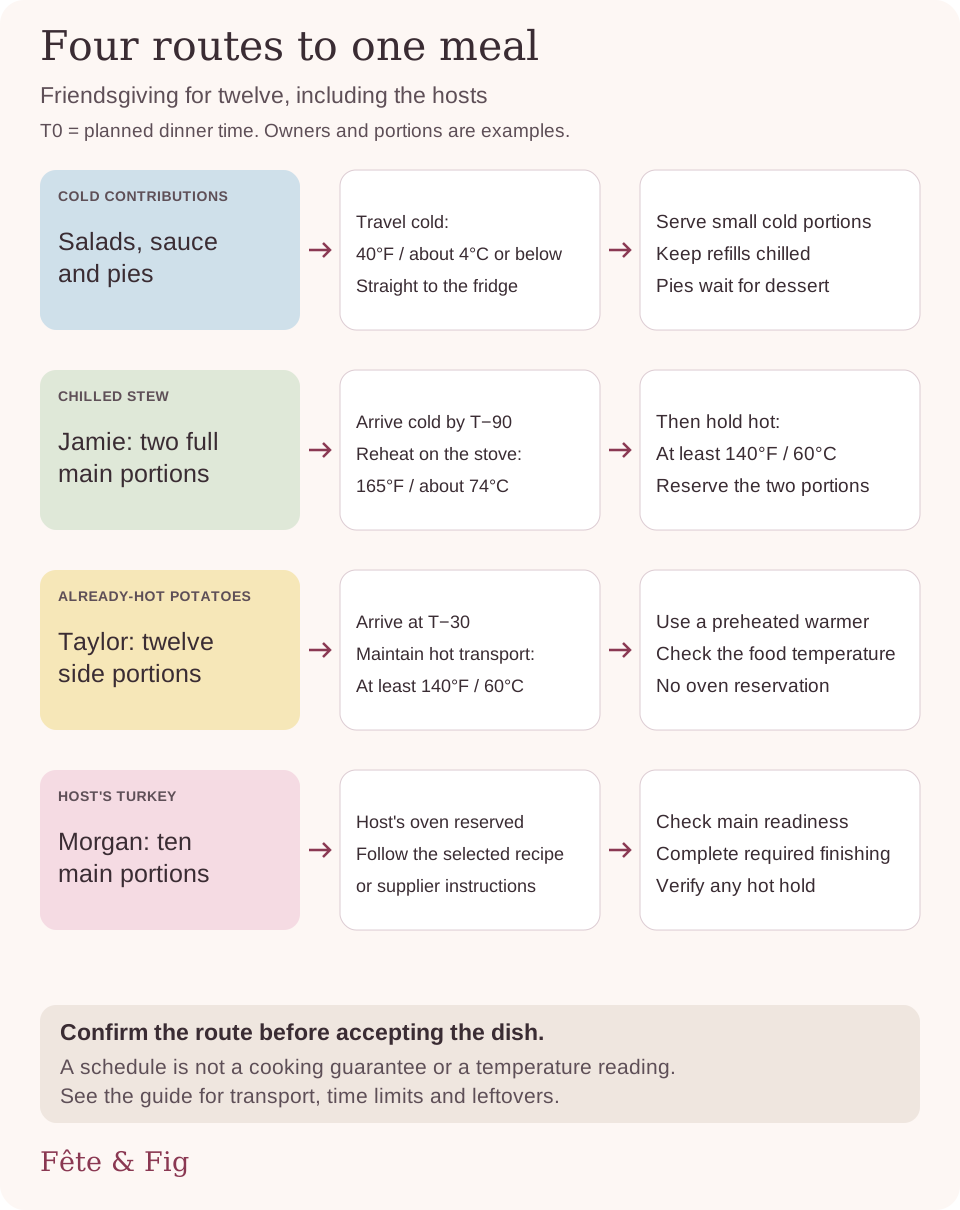
A food's route continues after it reaches the house. Put the chilled salads and pies into their reserved fridge space. Jamie takes the chilled stew to the agreed stove position. Taylor's already-hot potatoes move to suitable preheated holding equipment after their temperature check.

<figure class="content-diagram">
  <img src="/images/diagrams/friendsgiving-potluck-flow.svg" width="960" height="1210" loading="lazy" decoding="async" alt="Friendsgiving arrival routes: cold salads and pies go to the fridge, chilled stew is reheated on the stove, hot potatoes go to verified hot holding, and the host's oven stays reserved for turkey." />
  <figcaption>Original coordination diagram. These routes depend on the actual food, instructions and temperature checks. The same steps and limits appear in the table below. <a href="/images/diagrams/friendsgiving-potluck-flow.svg">Open the full-size potluck flow</a>.</figcaption>
</figure>

<table>
<caption>Four routes from preparation to the Friendsgiving table</caption>
<thead><tr><th scope="col">Food route</th><th scope="col">On arrival or at home</th><th scope="col">Before serving</th></tr></thead>
<tbody>
<tr><th scope="row">Chilled salads, sauce and pies</th><td>Transport at 40°F / about 4°C or below; move to the fridge</td><td>Bring small cold portions out at their course; keep refills chilled</td></tr>
<tr><th scope="row">Chilled lentil-and-mushroom stew</th><td>Jamie arrives by T−90; keep cold until the assigned stove is ready</td><td>Reheat to 165°F / about 74°C, then hold at least 140°F / 60°C; reserve two full portions</td></tr>
<tr><th scope="row">Already-hot mashed potatoes</th><td>Taylor arrives at T−30 using a plan that maintains at least 140°F / 60°C</td><td>Move to suitable preheated holding equipment; verify that the food stays hot</td></tr>
<tr><th scope="row">Host's turkey</th><td>Morgan follows the selected recipe or supplier instructions in the reserved oven</td><td>Check readiness, complete the required finishing sequence, and verify any hot hold</td></tr>
</tbody>
</table>

Reheating and holding are different jobs. [USDA advises against reheating leftovers in a slow cooker](https://ask.fsis.usda.gov/article/Can-you-reheat-leftovers-in-a-slow-cooker). Heat previously cooked food to 165°F on the stove, in an oven or in a microwave first; a suitable preheated slow cooker can then hold it at least 140°F. For this plan, Jamie uses the stove for reheating, so the host's oven stays free for turkey.

Check each warmer's capability and the food temperature. If a food arrives outside its agreed temperature conditions, do not automatically put it on the buffet or assume reheating fixes an unknown handling history. Establish how long it was outside temperature control and apply the time limits below; discard food that has exceeded them.

## Serve the meal before extending the buffet

Count fourteen dinner plates, forks, knives, napkins and water glasses: twelve places plus two spares. Add fourteen dessert plates and forks, and small bowls and spoons for the two stew portions. Confirm that each contributor's utensil arrives with the dish. Put a clean replacement serving dish near each perishable food's storage position.

Serve the two reserved main portions first or set them aside clearly for their diners. Let the remaining guests collect turkey and shared sides in a simple line: plates, main, potatoes, salads, sauce and bread. Keep drinks elsewhere. The [table setup guide](/stories/dinner-table-for-eight) shows how to check individual place settings; measure your actual twelve-person arrangement rather than copying its eight-seat layout.

Casey can watch drinks and the guest route while the food owners manage their dishes. Leave pie refrigerated until the dinner dishes are cleared. If the group wants a toast or a round of thanks, choose a pause that does not pull someone away from a cooking or food-storage job.

For seasonal decoration, the [fall table setting guide](/stories/fall-table-setting) keeps small arrangements on removable trays. Its measured example seats eight; use the styling idea with your own twelve-person layout and check the space again.

The [FDA's buffet guidance](https://www.fda.gov/food/buy-store-serve-safe-food/serving-safe-buffets) recommends hot holding at least 140°F and cold holding at 40°F or below. Replace serving dishes with clean, replenished ones instead of topping up food already on the table. Discard perishables left without temperature control for more than two hours, or one hour when the temperature is above 90°F / about 32°C.

Track time outside temperature control across preparation, travel and service. Arrival at the house does not give a dish a fresh two-hour allowance. A contribution list is useful for responsibilities; it is not a food-safety log or a thermometer.

## Close with food storage and container returns

Gather shallow containers, lids and labels before dinner. After the meal, have one person help portion suitable leftovers while another checks containers against their owners. Cut large portions into smaller pieces for prompt refrigeration instead of leaving a large pan on the counter to cool completely.

USDA recommends using refrigerated leftovers within **three to four days**, or freezing them. Follow any stricter product instructions and keep the original preparation date in mind; the party date does not make older food newly cooked. See [USDA's leftovers storage guidance](https://www.fsis.usda.gov/food-safety/safe-food-handling-and-preparation/food-safety-basics/leftovers-and-food-safety).

Only send perishable leftovers home when the recipient can maintain suitable transport and storage. A lidded container does not supply temperature control. It is fine to keep food refrigerated for an agreed collection or discard it when its safe handling cannot be established.

Return labeled dishes, serving spoons and borrowed warmers before packing decorations. Record one useful adjustment for the next potluck: which dish had too much, whose arrival needed more time, or which container did not fit the fridge.

A cookie exchange is a different contribution job: guests take home portions rather than bringing dishes for this meal. Use the [cookie exchange calculator](/stories/cookie-exchange-party) to count each baker's shares, tasting cookies and packages without copying the potluck portion assumptions.

## Fill in, print or export your plan

The [worksheet below](#potluck-planner) has ten contribution rows and five oven rows. Load the fictional example to see the format, then replace its names, quantities and timings with your agreed plan. Confirm recipes and equipment separately; the worksheet does not calculate cooking times or decide whether food is safe.

Your entries stay in this browser when local storage is available. This is one editable host copy, not a shared sign-up service. Export the dish list and oven reservations as separate CSV files, or send a printed copy to contributors, and ask one person to collect changes. Printing and exporting create snapshots, so confirm which version is current after an update.

The [Friendsgiving potluck print sheet](/printables/friendsgiving-potluck-planner) uses the saved plan in this browser. Check it before printing or saving as PDF, and keep the main guide available for the transport and service notes.

Plan the [food quantities](/stories/party-food-calculator) from your chosen portions and recipe yields, then choose an optional [Friendsgiving game](/stories/friendsgiving-games) after the meal.

## Images from this guide

![Roast turkey, squash-and-grain salad, cranberry sauce and bread rolls on an oak sideboard, with drinks on a separate cart.](https://feteandfig.com/images/friendsgiving-potluck-planner-turkey-service-1600.webp)

Give the shared dishes their own service area and keep drinks on a separate route. AI-created styling concept.

![Two individual bowls of mushroom-and-lentil stew with separate spoons, beside a closed pot and ladle.](https://feteandfig.com/images/friendsgiving-potluck-planner-reserved-stew-bowls-1600.webp)

Set aside the agreed main portions before opening the shared food line. AI-created styling concept.

![Two sealed salad containers between ice packs in a sage cooler, with wrapped serving utensils and a food thermometer.](https://feteandfig.com/images/friendsgiving-potluck-planner-chilled-arrival-kit-1600.webp)

Agree on transport equipment and check the food before moving it into storage. AI-created styling concept.


## Friendsgiving potluck worksheet

[Open the editable worksheet](https://feteandfig.com/stories/friendsgiving-potluck-planner#potluck-planner) or [open the printable worksheet](https://feteandfig.com/printables/friendsgiving-potluck-planner). Entries save in this browser only; the worksheet does not sync between guests or devices.

Guest count, including hosts: __________

### Blank dish assignments

| Row | Dish | Person bringing it | Planned servings | Arrival | Transport and holding plan | Equipment needed |
| --- | --- | --- | --- | --- | --- | --- |
| 1 |  |  |  |  |  |  |
| 2 |  |  |  |  |  |  |
| 3 |  |  |  |  |  |  |
| 4 |  |  |  |  |  |  |
| 5 |  |  |  |  |  |  |
| 6 |  |  |  |  |  |  |
| 7 |  |  |  |  |  |  |
| 8 |  |  |  |  |  |  |
| 9 |  |  |  |  |  |  |
| 10 |  |  |  |  |  |  |

### Blank oven reservations

Write the actual recipe requirements and allow for preheating, loading and checking. A reservation does not establish that a dish is cooked or reheated safely.

| Slot | Dish and oven space | Time window | Oven setting | Responsible person |
| --- | --- | --- | --- | --- |
| 1 |  |  |  |  |
| 2 |  |  |  |  |
| 3 |  |  |  |  |
| 4 |  |  |  |  |
| 5 |  |  |  |  |

### Illustrative example for 12

Illustrative plan for 12 adults, including hosts: 10 turkey eaters and 2 vegetarian eaters. T0 means a planned 5 p.m. dinner. Confirm every recipe yield and equipment arrangement. Oven windows are reservations, not cooking instructions or readiness guarantees.

| Row | Dish | Person bringing it | Planned servings | Arrival | Transport and holding plan | Equipment needed |
| --- | --- | --- | --- | --- | --- | --- |
| 1 | Roast turkey | Morgan (host) | 10 main portions; confirm recipe or supplier yield | Prepared at host home | Host oven only. Follow the chosen recipe and thermometer checks; record the carving and serving plan. | Roasting pan, covered serving pan, tongs, thermometer |
| 2 | Lentil and mushroom stew | Jamie | 2 full main portions, reserved for vegetarian guests | 3:30 p.m. (T minus 90 minutes) | Transport chilled at 40°F or below. Reheat on the stove to 165°F, then hold at 140°F or above. Confirm fridge and burner space. | Lidded saucepan, ladle, thermometer, agreed hot-hold equipment |
| 3 | Mashed potatoes | Taylor | 1.8 kg / about 4 lb; twelve 150 g side portions | 4:30 p.m. (T minus 30 minutes) | Only bring hot with verified transport and holding at 140°F or above. Bring a suitable preheated warmer. If unavailable, agree a chilled potato-salad swap in advance. | Suitable warmer, spoon, thermometer; confirm outlet |
| 4 | Roasted squash and grain salad | Avery | 1.2 kg / about 2 2/3 lb; twelve 100 g side portions | 4:15 p.m. | Transport chilled at 40°F or below and refrigerate on arrival. No oven finishing. | Covered bowl, serving spoon; confirm fridge shelf |
| 5 | Green bean salad | Sam | 900 g / about 2 lb; twelve 75 g side portions | 4:15 p.m. | Transport chilled at 40°F or below and refrigerate on arrival. | Covered bowl, tongs; confirm fridge shelf |
| 6 | Cranberry sauce | Riley | 360 g / about 13 oz; twelve 30 g condiment portions | 4:15 p.m. | Transport chilled; follow the recipe or label for storage. Put out a small dish at mealtime. | Jar or bowl, serving spoon |
| 7 | Plain dinner rolls | Drew | 18 rolls: one each plus six extra | 4:15 p.m. | Serve unwarmed. Follow storage instructions; no oven reservation. | Covered bread basket, tongs |
| 8 | Two purchased pies | Robin | Two pies labelled six servings each: 12 portions | 4:15 p.m. | Follow supplier directions for cold transport and storage. No oven finishing. | Pie plates, knife, server; confirm fridge space if needed |
| 9 | Welcome crackers and olives | Casey (cohost) | 180 g / about 6 oz crackers; 225 g / 8 oz drained olives | Prepared at host home | Light nibbles for 12. Follow storage instructions and label the dishes. | Tray, small bowl, spoon, ingredient labels |
| 10 | Water and sparkling apple drink | Morgan (host) | 6 L water plus 2 L apple drink initially; refills ready | Prepared at host home | Initial station supply, not a per-person drinking requirement. Keep drink ice separate from food transport and arrange refills. | Jugs, glasses, drink cooler, ice scoop |

| Slot | Dish and oven space | Time window | Oven setting | Responsible person |
| --- | --- | --- | --- | --- |
| 1 | Setup: preheat and capacity check | Before recipe start to recipe start | Follow chosen instructions; check pan fit | Morgan |
| 2 | Turkey only; whole oven | Recipe-calculated start to T minus 45 target; confirm duration | Chosen recipe or supplier instructions; target is not a cooking guarantee | Morgan |
| 3 | Readiness check and contingency; no guest dish | T minus 45 to T minus 30; extend if needed | Continue cooking if needed. Delay dinner if the main is not ready. | Morgan |
| 4 | Main hot hold, if needed | T minus 30 to T0 | Food at least 140°F / 60°C; verify food temperature, not just oven setting | Morgan |
| 5 | No further reservation | T0 onward, after main service | Off when no longer needed; rolls and dessert need no oven finishing | Morgan |
