# Simple Dessert Table Ideas: 3 Layouts for 8 or 12

Plan a simple dessert table for 8 or 12 with three measured layouts, portion counts, shopping lists and free printable setup and refill sheets.

Canonical: https://feteandfig.com/stories/dessert-table-ideas
Author: Fête & Fig Editorial (https://feteandfig.com/about)
Published: 2026-09-11T11:24:46.000Z
Updated: 2026-10-16T22:19:09.000Z

The most useful **dessert table ideas** begin with three decisions: how much dessert each guest will be offered, which serving pieces fit your surface, and what stays in reserve. Choose those before adding flowers or a backdrop. A pair of low platters can look finished without buying a tower of stands.

Below are three complete examples: cake and cookies after dinner for eight, a mini-treat table for twelve shower guests, and a narrow console serving twelve in two small batches. The quantities are our planning examples, not tested appetite rules. Check your actual dessert sizes and whether guests have eaten a meal. The photographs are AI-created styling concepts; the measured drawings and tables carry the specifications.

## Choose the table that suits the gathering

Pick **A** for a small dinner, **B** for light sweet refreshments at a shower, or **C** when a narrow surface is the main constraint. B does not provide a full lunch. If the invitation overlaps a meal, serve one and adjust the dessert plan to the menu.

<table>
<caption>Three dessert setups, with different jobs</caption>
<thead><tr><th scope="col">Plan</th><th scope="col">Guests and context</th><th scope="col">Example surface</th><th scope="col">Food offered per guest</th><th scope="col">Main preparation check</th></tr></thead>
<tbody>
<tr><th scope="row">A: two familiar sweets</th><td>8, after dinner</td><td>48 × 18 in, about 122 × 46 cm</td><td>1 normal loaf-cake slice and 1 cookie</td><td>Slice the actual loaf into eight appropriate servings</td></tr>
<tr><th scope="row">B: a small selection</th><td>12, light shower refreshments</td><td>60 × 24 in, about 152 × 61 cm</td><td>1 mini cupcake, 1 brownie bite and 1 cookie</td><td>Small pieces are not full-size bakery portions</td></tr>
<tr><th scope="row">C: two small displays</th><td>12, after a meal</td><td>36 × 18 in, about 91 × 46 cm</td><td>1 small chilled dessert cup and 1 cookie</td><td>Fit both cup trays in the refrigerator before service</td></tr>
</tbody>
</table>

Keep your chosen plan beside you with the free [A4 layout sheets](/downloads/dessert-table-layout-plans-a4.pdf) or [US Letter layout sheets](/downloads/dessert-table-layout-plans-letter.pdf). Plan A is page 1, B is page 2 and C is page 3; print just the page you need. Each includes the layout, first display, reserve and refill notes.

“Small” can mean few guests or little surface area. C has the narrowest table but serves the same twelve people as B. It needs a named refill person. A slightly larger table will not help if it blocks a door or makes the far platter hard to reach.

For a full main-course buffet, use the separate [buffet table layout guide](/stories/buffet-table-layout). Here the task is choosing and displaying the sweet course.

## How many desserts do you need?

Count **serving units**, not just trays. In these examples a slice is one slice, a brownie bite is one bite, and a cup is one small individual dessert. They are not equal in size. Do not turn “three mini treats” into a rule that every guest needs three full-size desserts.

<table>
<caption>Planned food, first display and reserve</caption>
<thead><tr><th scope="col">Plan</th><th scope="col">Dessert</th><th scope="col">Planned total</th><th scope="col">Put out first</th><th scope="col">Keep in reserve</th></tr></thead>
<tbody>
<tr><th scope="row">A, 8 guests</th><td>Loaf-cake slices</td><td>8</td><td>8</td><td>0</td></tr>
<tr><th scope="row">A, 8 guests</th><td>Shortbread cookies</td><td>8</td><td>8</td><td>0</td></tr>
<tr><th scope="row">B, 12 guests</th><td>Mini cupcakes</td><td>12</td><td>12</td><td>0</td></tr>
<tr><th scope="row">B, 12 guests</th><td>Brownie bites</td><td>12</td><td>6</td><td>6</td></tr>
<tr><th scope="row">B, 12 guests</th><td>Shortbread cookies</td><td>12</td><td>6</td><td>6</td></tr>
<tr><th scope="row">C, 12 guests</th><td>Chilled dessert cups</td><td>12</td><td>6</td><td>6</td></tr>
<tr><th scope="row">C, 12 guests</th><td>Shortbread cookies</td><td>12</td><td>6</td><td>6</td></tr>
</tbody>
</table>

That gives A **16 items**, B **36 mini treats**, and C **24 items**. B begins with 24 of its 36 treats; C begins with 12 of its 24 items. The reserve is part of the planned food, not an extra order on top.

For a different guest count, multiply the chosen per-person offer by the people eating. For example, ten guests using A's offer need ten cake slices and ten cookies. Choose the actual package sizes after that calculation, then keep any unallocated remainder separate. Appetite, a celebration cake, a long event or a larger meal may change your offer; the arithmetic does not decide those things for you.

## Plan A: cake and cookies after dinner for eight

Choose one loaf cake and one cookie you are happy to serve as they are. A golden loaf and plain shortbread make a quiet cream-and-oak display; a darker cake could work on the same light platter. This is a serving plan for purchased or independently prepared food, not a new cake recipe.

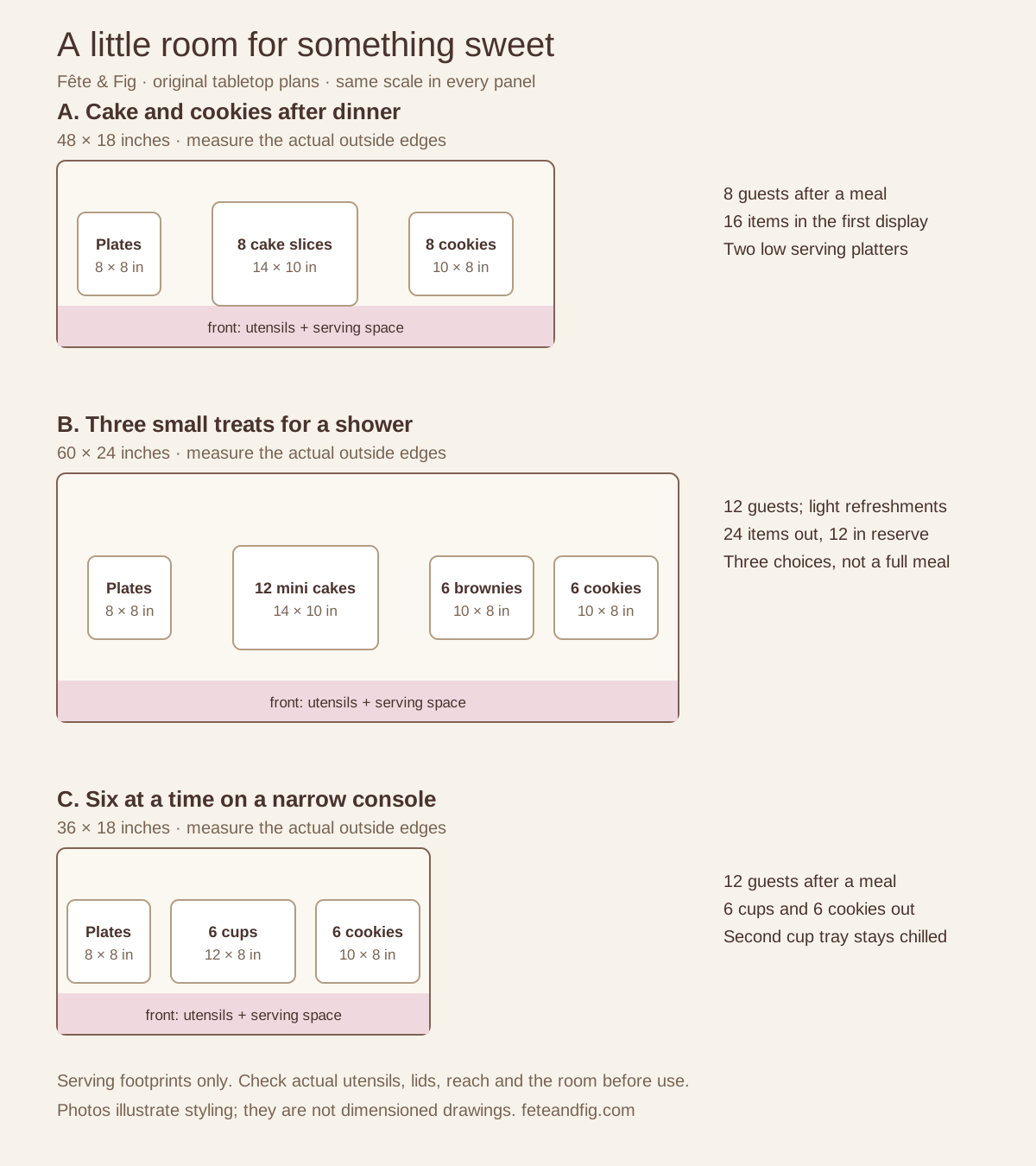
Cut eight servings using the cake's actual portion guide. Put them on one low rectangular platter, with eight cookies on a second platter. Keep the slices in a shallow arrangement so a guest can lift one without disturbing the rest. The diagram allows a **14 × 10-inch cake platter** and a **10 × 8-inch cookie platter**, measured at the outside edges.

Use two separate pairs of tongs and set dessert forks and napkins at the seats. A small bud vase can sit behind the food only if it leaves the labels and access clear. Skip it when the surface feels crowded. The cake and the room's existing artwork already provide a focal point.

This plan has no food refill scheduled. If you want second portions, decide and add them explicitly before shopping. A package remainder is not a promise that every guest will get another slice.

## Plan B: three small treats for twelve shower guests

Use **twelve mini cupcakes, twelve brownie bites and twelve cookies**, with one of each planned per guest. In this example the mini cupcakes are about 2 inches across, the brownie bites about 1½ inches square and the cookies about 2 inches across. Confirm the size of the food you actually choose before trusting a tray count.

Put all twelve mini cupcakes on the 14 × 10-inch platter. Start the two 10 × 8-inch platters with six brownie bites and six cookies each. Prepare a clean replacement platter of six for each of those two foods and keep it covered under the food's storage directions. The first display is intentionally smaller than the total order.

Pale linen and three simple serving pieces are enough to hold the arrangement together. Put one utensil by each platter. The front edge stays usable, while short labels go behind their matching food. Keep flowers low and out of the serving path; nothing needs to hang above an open cupcake.

The [bridal shower tea party plan](/stories/bridal-shower-tea-party) covers a fuller tea menu. For a brunch, start with the [baby shower brunch menu](/stories/baby-shower-brunch-menu) and choose dessert after the savory portions are set.

## Plan C: a narrow surface with six servings at a time

Use twelve small chilled dessert cups, about **3 to 4 fl oz each**, roughly 90 to 120 ml, plus twelve cookies. Pick a dessert with clear storage instructions. Its ingredients, not its pale color or small size, determine how it must be handled.

Arrange six cups on each of **two 12 × 8-inch trays**. Six cups about 2½ inches across can be arranged three by two within that example footprint; measure rims and handles, not just the bottoms. Before service, both covered trays need refrigerator space. For a side-by-side check, reserve at least the two trays' combined 24 × 8-inch footprint plus the actual lid height and handling clearance. This is a storage-fit example, not a refrigerator ventilation specification.

Bring out one cup tray and one platter of six cookies just before service. The other cup tray stays refrigerated; the other six cookies stay covered as their label requires. After the first cups are taken, pause access and replace the tray. Replace the cookie platter with a clean prepared one when needed. Keep dessert spoons at the seats.

Do not add a tall vase to this narrow plan. The cup tray and cookie platter are the display. A folded napkin gives enough color without using the food's space.

## Measure the dishes before adding decorations

These three original tabletop drawings use the same scale. Measure length from the **left end** and depth from the **back edge**. Positions refer to the center of each outside footprint. The pink front band reserves four inches for utensil placement and serving space; try your actual tongs there before using the plan.

<figure class="content-diagram" id="dessert-table-layouts">
  <img src="/images/diagrams/dessert-table-three-layouts.svg" width="1200" height="1350" loading="lazy" decoding="async" alt="Three measured dessert surfaces: a forty-eight by eighteen-inch table with two platters, a sixty by twenty-four-inch table with three platters, and a thirty-six by eighteen-inch console for one cup tray and cookies. Plates come first in each plan." />
  <figcaption>Original tabletop footprints. All positions are also listed below. The plans do not specify room aisles or establish accessibility. <a href="/images/diagrams/dessert-table-three-layouts.svg">Open the full-size layout drawing</a>.</figcaption>
</figure>

<table>
<caption>Serving footprints and center positions, in inches</caption>
<thead><tr><th scope="col">Plan</th><th scope="col">Piece</th><th scope="col">Outside width × depth</th><th scope="col">Center: from left / from back</th></tr></thead>
<tbody>
<tr><th scope="row">A</th><td>Plate stack</td><td>8 × 8</td><td>6 / 9</td></tr>
<tr><th scope="row">A</th><td>Cake platter</td><td>14 × 10</td><td>22 / 9</td></tr>
<tr><th scope="row">A</th><td>Cookie platter</td><td>10 × 8</td><td>39 / 9</td></tr>
<tr><th scope="row">B</th><td>Plate stack</td><td>8 × 8</td><td>7 / 12</td></tr>
<tr><th scope="row">B</th><td>Mini-cupcake platter</td><td>14 × 10</td><td>24 / 12</td></tr>
<tr><th scope="row">B</th><td>Brownie platter</td><td>10 × 8</td><td>41 / 12</td></tr>
<tr><th scope="row">B</th><td>Cookie platter</td><td>10 × 8</td><td>53 / 12</td></tr>
<tr><th scope="row">C</th><td>Plate stack</td><td>8 × 8</td><td>5 / 9</td></tr>
<tr><th scope="row">C</th><td>Cup tray</td><td>12 × 8</td><td>17 / 9</td></tr>
<tr><th scope="row">C</th><td>Cookie platter</td><td>10 × 8</td><td>30 / 9</td></tr>
</tbody>
</table>

One inch is 2.54 cm. For example, a 14 × 10-inch platter is about 36 × 25 cm. A product's named size may omit handles, so measure the real piece. If an ice bath or another holding device is needed, measure its full footprint and revise the layout; these drawings do not include one.

Test the farthest item from the guest side with an empty plate in your hand. Change the plan or offer table service if someone cannot comfortably reach it. Keep drinks and the used-dish return point on separate surfaces so they do not interrupt the dessert line.

If cake is part of your dessert plan, choose its portion size before ordering or cutting. The [cake serving chart](/stories/cake-serving-chart) explains its slice assumptions and gives original cutting diagrams; the display and combined dessert quantities stay in this guide.

## Shop for one plan, not all three

Keep one selected setup beside you with the [A4 layout and refill sheets](/downloads/dessert-table-layout-plans-a4.pdf) or [US Letter layout and refill sheets](/downloads/dessert-table-layout-plans-letter.pdf). Each file has three pages: A on page 1, B on page 2 and C on page 3. **Print only the page for your gathering.** It brings together the measured diagram, center positions, food total, first display, reserve, equipment and refill-owner blanks.

The drawings share a scale of seven PDF points per real tabletop inch. They are scaled reference drawings, not full-size templates or banquet plans. Use the printed measurements and your actual outside dish sizes; an ice bath or holding appliance may require a revised layout.

The packages below are **example arithmetic**, not claims about a particular shop's products. Replace the pack counts with the sizes you actually find. Order food only after confirming portions, ingredients and storage needs.

<table>
<caption>Example food shopping list for the selected plan</caption>
<thead><tr><th scope="col">Plan</th><th scope="col">Example packages</th><th scope="col">Allocated to this plan</th><th scope="col">Unallocated package remainder</th></tr></thead>
<tbody>
<tr><th scope="row">A</th><td>1 loaf yielding 8 appropriate slices; 1 pack of 12 cookies</td><td>8 slices and 8 cookies</td><td>4 cookies, kept separate and sealed</td></tr>
<tr><th scope="row">B</th><td>1 pack each of 12 mini cupcakes, 12 brownie bites and 12 cookies</td><td>All 36 mini treats, including the 12 held in reserve</td><td>None in this example</td></tr>
<tr><th scope="row">C</th><td>2 packs of 6 chilled dessert cups; 1 pack of 12 cookies</td><td>All 12 cups and 12 cookies, including the second display</td><td>None in this example</td></tr>
</tbody>
</table>

[Download the food quantities and shopping examples as a CSV](/downloads/dessert-table-shopping-plans.csv). It contains seven food rows across the three plans, with first-display, reserve and package-remainder columns. Select the rows for your plan; the download does not add quantities from all three gatherings together.

<table>
<caption>Serving equipment to gather for one chosen plan</caption>
<thead><tr><th scope="col">Piece</th><th scope="col">A: eight guests</th><th scope="col">B: twelve guests</th><th scope="col">C: twelve guests</th></tr></thead>
<tbody>
<tr><th scope="row">Dessert plates and napkins</th><td>10 each: 8 plus 2 spares</td><td>14 each: 12 plus 2 spares</td><td>14 each: 12 plus 2 spares</td></tr>
<tr><th scope="row">Eating utensils</th><td>10 dessert forks</td><td>14 small forks if guests use them for their mini treats</td><td>14 dessert spoons</td></tr>
<tr><th scope="row">Serving pieces</th><td>2 platters</td><td>5: 3 first-display platters and 2 clean prepared replacements</td><td>4: 2 cup trays and 2 cookie platters</td></tr>
<tr><th scope="row">Serving tongs</th><td>2, one per platter</td><td>5: 3 in use and 2 clean replacements</td><td>2 for the two cookie displays; guests lift their individual cups</td></tr>
<tr><th scope="row">Food labels</th><td>2</td><td>3</td><td>2</td></tr>
<tr><th scope="row">Separate handling areas</th><td>1 clean staging tray and 1 used-dish return area</td><td>The same, with covered reserve space</td><td>The same, with refrigerator space for both cup trays before service</td></tr>
</tbody>
</table>

Put the guest number of plates on display and keep the two spares nearby in a clean place. Seat-level utensils keep the table clearer. Use the pieces you own if they fit; five serving pieces can be a mix of platters and suitable trays, not a matching set purchased for one afternoon.

## Set up, refill and put the food away

**Before shopping:** choose the plan, ask about food needs and confirm what an agreed alternative portion should contain. Keep original ingredient information. A label or separate corner does not make shared food suitable for every allergy or dietary need.

**Before guests arrive:** check the empty layout, prepare clean replacements, and label the food. Keep cold desserts in the refrigerator until service. Do not let the food wait on the table while you finish decorating or take photographs.

**During service:** assign one host to the reserve and timing. FDA advises keeping cold food at **40°F or colder**, about 4°C, and replacing serving dishes instead of adding new food to old food. Perishables without suitable temperature control must be discarded after more than **2 hours**, or **1 hour above 90°F**, about 32°C. Track time out of controlled storage; changing trays does not restart it. Follow the actual product's instructions. [FDA: Serving Up Safe Buffets](https://www.fda.gov/food/buy-store-serve-safe-food/serving-safe-buffets).

**After dessert:** move used dishes to the return area and put suitable leftovers away promptly within their safe time. Write down which serving pieces were useful. That short note will improve your next gathering more than saving a photo of a table that was difficult to use.

For a coordinated dinner, pair A with the [menu for eight](/stories/elegant-dinner-party-at-home). Start with food your guests will enjoy, give it enough space, and let a few well-chosen pieces finish the table.

## Images from this guide

![Twelve mini cupcakes, six brownie bites and six round cookies on separate low platters over blush linen](https://feteandfig.com/images/dessert-table-mini-treats-1600.webp)

Plan B starts with 24 small treats; the remaining brownies and cookies stay in reserve. AI-created styling concept.

![Golden loaf cake slices and round shortbread cookies on two low ivory platters beside a stack of dessert plates](https://feteandfig.com/images/dessert-table-loaf-and-cookies-1600.webp)

Two familiar sweets and low serving pieces make a simple after-dinner display. AI-created styling concept.

![Six small dessert cups and six shortbread cookies on a narrow oak console, with plates and a folded sage napkin](https://feteandfig.com/images/dessert-table-small-batch-cups-1600.webp)

A small first display leaves the second set of dessert cups in refrigerated storage until needed. AI-created styling concept.


## Sources and file checks

The three original layouts use stated outside footprints and center positions. The new PDF sheets were checked against those positions and the first-display, reserve and shopping quantities, then every page was visually reviewed. These are planning examples; reach, actual dish fit and printer settings still need a check in your own home.

- [FDA: Serving Up Safe Buffets](https://www.fda.gov/food/buy-store-serve-safe-food/serving-safe-buffets): Small-batch serving, clean replacement dishes, cold holding and the two-hour or one-hour limits.

[How we prepare and check our guides](https://feteandfig.com/editorial-policy)
