# Bridal Shower Budget Worksheet: Costs, Payments and Host Contributions

Track bridal shower estimates, quotes, agreed costs, payments and host contributions with a free budget worksheet, printable plan and CSV export.

Canonical: https://feteandfig.com/stories/bridal-shower-budget-worksheet
Author: Fête & Fig Editorial (https://feteandfig.com/about)
Published: 2026-09-11T00:47:28.000Z
Updated: 2026-09-11T01:48:29.170Z

A useful bridal shower budget answers three different questions: **What are we planning to spend? What have we agreed to pay? Which host contributions have actually arrived or covered a bill?** Keep those figures separate, and an unpaid deposit or a missing contribution becomes easier to spot before someone has to cover it unexpectedly.

The [editable budget worksheet](#bridal-budget) tracks eight spending categories and four hosts. It calculates your current plan, the amount still owed on agreed costs, the gap between the plan and promised funding, and the money still needed for existing commitments. Start blank or load a clearly fictional example. You can print your current entries or download one CSV containing the spending table, contributions and summary.

The worksheet uses US dollars. Its example illustrates the arithmetic; it does not estimate what a bridal shower should cost in your town. Bring your own quotes and receipts. For the guest list, timing and other jobs around the event, use the separate [bridal shower planning checklist](/stories/bridal-shower-planning-checklist).

## Agree on the cap and the people funding it

Set the overall limit before choosing a venue, food order or decoration package. Include the people paying in that conversation, and ask what each person is comfortable contributing. A host's time, borrowed tableware or help with food can be valuable without creating an extra cash promise.

[Emily Post's guide to wedding expenses](https://emilypost.com/advice/wedding-expenses-who-pays-for-what) assigns the shower's expenses to its host or hosts. Its [shower etiquette guidance](https://emilypost.com/advice/shower-etiquette) also describes hosting together and sharing both costs and organizing. Use a clear agreement among the actual hosts instead of assuming every person in the wedding party has agreed to split a bill.

Choose one person to keep the working budget. Record each host's total promise and when the money will be transferred or used for a specific bill. A promise of $150 includes the first $50 already contributed; it does not become a $200 contribution when that payment arrives.

Leave a little of the cap unassigned if you want a reserve. Do not enter that unspent reserve as though it were a purchase. The worksheet's cap headroom shows the difference between the limit and the current plan.

## Give each amount the right meaning

An estimate, a quote and a receipt can all refer to the same cake. Adding them together would count the cake more than once. The worksheet keeps each stage in its own column and selects one amount for the current plan.

<table>
<caption>What each spending column means</caption>
<thead><tr><th scope="col">Column</th><th scope="col">Enter this</th><th scope="col">How the worksheet uses it</th></tr></thead>
<tbody>
<tr><th scope="row">Estimate</th><td>Your working allowance before a specific price is available</td><td>Used only while both Quote and Agreed total are blank</td></tr>
<tr><th scope="row">Quote</th><td>A price offered for the actual order, including the charges you have checked</td><td>Replaces the estimate in the current plan until you enter an agreed total</td></tr>
<tr><th scope="row">Agreed total</th><td>The whole cost you have accepted or purchased, including any deposit</td><td>Replaces both the quote and the estimate in the current plan</td></tr>
<tr><th scope="row">Paid</th><td>The amount already paid toward that agreed total</td><td>Reduces what is still owed; it is not added to the full cost again</td></tr>
<tr><th scope="row">Notes</th><td>What the amount covers, who pays, the next due date and where the receipt is kept</td><td>Helps the hosts check the numbers against their real agreements</td></tr>
</tbody>
</table>

Leave a figure blank when it is unknown. Enter zero when you know there is no charge. Those choices behave differently: an agreed total of $0 replaces a previous quote, while a blank agreed total leaves the quote in the plan. For a category with several purchases, keep the individual receipts together and enter their combined totals. The notes can identify what is included.

The sum of quoted prices is not necessarily a whole-event price. Some rows may still have only estimates. Use Current plan for the mixed-stage total, then check its warning about any categories with no amount entered.

## A fictional example: under the cap, but not fully funded

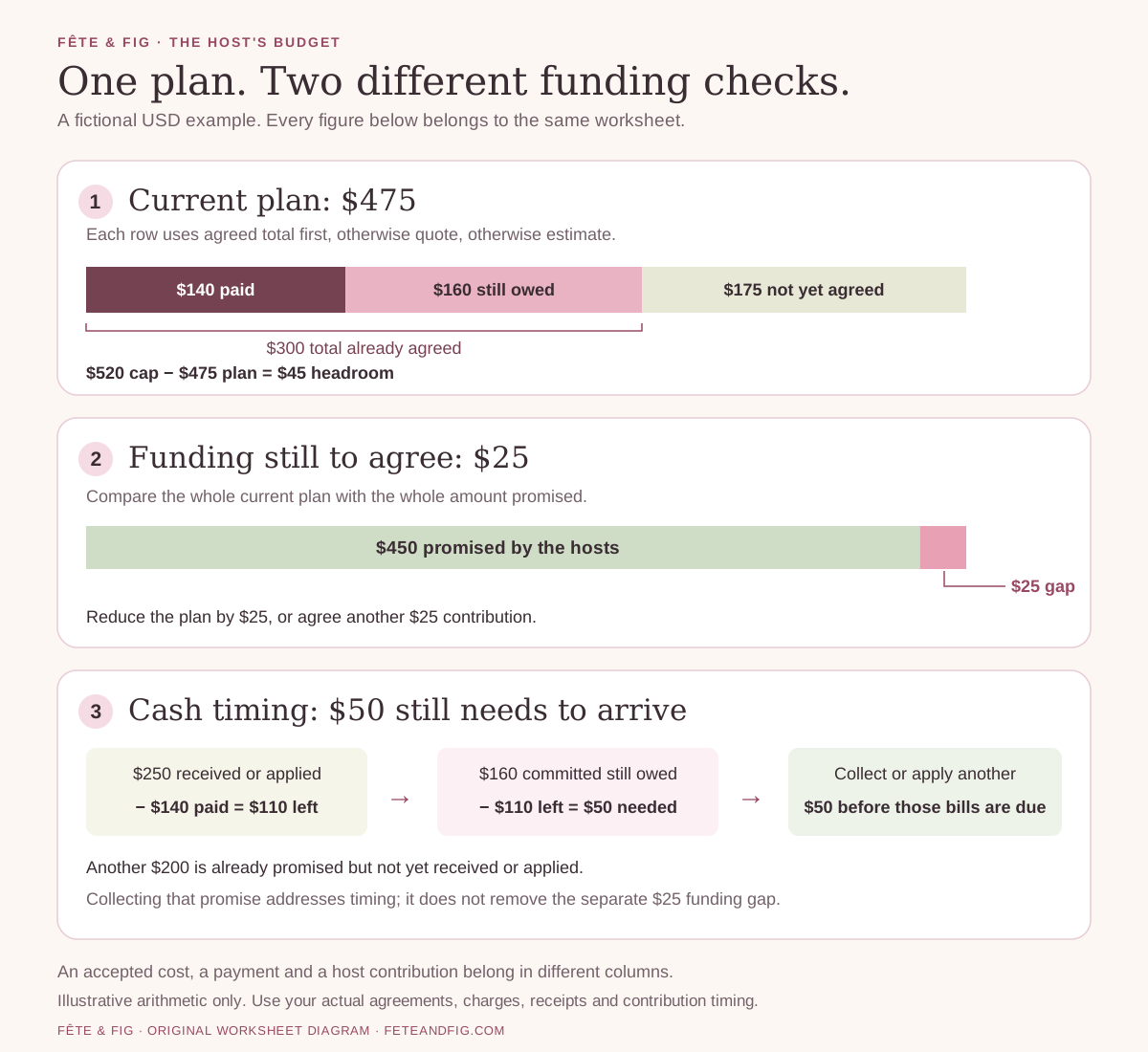
Imagine an afternoon shower at home for 16 people, including the hosts. For this example only, the group sets a $520 cap. The itemized example in the worksheet uses $475 in current planned costs, including a $240 food order, a $65 decoration quote and smaller estimates or agreed purchases. It leaves $45 below the cap.

Now look at the other numbers. Only $300 of that plan has been agreed or purchased. Of that $300, $140 has been paid, so the hosts still owe $160 on existing commitments. The remaining planned costs are estimates or quotes that have not been accepted yet.

Three fictional hosts have promised $450 altogether: Alex $200, Jamie $150 and Morgan $100. Only $250 has been received or applied so far. The plan therefore needs another $25 in agreed funding, even though it is $45 below the spending cap. A cap is permission to spend up to a limit; it is not money in the fund.

<table>
<caption>The fictional example has two different funding tasks</caption>
<thead><tr><th scope="col">Check</th><th scope="col">Calculation</th><th scope="col">Next decision</th></tr></thead>
<tbody>
<tr><th scope="row">Cap headroom</th><td>$520 cap minus $475 current plan = $45</td><td>The entered plan fits this particular cap</td></tr>
<tr><th scope="row">Funding still to agree</th><td>$475 current plan minus $450 promised = $25</td><td>Reduce the plan by $25 or agree another contribution</td></tr>
<tr><th scope="row">Committed still owed</th><td>$300 agreed minus $140 paid = $160</td><td>Check when those outstanding payments are due</td></tr>
<tr><th scope="row">Recorded fund balance</th><td>$250 received or applied minus $140 paid = $110</td><td>This is the amount recorded as unspent in the shared fund</td></tr>
<tr><th scope="row">More received funding needed for commitments</th><td>$160 still owed minus $110 fund balance = $50</td><td>Arrange receipt or direct payment of at least $50 before those commitments must be settled</td></tr>
</tbody>
</table>

Another $200 has already been promised but has not yet arrived or covered a bill. Collecting part of that promise can solve the $50 timing issue. It does not solve the separate $25 gap between the whole plan and the whole amount promised. The [full-size budget diagram](/images/diagrams/bridal-budget-flow.svg) keeps those two checks side by side.

All prices, names and contributions in this example are invented. Open **See the fictional example and its arithmetic** within the worksheet to read the eight spending rows before deciding whether to load them into your own copy.

<figure class="content-diagram">
  <img src="/images/diagrams/bridal-budget-flow.svg" width="1200" height="1100" loading="lazy" decoding="async" alt="The fictional bridal shower budget separates the 475-dollar spending plan, 140 dollars paid and 450 dollars promised by hosts, with 25 dollars still to agree in funding." />
  <figcaption>Original worksheet diagram. All prices and host contributions are fictional; the table above explains the same calculations.</figcaption>
</figure>

## Record a direct supplier payment without counting it twice

Some groups use a shared fund; others ask individual hosts to pay particular bills. This worksheet can record either arrangement, provided the two sides of a direct payment are recorded consistently.

If Jamie pays $50 directly toward the food order, add $50 to that order's Paid total and add the same $50 to Jamie's Received or applied total. The expense payment is one side of the transaction; the host contribution covering it is the other. Do not also record an imaginary $50 transfer into the shared fund.

In the example, paid costs would rise from $140 to $190 and received or applied contributions would rise from $250 to $300. The recorded fund balance stays $110 because the direct payment did not add cash to the shared fund. Existing commitments still owed fall from $160 to $110.

A negative recorded fund balance signals that entered payments exceed contributions entered as received or applied. Check whether a host advance, a direct payment or a contribution is missing. The worksheet does not connect to a bank account, so the figure is a reconciliation prompt, not a live account balance.

## Reduce the plan before accepting optional costs

If the current plan is above the cap, or hosts have not agreed enough funding, review the rows still based on an estimate or quote. Those are the places where a decision is still open. An already accepted order may have cancellation terms; changing its number in the worksheet does not cancel it with the supplier.

For a small shower, useful questions include whether you can borrow serving pieces, use an existing tablecloth, choose one optional activity or simplify favors. If the food format is still undecided, the [bridal shower tea party guide](/stories/bridal-shower-tea-party) helps you list the menu and serving equipment together. Changing the service format can affect several rows, so revise the full plan after making that decision.

Record the complete cost of an accepted order before entering its deposit. Include delivery, tax and any other charges the supplier has confirmed. Keep due dates in the notes and put the actual receipt somewhere the paying hosts can find it. Do not include card numbers, bank details or private account information in this worksheet.

## Keep one working copy and share a snapshot

Your entries save in this browser on this device when local storage is available. The story and its [standalone printable worksheet](/printables/bridal-shower-budget) use the same saved copy. They do not create a shared document for the other hosts. A printed plan or downloaded CSV is a snapshot that will need replacing after you change the figures.

The CSV contains the spending rows, host contributions and summary. If an amount is invalid, you can still export the entered text, but totals are withheld until the marked entries are corrected. The worksheet also flags a payment larger than the agreed cost and a received contribution larger than the corresponding total promise. Update the underlying agreement first if those amounts have changed.

At the final review, compare Paid with receipts and Received or applied with the contribution record. Resolve any outstanding supplier balances, confirm refunds before revising net paid amounts, and agree what to do with unused contributions. Then share a final dated copy with the hosts who need it.

## Images from this guide

![A blank notebook, calculator, folders and receipt backs on a bright home planning table](https://feteandfig.com/images/bridal-shower-budget-worksheet-budget-planning-workspace-1600.webp)

Gather the costs and contribution records before filling the budget worksheet. AI-created styling concept.

![Plain serving platters, plates, utensils and folded linens grouped on a wooden sideboard](https://feteandfig.com/images/bridal-shower-budget-worksheet-borrowed-serving-pieces-1600.webp)

Check existing and borrowed pieces before accepting optional purchases. AI-created styling concept.

![Three unlabeled folders with blank divider tabs beside envelopes, a pen and an empty dish](https://feteandfig.com/images/bridal-shower-budget-worksheet-cost-and-contribution-folders-1600.webp)

Keep one working budget and reconcile it with the separate receipts and contributions. AI-created styling concept.


## Editable bridal shower budget

[Open the worksheet](https://feteandfig.com/stories/bridal-shower-budget-worksheet#bridal-budget) or [print a blank copy](https://feteandfig.com/printables/bridal-shower-budget). Entries save in this browser only. The file is not a shared account or payment service.

For each category, current plan = agreed amount when entered; otherwise quote; otherwise estimate. An explicit zero takes precedence over an older quote or estimate. Still owed = agreed minus paid. Funding still to agree = current plan minus total promised, with a minimum of zero.

### Fictional worked example

Fictional USD example for an afternoon shower at home with 16 people, including hosts. These figures demonstrate the worksheet; they are not current prices, supplier quotes or a recommended spending target.

| Category | Estimate USD | Quote USD | Agreed USD | Paid USD |
| --- | --- | --- | --- | --- |
| Venue and rentals | 0 | 0 | 0 | 0 |
| Food and cake | 220 | 240 | 240 | 80 |
| Drinks | 45 | Not entered | Not entered | Not entered |
| Tableware and linens | 50 | 42 | 42 | 42 |
| Flowers and decor | 70 | 65 | Not entered | Not entered |
| Invitations and paper | 20 | 18 | 18 | 18 |
| Games and favors | 35 | Not entered | Not entered | Not entered |
| Other costs | 30 | Not entered | Not entered | Not entered |

| Host | Total promised USD | Received or applied USD |
| --- | --- | --- |
| Alex | 200 | 200 |
| Jamie | 150 | 50 |
| Morgan | 100 | 0 |

The current plan is $475.00, leaving $45.00 below the $520.00 cap. Of $300.00 committed, $140.00 is paid and $160.00 is still owed. Promised funding is $450.00 and received or applied funding is $250.00. The plan still needs $25.00 in agreed funding. The recorded fund balance is $110.00, so existing unpaid commitments require $50.00 more to be received or applied.

### Blank worksheet

Spending cap in USD: __________

| Category | Estimate | Quote | Agreed total | Paid | Notes |
| --- | --- | --- | --- | --- | --- |
| Venue and rentals | | | | | |
| Food and cake | | | | | |
| Drinks | | | | | |
| Tableware and linens | | | | | |
| Flowers and decor | | | | | |
| Invitations and paper | | | | | |
| Games and favors | | | | | |
| Other costs | | | | | |

| Host | Total promised | Received or applied | Notes |
| --- | --- | --- | --- |
| | | | |
| | | | |
| | | | |
| | | | |
